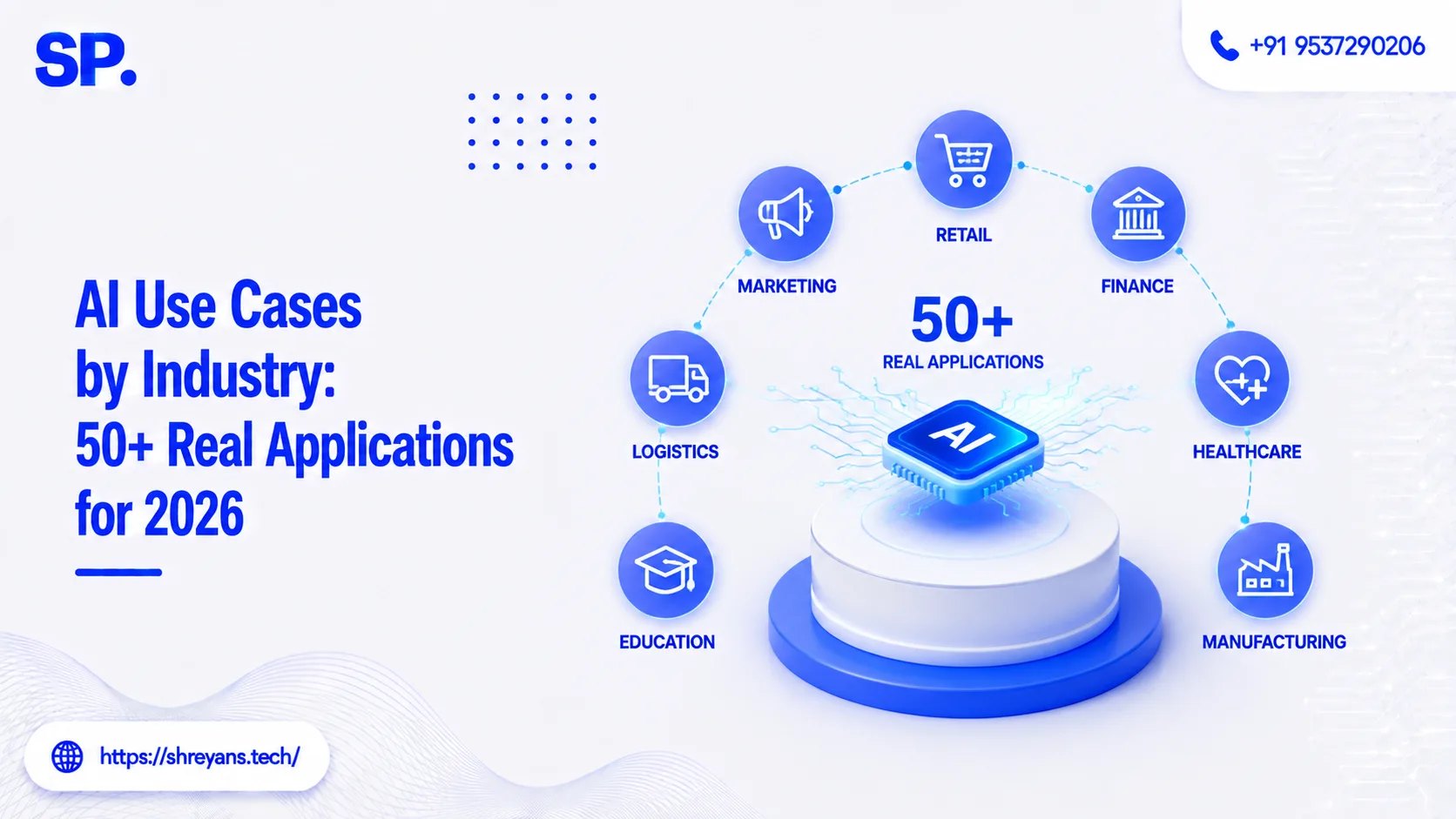
In 2026, more than two-thirds of all businesses use some form of artificial intelligence, from generative AI tools to fully autonomous AI agents handling complex workflows end to end. The global AI market reached $390.91 billion, forcing companies to move from small-scale testing to full integration. Success now depends on technical readiness and the speed of deployment.
One construction firm running a pilot AI system for cost prediction wrote off $2.3 million when the model failed to generalise from its training site conditions, requiring complete rebuild and retraining. The project manager reported that 80 percent of AI projects fail due to hidden technical debt rather than algorithmic limitations.
The Fundamental Learning Mechanism: From Data to Patterns
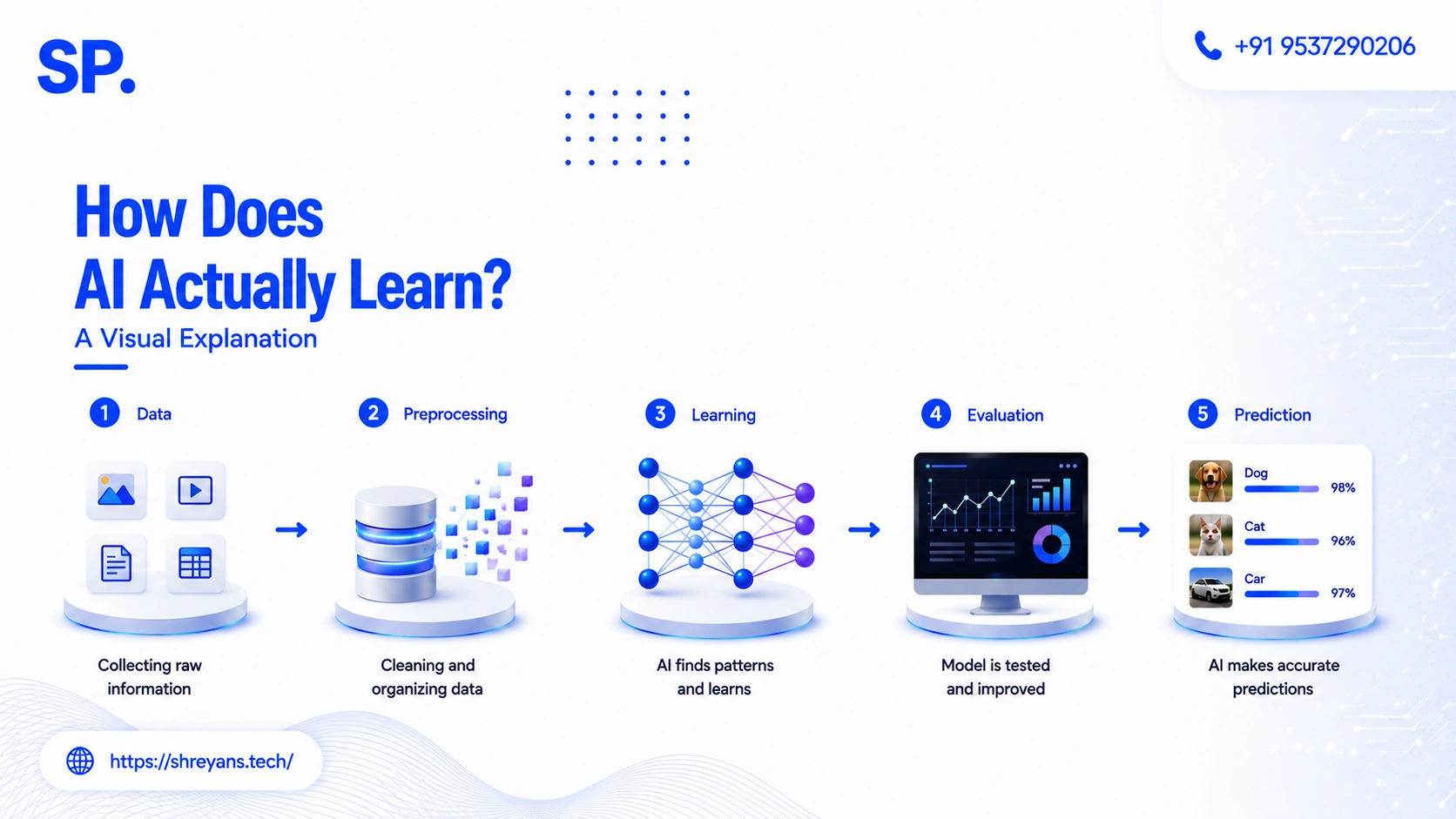
The fundamental learning mechanism in AI transforms raw data into actionable patterns through mathematical optimisation, where algorithms iteratively adjust internal parameters to minimise prediction errors. Supervised learning exemplifies this process: models like Support Vector Machines or Random Forests analyse thousands of labelled examples, such as spam versus legitimate emails, to learn decision boundaries. Gmail demonstrates this at scale, training on millions of marked messages to identify linguistic markers and sender behaviours that distinguish unwanted content, continuously refining its filters as spammers evolve their tactics. Understanding the hidden costs guide reveals how this iterative optimisation extends beyond initial deployment into ongoing model maintenance and retraining cycles.
Unsupervised learning takes a different approach, discovering inherent structure in unlabeled data without explicit guidance. Clustering algorithms group similar customer transactions to reveal purchasing patterns, while dimensionality reduction techniques like PCA compress high-dimensional datasets into meaningful features. Netflix employs unsupervised methods to analyse viewing histories, identifying latent factors that explain why certain genres correlate with others. This pattern discovery forms the foundation for recommendation engines that adapt to user behaviour without requiring labelled training examples for every possible content type.
Neural Networks: The Computational Architecture Behind AI Learning
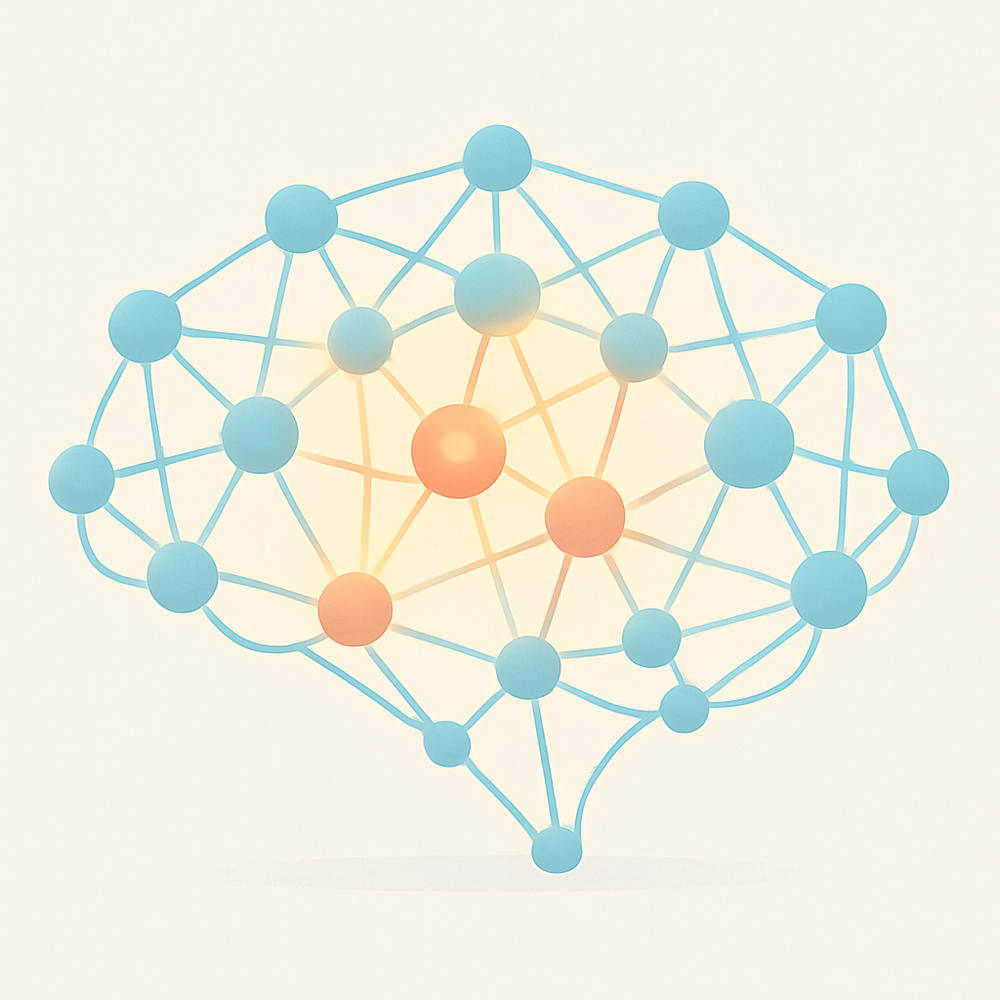
Neural networks are computational models inspired by the human brain's structure, composed of interconnected nodes or neurons that process information through weighted connections. Each neuron receives inputs, applies an activation function, and passes its output to subsequent layers, creating a hierarchical processing pipeline. The architecture typically consists of an input layer that receives raw data, one or more hidden layers that extract features, and an output layer that produces predictions or classifications. During training, the network adjusts these weighted connections based on errors, gradually improving its ability to recognise patterns in data such as images, text, or numerical values.
The Training Process: Optimisation, Loss, and Iterative Improvement
AI training operates as an iterative refinement process where models gradually improve through repeated exposure to data and feedback. According to industry definitions, this process involves feeding systems with structured or unstructured data, applying optimization techniques, and adjusting parameters based on performance metrics. The system refines itself by using feedback and validation results to enhance accuracy while avoiding overfitting to the training examples.
The loss function serves as the quantitative measure of how well the model's predictions align with ground truth labels during training. Common implementations include mean squared error for regression tasks or cross-entropy loss for classification problems, where the latter penalises confident wrong predictions more severely. This scalar value represents the aggregate error across all training examples, providing the optimisation algorithm with a clear target for minimisation.
Backpropagation executes the learning algorithm by computing gradients of the loss function with respect to each network parameter, then propagating these error signals backward through the network layers. Using the chain rule of calculus, the algorithm determines how much each weight contributed to the final error, enabling precise updates that move the model toward better predictions. Optimization techniques like stochastic gradient descent or Adam then apply these gradient calculations to adjust weights, with the learning rate controlling the magnitude of each update to balance convergence speed and stability.
Backpropagation: The Learning Algorithm in Action
Backpropagation computes gradients of the loss function with respect to each network parameter using the chain rule of calculus, then updates weights in the opposite direction of these gradients. The process begins at the output layer and flows backward through each connection, calculating partial derivatives that indicate how much each weight contributed to the final error. Optimisation algorithms such as Adam or SGD then apply these gradients to adjust parameters, typically using a learning rate between 0.001 and 0.01 to prevent overshooting optimal values. Akamai explains that AI training uses iterative processes including adjusting parameters based on performance metrics, with backpropagation serving as the core mechanism for this refinement. Modern implementations often employ gradient clipping to prevent exploding gradients and batch normalisation to stabilise training dynamics across different layers and epochs.
Build Production-Ready AI Agents
Don’t stop at powerful models. Build AI systems that are secure, reliable, scalable, and ready for real-world production. Get expert help turning your LLM ideas into business-ready AI agents.
Talk to an AI ExpertMachine Learning Paradigms: When to Use Supervised, Unsupervised, and Reinforcement Learning
Machine learning divides into three primary paradigms, each suited to distinct problem classes. Supervised learning dominates production systems where labelled data exists, such as fraud detection in finance or disease diagnosis from medical images. Unsupervised learning excels when you need to discover hidden structure, like customer segmentation for marketing or anomaly detection in manufacturing sensor data. Reinforcement learning drives sequential decision making, powering recommendation engines that optimise long-term user engagement or autonomous agents that master complex control tasks through trial and error.
The choice between these paradigms fundamentally determines your data requirements and system architecture. Supervised models require extensive labelled datasets, which can cost thousands of pounds to curate. Unsupervised approaches work with raw data but offer less direct control over outcomes. Reinforcement systems need carefully designed reward functions and typically demand significant computational resources for training. McKinsey estimates data labelling costs at $0.05 to $0.30 per example depending on complexity.
|
Paradigm |
Data Requirement |
Typical Use Case |
Development Cost |
|
Supervised |
Extensive labelled data |
Fraud detection, medical imaging |
High (labelling costs) |
|
Unsupervised |
Raw unlabelled data |
Customer segmentation, anomaly detection |
Medium |
|
Reinforcement |
Reward feedback, simulation environment |
Recommendation systems, autonomous control |
Very high (compute intensive) |
Supervised Learning: Learning with Labelled Examples
Supervised learning trains models on input-output pairs where the correct answer is known. In fraud detection, for instance, transaction data serves as input while labelled examples indicate fraudulent versus legitimate activity. The algorithm minimises prediction error by adjusting weights until it generalises from training examples to new, unseen transactions. This paradigm dominates computer vision applications like medical image diagnosis, where radiologists provide ground truth labels that models learn to replicate.
Unsupervised Learning: Discovering Hidden Patterns
Unsupervised learning operates without explicit guidance, identifying structure in raw data through techniques like clustering or dimensionality reduction. Customer segmentation exemplifies this approach: marketing teams feed purchase behaviour data into algorithms that group customers by similarity, revealing previously unknown market segments. Anomaly detection in manufacturing uses unsupervised methods to spot equipment failures by learning normal operational patterns from sensor data, flagging deviations without requiring labelled failure examples.
Real-World Visual Examples: From Images to Text
YOLOv8 demonstrates object detection in real-time by processing video streams at 60 frames per second, identifying and bounding multiple classes including vehicles, pedestrians, and traffic signs with mean average precision exceeding 50 percent on the COCO dataset. This capability translates directly to autonomous vehicle systems where split-second decisions depend on accurate scene understanding. A competent developer will integrate such models with appropriate preprocessing pipelines to handle varying lighting conditions and camera angles that challenge production deployments.
Roberta-based sentiment classifiers achieve 92.3 percent accuracy on the Stanford Sentiment Treebank when fine-tuned for product review analysis, enabling automated customer feedback categorisation at scale. These models process raw text through tokenisation layers that map words to embeddings, then propagate signals through attention mechanisms that weigh contextual importance. When deploying natural language processing solutions, you should verify that the training data reflects the linguistic patterns of your target user base to avoid performance degradation in production.
Frequently asked questions
how ai learns from data ?
what is the difference between supervised and unsupervised learning?
how does backpropagation actually work?
why do neural networks need multiple layers?
how long does it take to train an ai model?
what happens after an ai model is deployed?



Shreyans Padmani
Shreyans Padmani has 5+ years of experience leading innovative software solutions, specializing in AI, LLMs, RAG, and strategic application development. He transforms emerging technologies into scalable, high-performance systems, combining strong technical expertise with business-focused execution to deliver impactful digital solutions.