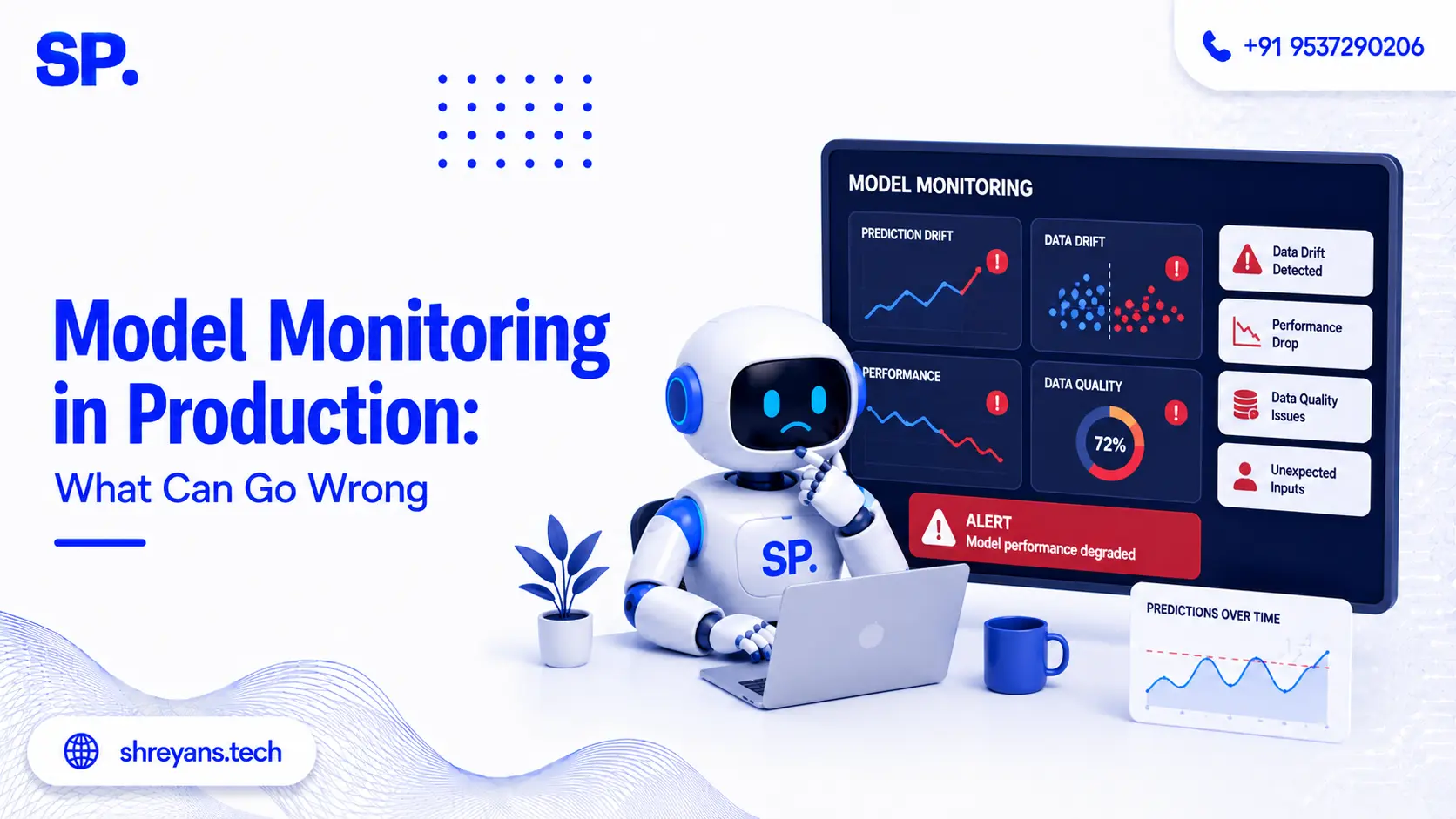
Model Monitoring in Production: What Can Go Wrong
In a controlled study of temporal model degradation, researchers tested four model types across 32 datasets and observed degradation in 91% of model-data pairs. Decay is close to universal, not exceptional.
The harder problem is that you usually cannot see it happening. Confirming a model is still correct requires ground truth, and ground truth arrives days, weeks, or months after the prediction, if it arrives at all. That's the defining constraint of model monitoring production work: you are almost always watching proxies, and every proxy is blind to something specific.
The Ground Truth Problem
A fraud model scores a transaction now. Whether that transaction was actually fraudulent becomes known when a chargeback lands, perhaps sixty days later. A churn model predicts today; the customer either renews or doesn't in six months. A loan underwriting model's accuracy is only fully knowable over the life of the loan.
In each case, real-time accuracy monitoring is not merely difficult, it's structurally unavailable. And in some systems ground truth never arrives at all: a fraud model that blocks a transaction never learns whether it was right, because the outcome it prevented cannot be observed.
So production monitoring becomes the practice of watching signals that correlate with correctness, then reasoning carefully about what each of them can and cannot tell you.
Hire Edge Computer Vision
Four Problems That Look Identical on a Dashboard
Accuracy dropping is a symptom, not a diagnosis. Four distinct causes produce it, and they demand completely different responses, which is why retraining is so often the wrong reflex.
|
Problem |
What actually changed |
The correct fix |
|---|---|---|
|
Data drift (covariate shift) |
Input distribution moved; the underlying relationship still holds |
Sometimes nothing; retrain if performance genuinely dropped |
|
Concept drift |
The relationship between inputs and outcome changed; inputs may look identical |
Retrain on recent data; the old patterns are now wrong |
|
Training-serving skew |
Nothing changed. A feature is computed differently in training than at inference |
Fix the pipeline. Retraining will not help and may entrench the bug |
|
Upstream schema change |
A column renamed, units changed, or a new null pattern appeared |
Patch the data pipeline; the model is fine |
Training-serving skew is the one worth internalising, because it produces a model that validates beautifully and underperforms in production with no drift signal at all, and the instinctive response of retraining leaves the defect exactly where it was.
There's also a subtler case that trips up experienced teams: model quality can fall because a segment the model always handled poorly simply grew larger. The patterns didn't change, the population mix did. That's data drift without concept drift, and retraining on recent data may help, but the real insight is that the model was always weak on that segment and nobody had noticed.
Hire Edge Computer Vision
What Each Proxy Signal Is Blind To
This is the part most monitoring advice omits. Every available proxy has a documented failure mode.
|
Signal |
Catches |
Blind to |
|---|---|---|
|
Data quality checks |
Nulls, type mismatches, out-of-range values, pipeline breaks |
Anything statistically valid but semantically wrong |
|
Input feature drift |
Model being applied to a population it wasn't trained on |
Concept drift entirely: if the relationship changes while inputs look normal, there is no signal |
|
Prediction drift |
Early warning that something shifted upstream |
Whether the shift is harmful; also fails when errors offset each other |
|
Business KPIs |
Real-world impact that matters commercially |
Attribution: many things move a KPI besides the model |
|
Delayed accuracy |
The truth, eventually |
Anything happening right now |
The feature drift blind spot is the most consequential. When the relationship between inputs and outcome changes while the input distribution stays constant, feature monitoring provides no signal whatsoever. A pricing change, product redesign, or market event can render a stable-looking feature set completely non-predictive, and every drift dashboard will stay green throughout.
Prediction drift is the most useful early warning precisely because it sits downstream of the model's reasoning. If a classifier's positive rate moves from 12% to 28% over two weeks, something has changed even if you can't yet label what. It's a signal to investigate, not a diagnosis.
The Failures Dashboards Actively Hide
Aggregate metrics masking segment collapse

Overall accuracy holds steady at 94% while performance on one customer segment, region, or device type falls off a cliff, offset by improvements elsewhere. The aggregate is the average of a success and a failure, and it reports neither. Monitoring has to be segmented along the dimensions where failure would actually matter, decided before launch rather than during an incident.
Feedback loops contaminating future training data
A model's outputs shape the data it later learns from. A recommendation model influences what users see and therefore what they click, so next quarter's training data reflects the model's own past choices rather than independent preference. A fraud model that blocks transactions never observes their outcome, so the training set drifts toward the cases it lets through. These loops tighten silently and are effectively invisible to drift monitoring.
Alert fatigue from benign drift
Not all distribution shift degrades performance. Naive statistical drift testing doesn't distinguish harmful shifts from harmless ones, so a poorly tuned system generates alerts for changes that don't matter. Teams then learn to ignore the alerts, which is worse than not having them, because it produces confidence without coverage.
Hire Edge Computer Vision
A Monitoring Stack That Holds Up

The practical answer is layering, because no single signal is sufficient and each layer covers a different blind spot.
Start with data quality gates on null rates, types, and ranges, since pipeline breakage is the most common cause and the cheapest to detect. Add input distribution monitoring against a training baseline. Add prediction drift as an early proxy. Tie the whole thing to business KPIs so technical signals connect to something commercially meaningful. Then close the loop with delayed accuracy measurement whenever ground truth does eventually land, using it to calibrate how much the proxies were worth trusting.
Two details decide whether this works. The baseline has to be captured before launch, not reconstructed afterward from memory, which is the same discipline building an AI PoC applies at project level. And alerts should trigger a defined action, a retraining job, a rollback, a page to a named owner, rather than an email nobody owns.
Operational metrics belong in the same stack and are frequently forgotten. A perfectly accurate model that is too slow, too expensive, or unavailable when called is still a production failure. For LLM-based systems this layer expands to token usage, response time, retrieval latency, and cost per request, ML web app development covers how that serving layer fits together.
The last requirement is organisational rather than technical. Drift produces no error log, no stack trace, and no user complaint until the damage is commercial, so a model without a named owner and a review cadence will decay regardless of how good the tooling is. dedicated ML hiring covers structuring that ownership without carrying continuous capacity you only need periodically.
Hire Edge Computer Vision
Frequently asked questions
What is the difference between data drift and concept drift?
Why can't you just monitor model accuracy in production?
What is training-serving skew and why is retraining the wrong fix?
How can overall accuracy stay stable while a model is failing?
What are feedback loops in production ML and why are they dangerous?
What should a production monitoring stack include?



Shreyans Padmani
Shreyans Padmani has 5+ years of experience leading innovative software solutions, specializing in AI, LLMs, RAG, and strategic application development. He transforms emerging technologies into scalable, high-performance systems, combining strong technical expertise with business-focused execution to deliver impactful digital solutions.