In July 2025, Gartner declared that "context engineering is in, prompt engineering is out." Job titles followed: postings for "prompt engineer" dropped roughly 40% between 2024 and 2025 and have largely disappeared from listings since.
Yet a 2026 State of Context Management report found 82% of IT and data leaders say prompt engineering alone is no longer sufficient to power AI at scale, which is a very different claim from saying it doesn't matter. For a business leader trying to decide whether to train a team on this, that distinction is the whole decision. Here are the prompt engineering basics that actually hold up, and the point at which prompting stops being the answer. This sits inside the wider picture our generative ai for business guide covers.
What Prompt Engineering Actually Is
Prompt engineering is the practice of writing instructions that reliably get useful output from a language model. That's it. The mystique that built up around it in 2023, secret phrasings and magic words, was mostly an artifact of early models that were genuinely bad at interpreting intent.
Modern models read intent well enough that phrasing tricks add little. What still matters is whether the instruction contains the information the model needs to do the job. A vague request produces vague output not because you phrased it wrong, but because you didn't say what you actually wanted. That reframing is the single most useful thing a non-technical leader can take from this topic.
The Four Fundamentals That Account for Most of the Gain
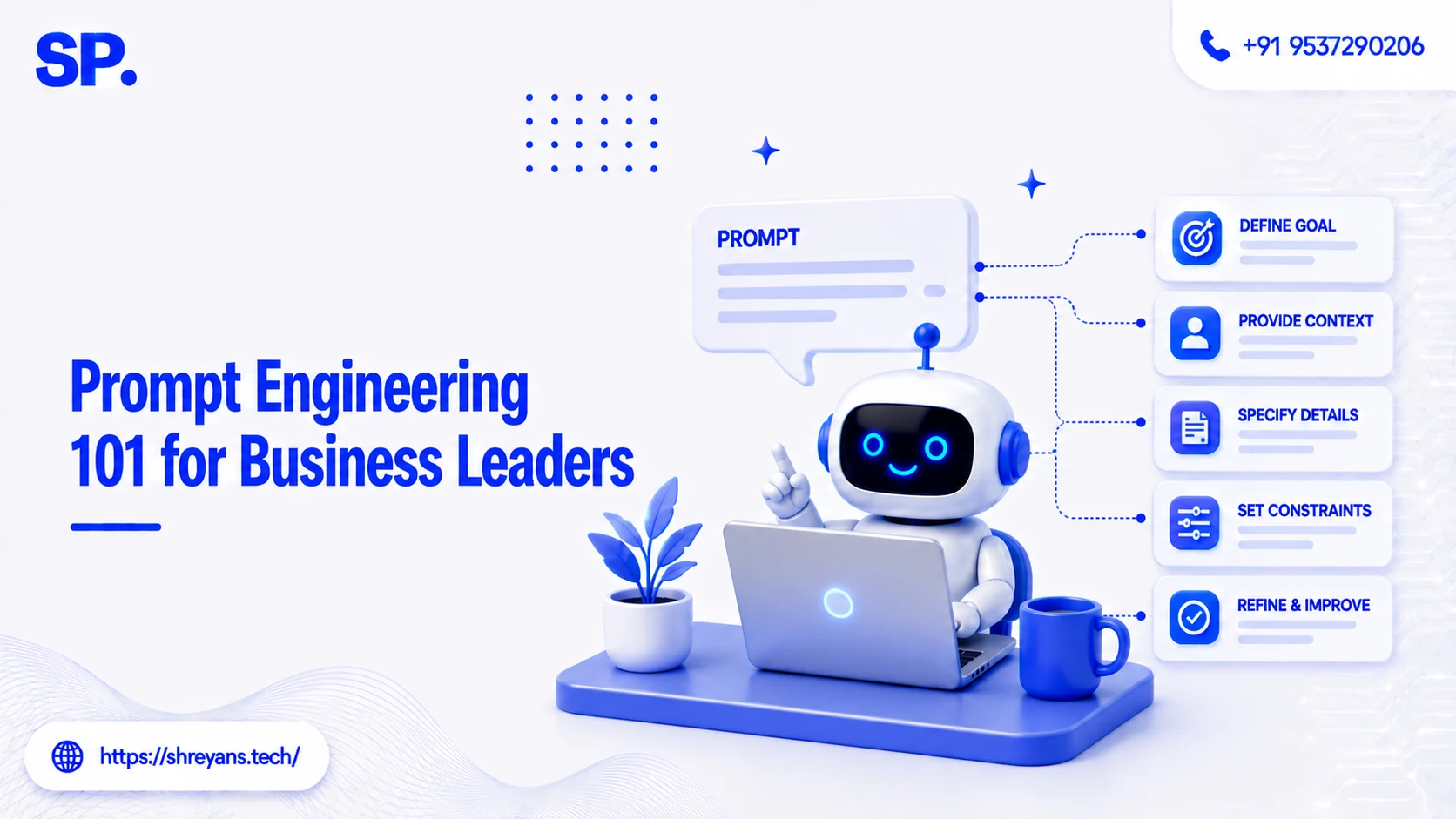
OpenAI's own prompting guidance reduces to four moves, and they've stayed stable across model generations while the tricks around them came and went.
|
Fundamental |
What it means |
What it looks like in practice |
|---|---|---|
|
Outline the task |
State the actual job, not a topic |
"Summarise this contract's payment terms and flag anything unusual" beats "look at this contract" |
|
Give helpful context |
Supply the background the model can't know |
Who the audience is, what the constraints are, what happened before |
|
Describe the ideal output |
Specify format, length, and structure up front |
"Three bullet points, under 20 words each, no preamble" |
|
Iterate |
Treat the first output as a draft, not a verdict |
Adjust one variable at a time and see what changed |
Well-applied prompting of this kind typically improves output accuracy by roughly 20% to 30% over an unstructured request. That's a real gain, and it's available to anyone on your team within an afternoon of practice. It does not require a specialist hire.
Why the Job Title Disappeared (and What That Means for You)
Two forces collapsed the standalone role. First, models got better at inferring intent, so the value of expert phrasing shrank. Second, and more importantly, teams building real AI systems discovered that the prompt was only a small share of what determined whether the system worked.
In production, the prompt shares the model's attention with retrieved documents, conversation history, tool outputs, and user data. Andrej Karpathy coined "context engineering" in mid-2025 to describe the broader job of governing all of it. The skill didn't vanish; it became one layer inside a larger discipline.
The practical translation for a leader: don't hire a prompt engineer. Do make sure the people already using AI daily know the four fundamentals above, and make sure whoever builds your AI systems understands the context layer underneath them.
Where Prompting Stops Being Enough
This is the decision point that matters commercially. Prompting works well when the model already has, or can be handed, everything it needs. It breaks down predictably in three situations.
The model needs information it doesn't have
If the answer depends on your internal documents, product catalogue, or policy library, no prompt can conjure it. That's a retrieval problem, and it's solved with infrastructure rather than wording. RAG in generative AI covers how retrieval-augmented generation grounds responses in your actual content, which is the standard fix here.
The task repeats at volume
A well-crafted prompt used once is a productivity win. The same prompt pasted manually a thousand times is an unbuilt system. At volume, the instruction should live in code with governed inputs, not in someone's clipboard.
The workflow runs many steps
Multi-step agents fail on state management, not phrasing. Gartner's research found organisations investing in structured context architectures saw roughly 50% better response times and 40% higher output quality than prompt-only approaches, and predicts context engineering features will appear in 80% of AI application development tools by 2028.
Hire Prompt Engineering
What Leaders Should Actually Do
Three decisions follow from all of this, and none of them require technical depth.
Train broadly, not deeply. The four fundamentals are worth teaching to everyone who touches AI tools, in a short session rather than a certification programme. The gain is real and the ceiling on this particular skill is low, which is a good thing: it means you can capture most of the value cheaply.
Don't build a specialist role around it. With 95% of data teams reporting plans to invest in context engineering rather than prompt engineering, hiring for the narrower, fading title would be building a team around the wrong unit of work.
Know when you've hit the ceiling. When people start copying long prompts between documents, or the same request gets run dozens of times a week, that's the signal to build something rather than prompt harder. GenAI enterprise solutions covers what that transition from ad-hoc use to a real system typically involves.
Frequently asked questions
What are the prompt engineering basics every business user should know?
Is prompt engineering still a relevant skill in 2026?
What is context engineering and how is it different from prompt engineering?
Should my company hire a prompt engineer?
When should we stop relying on prompts and build a proper AI system?



Shreyans Padmani
Shreyans Padmani has 5+ years of experience leading innovative software solutions, specializing in AI, LLMs, RAG, and strategic application development. He transforms emerging technologies into scalable, high-performance systems, combining strong technical expertise with business-focused execution to deliver impactful digital solutions.