When Fine-Tuning Breaks: 6 Scenarios Where Businesses Waste Budget on AI Model Training
Andrew Ng's estimate, cited in BuildMVPFast's 2026 anti-pattern guide, puts the number at roughly 75 percent of teams doing fine-tuning who would be better served by a simpler approach: prompting, retrieval, or an agentic workflow instead of a training run. Unosquare's 2026 research on AI implementation costs adds the financial backdrop: 80 percent of AI projects fail, roughly twice the failure rate of traditional IT initiatives, and the share of companies abandoning most of their AI initiatives has climbed to 42 percent in 2026, up from 17 percent in 2024, with LLM hallucinations alone estimated to have cost businesses over 67 billion US dollars in losses during 2024.
Fine-tuning specifically has its own failure pattern, distinct from AI project failure generally, and it shows up in the same six scenarios again and again. Recognising them before signing off on a training run is what separates custom AI model training that actually pays off from a training run that quietly burns budget on a model nobody needed.
1. Fine-Tuning to Inject Knowledge That Changes Weekly

BuildMVPFast's 2026 anti-pattern guide calls this the single most common fine-tuning mistake: a team has internal docs, product specs, or domain knowledge and wants the model to "know" it, so they fine-tune on it directly. The problem is structural, not a matter of doing it more carefully. Fine-tuning pushes knowledge into a model's weights, which means that knowledge goes stale the moment the source documents change, and retraining on every update is neither fast nor cheap.
Retrieval-augmented generation solves this same problem more cheaply and keeps the data current, since the knowledge lives in an external database the model queries at request time rather than being baked into fixed weights. A team scoping generative AI development services around a knowledge-heavy use case should default to a RAG pipeline first and reserve fine-tuning for clearly different problems, tone, structure, and refusal behaviour, not fact recall.
2. Fine-Tuning Before Testing Whether a Better Prompt Solves It
BuildMVPFast's guide is candid that this mistake is embarrassingly common even among experienced teams: setting up a full fine-tuning pipeline before testing whether few-shot prompting with strong examples solves the problem first. The recommended test is specific: run your best prompt against 50 to 100 representative inputs, log every failure, and check the pattern. If the failures are random and inconsistent, a better prompt is the fix. Fine-tuning only earns its cost when failures are systematic and repeat across the same type of input.
This test takes an afternoon and costs nothing beyond API calls, which makes skipping it one of the more avoidable ways businesses waste a training budget. If the task truly needs multiple steps rather than a single model call, an agentic workflow, chaining calls, validating outputs, and retrying on failure, often solves what looked like a fine-tuning problem without touching model weights at all, which is where custom AI agent solutions frequently fit better than a training run.
Hire Edge Computer Vision
3. Fine-Tuning to Fix Output Formatting That Structured Output Modes Already Solve
A model returning inconsistent or incomplete JSON looks like a textbook fine-tuning problem, but BuildMVPFast's guide notes the formatting problem is now largely solved at the inference layer rather than requiring any training. OpenAI's JSON mode, Anthropic's tool use with defined schemas, and constrained decoding in open-weight models all enforce valid output structure without a single training run. One practitioner cited in the guide reported improving JSON accuracy from under 5 percent to over 99 percent through fine-tuning, but that was before constrained decoding tools became widely available.
Teams building on open-weight models specifically can reach for grammar-constrained generation tools that enforce valid JSON at the token level with zero training required. Spending a training budget on a formatting problem that a configuration change or a schema definition already solves is one of the clearer and more avoidable ways this budget gets wasted.
4. Fine-Tuning a Large Model When a Distilled Small Model Would Work
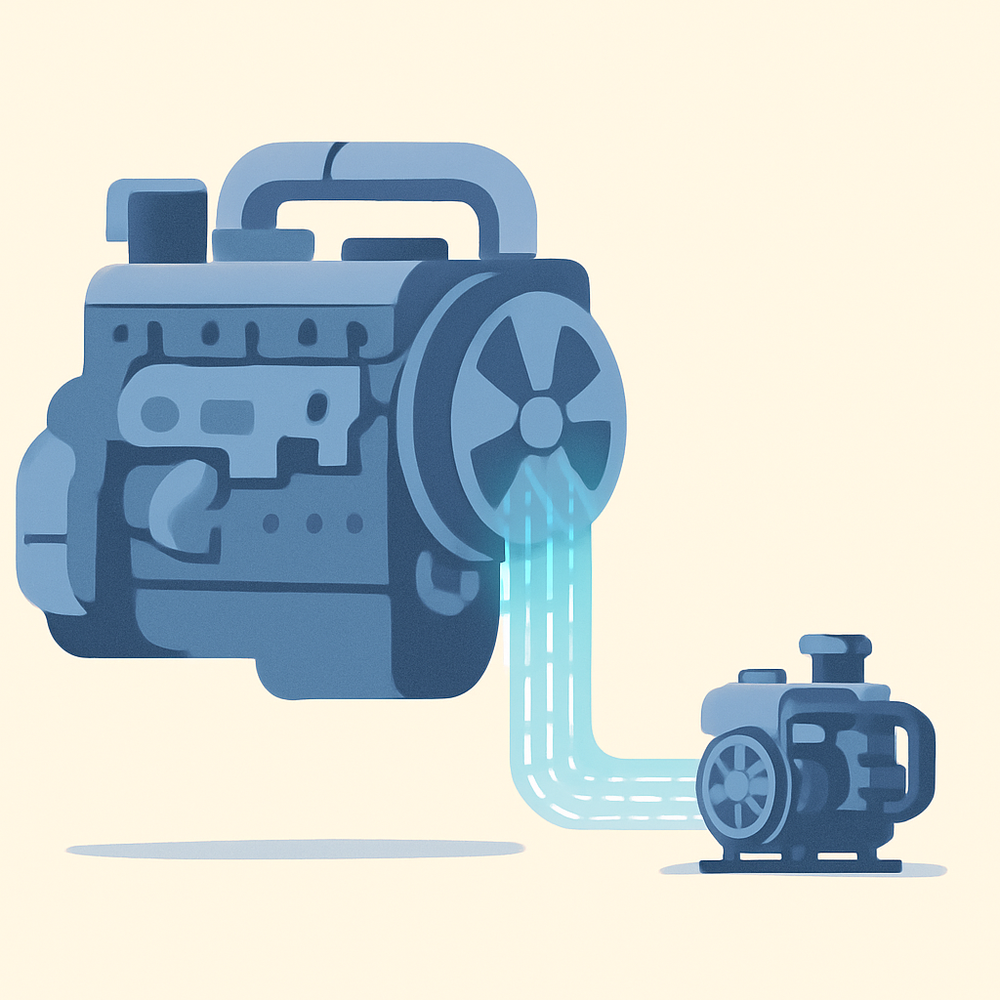
BuildMVPFast's guide describes teams fine-tuning 70 billion parameter models for tasks a 7 billion parameter model could handle with the right setup, which the guide compares to paying for a far larger engine than the job requires. The cheaper and often better-performing alternative is distillation: use a large frontier model to generate high-quality training data, then fine-tune a smaller model on that output. One developer cited in the guide reported getting a 14 billion parameter model to run six times faster at roughly 3 percent of a large frontier model's inference cost after distillation, with the distillation setup itself taking about 20 minutes.
The model training approaches comparison covers how distillation, LoRA, QLoRA, and full fine-tuning trade off against budget and use case in more depth. Defaulting to the largest available model without first testing whether a smaller, distilled model reaches acceptable accuracy is a reliable way to overspend on both training and every inference call that follows.
5. Fine-Tuning Without a Test Set or Evaluation Baseline
BuildMVPFast's guide describes a pattern that shows up constantly: a team fine-tunes for weeks, declares victory based on a handful of cherry-picked examples, then discovers in production that the model regressed on roughly half its use cases. The fix requires committing to an evaluation framework before training starts: a test set of at least 100 examples with expected outputs, automated scoring, a baseline measurement from the un-fine-tuned model, and regression checks specifically for catastrophic forgetting on tasks outside the training distribution.
The cost of skipping this step is not hypothetical. NStarX's 2025 enterprise fine-tuning research cites a study where improperly fine-tuned models leaked personally identifiable information in 19 percent of outputs after training on datasets containing personal data without adequate safeguards, and points to Meta's Galactica model as a public example, fine-tuned on scientific text but pulled from public demo within three days after producing authoritative-sounding hallucinations nobody had tested for in advance. The questions before you fine-tune post covers what to ask a developer about their evaluation plan before a training run starts, not after it finishes.
6. Fine-Tuning Right Before a Better Base Model Ships
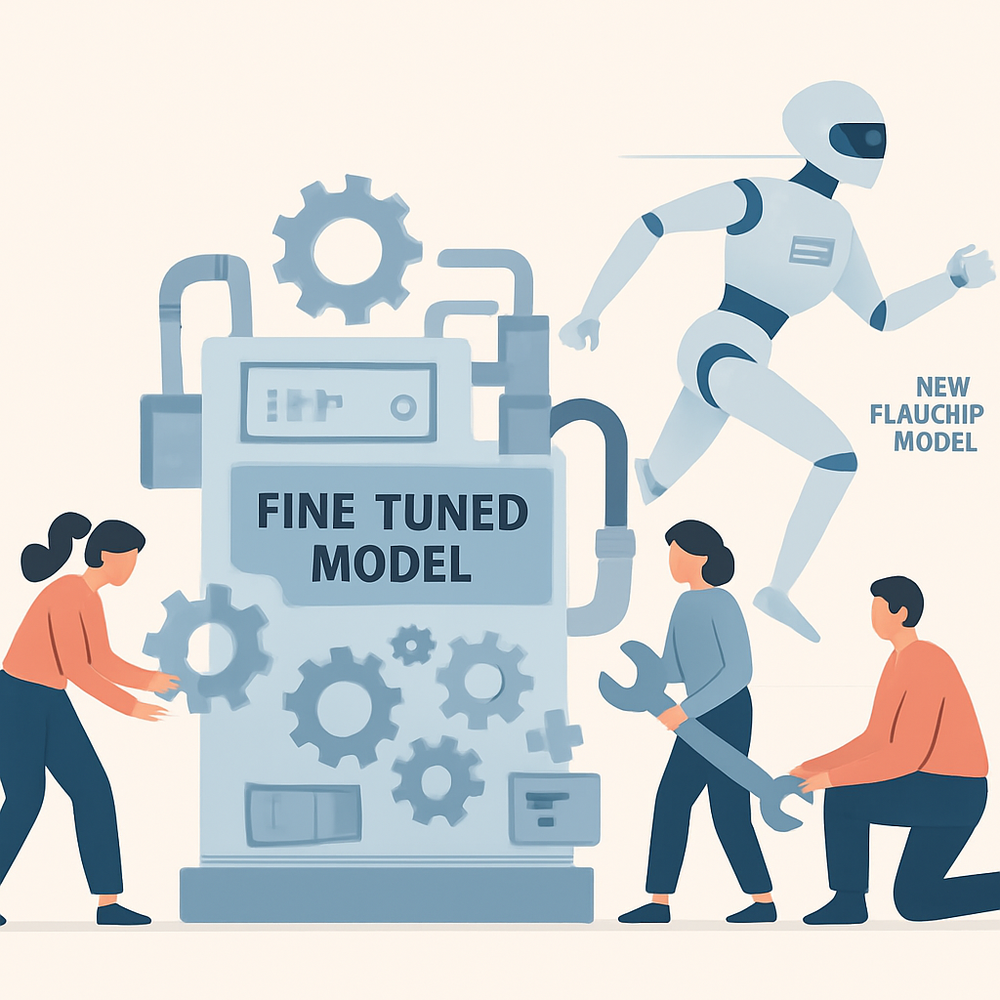
BuildMVPFast's guide opens with exactly this scenario: a startup spent 8,000 US dollars fine-tuning a 70 billion parameter open-weight model for customer support, three weeks of data labelling followed by two weeks of training runs, and the result was barely distinguishable from what a strong frontier model could already do with a well-crafted system prompt. By the time the project finished, a newer flagship model had launched and made the fine-tuned model obsolete essentially overnight.
Model release cadence in 2026 is relentless, with major providers shipping new flagship and mid-tier models on a near-monthly cycle, and every fine-tuned model carries a shelf life that keeps shrinking as a result. Prompts, retrieval pipelines, and agentic workflows transfer to a new model release with minimal changes; fine-tuned weights do not. The mitigation is not avoiding fine-tuning entirely, but investing the heavier share of the budget in evaluation tooling and clean training data, since that infrastructure stays useful across model generations even when the fine-tuned weights themselves do not.
Hire Edge Computer Vision
6 Scenarios and the Cheaper Alternative
|
Scenario |
Cheaper Alternative |
Typical Cost and Time |
|---|---|---|
|
Knowledge that changes weekly |
Retrieval-augmented generation |
Modest ongoing hosting cost, days to build |
|
Prompt not yet tested properly |
Better system prompt with few-shot examples |
API costs only, hours to test |
|
Inconsistent output formatting |
Structured output modes or schema constraints |
Free, hours to configure |
|
Oversized model for the task |
Distillation into a smaller model |
Modest GPU cost, one to two days |
|
No evaluation baseline |
Build a 100+ example test set first |
Days, but prevents a much larger loss later |
|
Base model about to update |
Invest in portable prompt and RAG infrastructure |
Ongoing, but transfers across model generations |
Ask What Was Tried Before Fine-Tuning Was Proposed
Every one of these six scenarios shares a common root cause: fine-tuning proposed as the first solution rather than the last one, after prompting, retrieval, structured output constraints, and a smaller distilled model have already been tested and found insufficient. That order is not a formality, it is the difference between a training run that solves a real, measured gap and one that quietly burns budget on a problem a configuration change would have fixed.
The Gen AI vetting questions post covers the broader set of questions worth asking any AI developer before a project starts. Hire an AI developer who can show you what was tried before fine-tuning was proposed, not just a training pipeline ready to run.
Hire Edge Computer Vision
Frequently asked questions
What percentage of fine-tuning projects are actually unnecessary?
Why shouldn't I fine-tune a model on my company's internal documents?
Can structured output problems really be fixed without fine-tuning?
What is model distillation and when should I use it instead of fine-tuning a large model?
How do I know if my fine-tuned model has regressed on tasks outside its training data?
Is it ever worth fine-tuning right before a new flagship model is expected to launch?



Shreyans Padmani
Shreyans Padmani has 5+ years of experience leading innovative software solutions, specializing in AI, LLMs, RAG, and strategic application development. He transforms emerging technologies into scalable, high-performance systems, combining strong technical expertise with business-focused execution to deliver impactful digital solutions.