Introduction
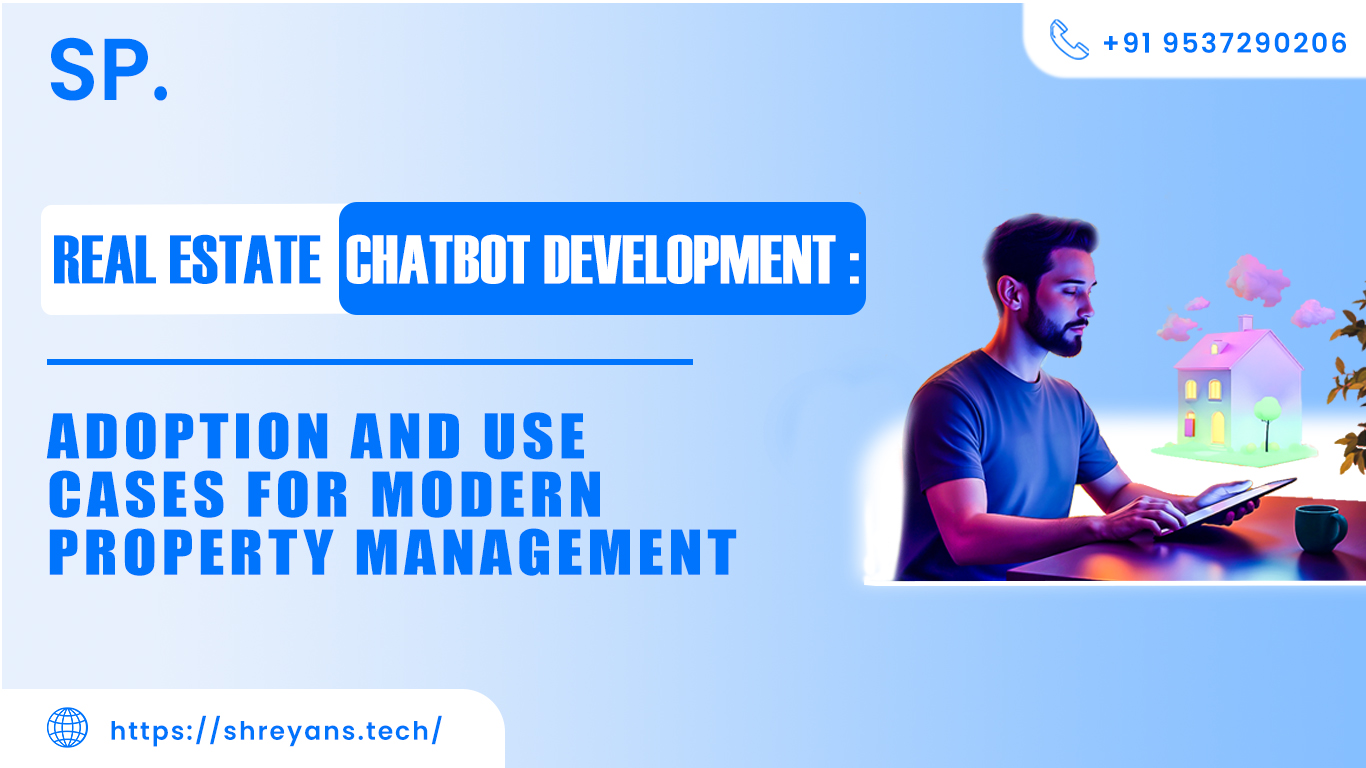
The real estate industry is evolving rapidly with the integration of Artificial Intelligence (AI). One of the most impactful innovations is the real estate chatbot—a smart virtual assistant designed to automate communication, improve customer engagement, and streamline property management operations.
Today’s property buyers, tenants, and investors expect instant responses, personalized experiences, and 24/7 availability. Real estate chatbots fulfill these expectations by transforming how businesses interact with customers and manage properties.
From lead generation to tenant support, chatbot adoption is becoming essential for modern property management systems. This blog explores how real estate chatbot development is reshaping the industry, its adoption trends, and key use cases.
What is a Real Estate Chatbot?
A real estate chatbot is an AI-powered software that interacts with users through chat interfaces (websites, apps, or messaging platforms) to assist with property-related queries.
It can:
🔹 Answer Customer Questions
-
Real estate chatbots can instantly respond to common customer queries such as property prices, location details, amenities, availability, and legal information. Instead of waiting for an agent, users get immediate answers 24/7. Advanced chatbots use AI and Natural Language Processing (NLP) to understand user intent and provide accurate, human-like responses. This improves customer satisfaction and ensures that no inquiry is missed, even during non-working hours.
🔹 Recommend Properties
-
Chatbots analyze user preferences such as budget, preferred location, property type (flat, villa, office), and specific requirements (parking, furnished, etc.). Based on this data, they suggest the most relevant properties in real-time. This personalized recommendation system helps users quickly find suitable options and increases the chances of conversion for real estate businesses.
🔹 Schedule Visits
-
Instead of manual coordination, chatbots can automatically book property visits or virtual tours. They check available time slots, confirm appointments, and send reminders to both customers and agents. This reduces scheduling conflicts, saves time, and ensures a smooth experience for both parties.
🔹 Handle Tenant Requests
-
For property management, chatbots assist tenants in reporting issues such as maintenance problems (plumbing, electricity, repairs). They can log complaints, generate service tickets, and notify the concerned team. Chatbots also provide updates on request status, ensuring transparency and faster resolution, which improves tenant satisfaction.
Unlike traditional systems, modern chatbots use Natural Language Processing (NLP) and Machine Learning to understand and respond intelligently.
Why Real Estate Businesses Are Adopting Chatbots
The adoption of chatbots in real estate is growing rapidly due to increasing competition and digital transformation.
Key Reasons for Adoption:
1. 24/7 Customer Support
Chatbots provide round-the-clock assistance, ensuring no customer query goes unanswered.
2. Faster Response Time
Instant replies improve customer satisfaction and reduce waiting time.
3. Cost Reduction
Automation reduces dependency on large support teams.
4. Lead Generation & Qualification
Chatbots collect user data and identify serious buyers efficiently.
5. Improved Operational Efficiency
Routine tasks like answering FAQs and managing requests are automated.
6. Competitive Advantage
Companies using AI tools attract more tech-savvy customers.
Role of Chatbots in Modern Property Management
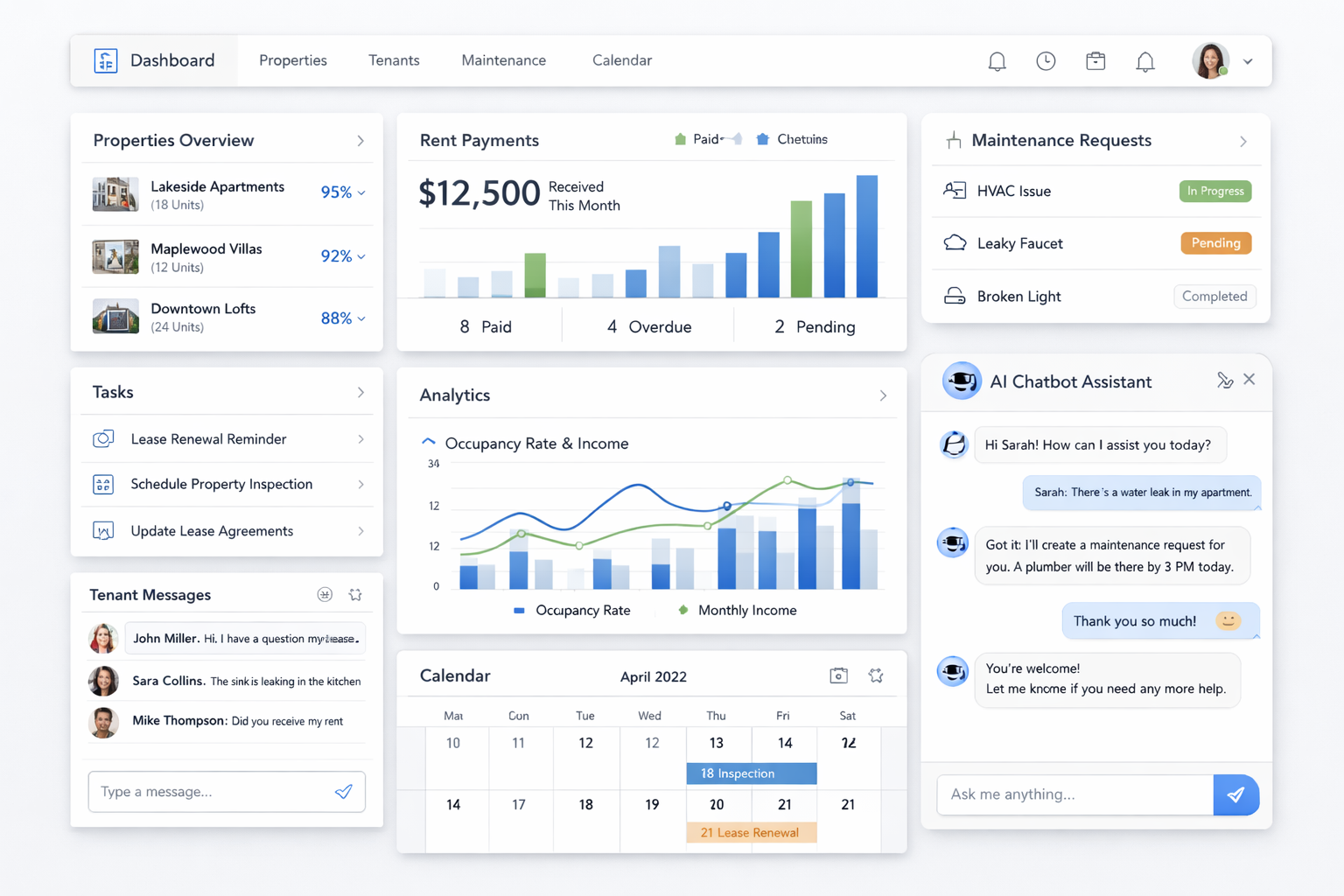
Modern property management involves multiple responsibilities:
1. Tenant Communication
-
Chatbots make communication between tenants and property managers fast and seamless. Tenants can ask questions related to rent, policies, notices, or updates anytime without waiting for office hours. The chatbot can also send important announcements, reminders, and updates automatically, ensuring clear and consistent communication. This reduces misunderstandings and improves the overall tenant experience.
2. Maintenance Requests
-
Chatbots simplify the process of reporting maintenance issues such as plumbing, electrical faults, or repairs. Tenants can easily submit requests through chat, and the chatbot automatically logs the issue, assigns it to the relevant team, and provides a tracking ID. It can also update tenants on the status of their request, ensuring faster resolution and better service management.
3. Lease Management
-
Managing leases becomes easier with chatbots as they can send reminders for rent payments, lease renewals, and important deadlines. They can also assist tenants with lease-related queries, documentation, and renewal processes. This automation helps property managers reduce manual work and ensures that no critical deadlines are missed.
4. Property Listings
-
Chatbots help users explore property listings quickly and efficiently. They provide detailed information such as price, location, size, amenities, and availability. Users can filter properties based on their preferences, and the chatbot presents the most relevant options. This makes property searching faster, more interactive, and user-friendly.
Chatbots act as a central communication layer connecting tenants, agents, and property managers.
They integrate with:
1. CRM Systems (Customer Relationship Management)
-
Chatbots integrate with CRM systems to manage and track customer interactions effectively. Every conversation, inquiry, and user detail (such as preferences, contact information, and behavior) is stored automatically. This helps real estate businesses nurture leads, follow up with potential buyers, and provide personalized services. With CRM integration, agents can access complete customer history and make better decisions to improve conversion rates.
2. Property Management Systems (PMS)
-
When integrated with Property Management Systems, chatbots can handle various operational tasks such as rent tracking, tenant records, maintenance schedules, and lease details. This allows the chatbot to provide real-time updates to tenants and property managers. For example, tenants can check rent status or request services, while managers can monitor operations efficiently—all through a single automated interface.
3. Databases and Listing Platforms
-
Chatbots connect with property databases and listing platforms to fetch real-time information about available properties. This includes details like pricing, location, availability, images, and amenities. When a user searches for a property, the chatbot instantly pulls accurate and updated listings, ensuring users get the most relevant results. This integration enhances user experience and keeps property information consistent across all platforms.
This integration ensures automation + real-time updates across operations.
Top Use Cases of Real Estate Chatbots
1. Lead Generation and Qualification
Chatbots engage visitors and collect data like budget, location, and preferences, turning them into qualified leads.
2. Property Search & Recommendations
Users can describe their needs, and chatbots suggest suitable properties instantly.
3. Appointment Scheduling
Chatbots book property visits automatically, saving time for agents.
4. 24/7 Customer Support
Customers can get instant answers about pricing, availability, and property details anytime.
5. Tenant Support & Maintenance Requests
Tenants can report issues (e.g., plumbing, electricity), and chatbots create service tickets automatically.
6. Lease Management & Renewals
Chatbots send reminders for lease renewals and assist in documentation.
7. FAQ Automation
Common questions like:
-
🔹 Property Price:
-
Chatbots provide instant and accurate information about property prices based on real-time data. Users can ask about the cost of a specific property, price ranges in a particular area, or compare multiple options. Advanced chatbots can also suggest properties within the user’s budget, helping buyers make informed financial decisions quickly without manual assistance.
-
🔹 Location Details:
-
Chatbots offer detailed information about property locations, including nearby landmarks, connectivity, transport facilities, schools, hospitals, and shopping areas. This helps users understand the surrounding environment and suitability of the property. Some advanced systems even provide map links or area insights, making decision-making easier for buyers and tenants.
-
🔹 Amenities:
-
Chatbots clearly list all available amenities of a property such as parking, security, gym, swimming pool, power backup, and furnished options. Users can filter properties based on their preferred amenities, ensuring a personalized search experience. This saves time and helps users quickly find properties that match their lifestyle needs.
are answered instantly.
8. Personalized User Experience
AI analyzes user behavior and provides tailored suggestions.
9. After-Hours Engagement
Chatbots ensure no business opportunity is missed outside working hours.
10. Data Collection & Insights
Chatbots track user behavior and generate insights for better decision-making.
Key Features of a Real Estate Chatbot
A professional chatbot should include:
🔹 AI-powered Conversation Engine
-
This is the core of a chatbot that enables it to understand and respond to user queries intelligently. Using technologies like Natural Language Processing (NLP) and Machine Learning, the chatbot can interpret user intent, provide accurate answers, and simulate human-like conversations. It continuously learns from interactions, improving its responses over time.
🔹 CRM & Database Integration
-
Chatbots integrate with CRM systems and databases to store and manage user data such as inquiries, preferences, and contact details. This allows businesses to track leads, personalize communication, and maintain a complete history of customer interactions. It helps in better decision-making and improves customer relationship management.
🔹 Multi-platform Support (Website, WhatsApp, App)
-
A modern chatbot works across multiple platforms, including websites, mobile apps, and messaging platforms like WhatsApp. This ensures that users can interact with the business from their preferred channel, providing a seamless and consistent experience across all touchpoints.
🔹 Lead Capture Forms
-
Chatbots can collect important user information such as name, phone number, email, budget, and property preferences through interactive forms. This data is automatically stored and used for follow-ups, helping businesses generate and manage high-quality leads efficiently.
🔹 Appointment Scheduling System
-
This feature allows users to book property visits or consultations directly through the chatbot. It checks availability, confirms time slots, and sends reminders to both customers and agents. This reduces manual coordination and ensures a smooth scheduling process.
🔹 Analytics Dashboard
-
Chatbots provide detailed analytics such as user interactions, popular queries, conversion rates, and performance metrics. These insights help businesses understand customer behavior, improve chatbot responses, and optimize marketing strategies.
🔹 Multilingual Support
-
To serve a diverse audience, chatbots support multiple languages. Users can interact in their preferred language, making communication easier and more inclusive. This is especially useful in real estate, where customers may come from different regions and backgrounds.
Real Estate Chatbot Development Process
Step 1: Requirement Analysis
Understand business goals and user needs.
Step 2: Platform Selection
Choose where chatbot will be deployed (web/app/social media).
Step 3: Designing Conversation Flow
Create user-friendly interaction scenarios.
Step 4: AI Model Integration
Use NLP and ML for smart responses.
Step 5: System Integration
Connect chatbot with CRM, PMS, and databases.
Step 6: Testing
Ensure accuracy, speed, and reliability.
Step 7: Deployment & Optimization
Launch chatbot and continuously improve performance.
Benefits of Real Estate Chatbots
-
Increased Lead Conversion
-
Chatbots engage website visitors instantly and guide them through the buying journey. By asking relevant questions, suggesting suitable properties, and capturing user details, they convert casual visitors into potential buyers. Quick responses and personalized interactions significantly increase the chances of converting leads into actual customers.
-
Improved Customer Engagement
-
With real-time conversations and personalized responses, chatbots keep users actively engaged. Instead of static browsing, users experience interactive communication, which makes property searching more interesting and effective. Continuous engagement also builds trust and strengthens customer relationships.
-
Reduced Operational Cost
-
By automating repetitive tasks such as answering FAQs, handling inquiries, and scheduling appointments, chatbots reduce the need for large customer support teams. This helps businesses save operational costs while maintaining high-quality service.
-
Better Data Insights
-
Chatbots collect valuable data from user interactions, such as preferences, behavior, and common queries. This data can be analyzed to understand market trends, customer needs, and performance metrics, helping businesses make smarter decisions and improve strategies.
-
Enhanced Tenant Satisfaction
-
For existing tenants, chatbots provide quick support for queries, maintenance requests, and updates. Faster responses and efficient issue resolution lead to higher satisfaction levels and better tenant retention.
-
Scalable Business Operations
-
Chatbots can handle multiple conversations simultaneously without any delay, making it easy for businesses to scale operations. Whether there are 10 users or 10,000 users, the chatbot can manage interactions efficiently without additional resources.
Chatbots allow businesses to focus on high-value tasks while automation handles repetitive work.
Challenges in Chatbot Adoption
-
🔹 Initial Development Cost
-
Developing a real estate chatbot requires investment in AI technologies, design, development, and integration with existing systems like CRM and databases. Advanced chatbots with features like NLP, analytics, and automation can be costly initially. However, this cost is often justified in the long run through improved efficiency and reduced operational expenses.
-
🔹 Limited Understanding in Basic Bots
-
Basic or rule-based chatbots can only respond to predefined queries and may fail to understand complex or unexpected user inputs. This can lead to incorrect responses or poor user experience. To overcome this, businesses need to invest in AI-powered chatbots that continuously learn and improve over time.
-
🔹 Need for Regular Updates
-
Chatbots require continuous updates to stay relevant and effective. This includes updating property listings, improving conversation flows, fixing errors, and adapting to changing customer needs. Without regular maintenance, chatbot performance may decline and provide outdated or inaccurate information.
-
🔹 Data Privacy Concerns
-
Chatbots collect and store user data such as contact details, preferences, and interactions. This raises concerns about data security and privacy. Businesses must ensure proper data protection measures, comply with regulations, and use secure systems to protect user information and build trust.
However, advanced AI solutions are continuously improving these limitations.
Future of Real Estate Chatbots
The future of chatbots in property management includes:
-
🔹 Voice-enabled Assistants
-
Future real estate chatbots will support voice interactions, allowing users to speak instead of typing. With voice-enabled assistants, users can ask questions, search for properties, or schedule visits using simple voice commands. This makes the experience faster, more natural, and accessible, especially for users who prefer hands-free interaction.
-
🔹 AI-powered Virtual Property Tours
-
AI will enable immersive virtual tours where users can explore properties remotely in real-time. Chatbots can guide users through rooms, highlight key features, and answer questions during the tour. This reduces the need for physical visits and helps buyers make quicker decisions from anywhere in the world.
-
🔹 Predictive Analytics for Property Investment
-
Chatbots powered by predictive analytics can analyze market trends, user behavior, and historical data to provide investment insights. They can suggest properties with high growth potential, estimate future prices, and guide users in making smarter investment decisions based on data-driven predictions.
-
🔹 Integration with IoT Smart Homes
-
Integration with IoT (Internet of Things) will allow chatbots to interact with smart home devices. Users can control lighting, security systems, temperature, and appliances through chatbot commands. Property managers can also monitor and manage smart devices remotely, improving efficiency and enhancing the living experience.
AI will continue to transform real estate into a fully digital, automated ecosystem.
FAQs
Q1. What is a real estate chatbot?
Ans: A real estate chatbot is an AI-based tool that interacts with users to answer queries, suggest properties, and automate tasks like scheduling and lead generation.
Q2. How do chatbots help in property management?
Ans: They automate tenant communication, maintenance requests, lease management, and customer support.
Q3. Are real estate chatbots expensive to develop?
Ans: Costs vary depending on features, integrations, and AI capabilities.
Q4. Can chatbots replace real estate agents?
Ans: No, they assist agents by automating repetitive tasks, allowing agents to focus on closing deals.
Q5. What platforms support real estate chatbots?
Ans: Websites, mobile apps, WhatsApp, Facebook Messenger, and other messaging platforms.
Conclusion
Real estate chatbot development is no longer optional—it is a necessity for modern property management. As customer expectations evolve, businesses must adopt AI-driven solutions to stay competitive.
From lead generation to tenant management, chatbots are transforming the real estate industry by improving efficiency, reducing costs, and delivering exceptional user experiences.
Companies that invest in chatbot technology today will gain a strong competitive edge in the future digital real estate market.



Shreyans Padmani
Shreyans Padmani has 5+ years of experience leading innovative software solutions, specializing in AI, LLMs, RAG, and strategic application development. He transforms emerging technologies into scalable, high-performance systems, combining strong technical expertise with business-focused execution to deliver impactful digital solutions.