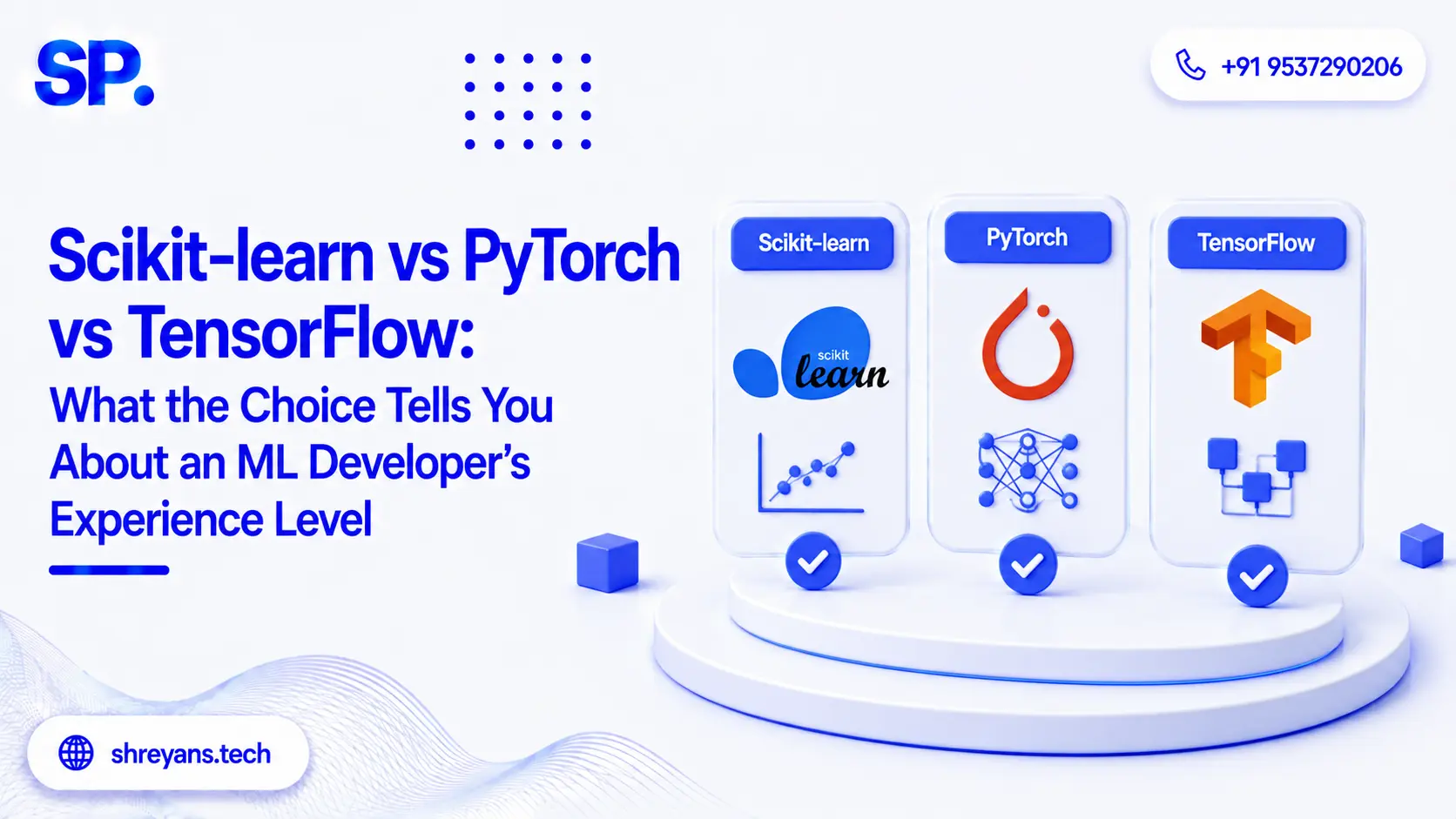
The Papers With Code 2024 framework leaderboard showed PyTorch powering 78 percent of research papers with code across NeurIPS, ICML, and ICLR. TensorFlow, which led the same category as recently as 2020, now accounts for approximately 15 percent. Scikit-learn, despite being absent from deep learning benchmarks entirely, remains the most downloaded Python ML library on PyPI, with over 15 million monthly downloads reported in 2025. These three numbers tell three different stories, and understanding what each framework signals about the developer who reaches for it is one of the most reliable ways to assess ML engineering depth before a single line of code is written.
This post is not a framework tutorial. It is a hiring and vetting guide for founders and technical buyers evaluating machine learning development services for specific project types. The framework a developer defaults to, and how they talk about that choice, is a proxy signal for the type of problems they have actually solved in production.
Why Framework Choice Is a Signal, Not a Preference
A developer who defaults to scikit-learn for a natural language classification task has not made a neutral technical decision. They have revealed something about their experience ceiling. A developer who reaches for full PyTorch when fitting a gradient-boosted tree on a tabular dataset has revealed something different: either framework unfamiliarity or a preference for complexity that can inflate project cost without improving outcome.
Experienced ML engineers treat framework selection as a function of three variables: the data modality (tabular, text, image, audio, time series), the model complexity required (classical statistical learning versus deep representation learning), and the deployment target (embedded edge, REST API, batch processing, real-time streaming). A developer who cannot articulate that reasoning clearly when asked, and instead says they prefer one framework without reference to those variables, has likely learned one stack in one context and is applying it universally.
The ML interview questions post contains specific technical questions to probe this reasoning during interviews, including ones that surface whether a developer understands when not to use deep learning.
What Scikit-learn Proficiency Actually Signals
Scikit-learn is the standard library for classical machine learning in Python, covering linear and logistic regression, tree-based ensembles (Random Forest, Gradient Boosting, XGBoost through sklearn-compatible wrappers), support vector machines, clustering, and dimensionality reduction. A developer who is genuinely proficient in scikit-learn, not just familiar with its API but comfortable with its internals, its Pipeline abstraction, and its integration with tools like Optuna for hyperparameter search, has a solid foundation in the statistical principles that underpin all of ML.
The signal is positive for tabular data problems, which represent the majority of commercial ML projects in finance, retail operations, and process manufacturing. Gradient-boosted tree ensembles (XGBoost, LightGBM, CatBoost, all sklearn-compatible) consistently outperform deep learning approaches on structured tabular data with fewer than a million rows, a finding replicated across Kaggle competition results and academic benchmarks including the 2022 Grinsztajn et al. study published in the NeurIPS datasets track.
The signal becomes negative when a developer presents scikit-learn as sufficient for tasks that require representation learning: image recognition, sequence modelling, or dense retrieval on unstructured text. A developer who proposes a TF-IDF vectoriser and a logistic regression classifier for a semantic search problem in 2026 is proposing a 2014-era solution. That is a meaningful seniority signal.
What PyTorch Proficiency Actually Signals
PyTorch is the framework of choice for deep learning research and, increasingly, for production deep learning systems. Developed by Meta AI and now governed by the Linux Foundation, it achieved its dominance through dynamic computation graphs (which make debugging and iteration faster than TensorFlow's static graph approach) and an API that reads like idiomatic Python rather than a domain-specific language layered on top of it.
A developer who is genuinely proficient in PyTorch, meaning they can write custom training loops, implement custom loss functions, debug gradient flow issues, and deploy models via TorchScript or ONNX, has demonstrated practical deep learning engineering depth. The key distinction is between a developer who can call pretrained model APIs from HuggingFace (which requires minimal PyTorch knowledge) and one who can train a model from scratch on custom data, implement a non-standard architecture, or diagnose a vanishing gradient problem mid-training.
For NLP projects in particular, PyTorch is the default production framework. HuggingFace Transformers, the dominant library for fine-tuning and deploying language models, is PyTorch-native (with JAX support added later). A developer scoped to hire an NLP developer who is not proficient in PyTorch is likely operating below the current production standard for transformer-based systems.
What TensorFlow and Keras Proficiency Actually Signals
TensorFlow's trajectory since 2022 has been one of consolidation rather than growth in the research community, but its enterprise deployment footprint remains substantial. Google's internal ML infrastructure is TensorFlow-native. TensorFlow Serving, the production serving layer, handles billions of predictions per day across Google products. TFLite is the dominant framework for on-device inference on Android hardware. These are not trivial deployment contexts.
A developer who cites TensorFlow experience and can speak specifically to TF Serving configuration, SavedModel format, or TFLite quantisation is signalling experience in enterprise-scale or mobile deployment contexts. A developer who cites Keras and means they know how to call model.fit() on a pre-built architecture has demonstrated basic familiarity, not production depth. The distinction matters because Keras is now the high-level API for both TensorFlow and JAX (Keras 3.0 released in late 2023), meaning Keras proficiency alone no longer implies TensorFlow-specific deployment knowledge.
For projects that require model training at enterprise scale, the right framework depends on the infrastructure. Google Cloud Platform deployments benefit from TensorFlow's native Vertex AI integration. AWS SageMaker has strong support for both PyTorch and TensorFlow. The relevant question is not which framework the developer prefers but which framework best fits the client's existing infrastructure and the expertise of whoever will maintain the system post-deployment. For a thorough look at how training approach maps to budget and timeline, the model training approaches breakdown is useful context.
Framework Comparison at a Glance
|
Dimension |
Scikit-learn |
PyTorch |
TensorFlow / Keras |
|
Primary use |
Classical ML, tabular data |
Research, deep learning, production DL |
Enterprise DL, production pipelines |
|
Learning curve |
Low |
Medium |
Medium to high |
|
GPU training |
No (CPU only) |
Native CUDA support |
Native CUDA support |
|
Production deployment |
Via joblib/ONNX |
TorchServe, ONNX, TorchScript |
TF Serving, TFLite, TF.js |
|
Research adoption |
Standard for ML baselines |
Dominant (NeurIPS, ICML 2024) |
Declining in research |
|
Enterprise adoption |
Embedded in sklearn pipelines |
Growing rapidly (Meta, OpenAI) |
Strong (Google, large enterprises) |
|
What proficiency signals |
Solid ML fundamentals |
Deep learning and research capability |
Enterprise deployment experience |
The Red Flags to Watch For
The most common framework-related red flag in ML developer portfolios is framework monotheism: every project solved with the same tool regardless of problem type. A portfolio where every project uses PyTorch, including tabular classification tasks where a gradient boosted tree would have been faster, cheaper, and more accurate, suggests a developer who has learned one paradigm and applies it uniformly. The same applies in reverse: a portfolio that is entirely scikit-learn with no evidence of deep learning capability is an honest signal that the developer's scope is limited to classical ML.
The second red flag is inability to justify the choice. Ask a candidate why they used PyTorch instead of TensorFlow for a specific project, and the answer should reference specific features (dynamic graph, HuggingFace ecosystem compatibility, team familiarity, deployment target). An answer that amounts to personal preference, without reference to the problem constraints, suggests shallow experience. For other signals to watch for in portfolios, the vetting ML developers post covers the portfolio-review equivalent of these framework questions.
The third red flag is unfamiliarity with the alternatives. A genuinely senior ML engineer has at minimum used all three frameworks across different project types and can articulate why each exists and what it is optimised for. Developers who have only ever used one framework at a production level are specialists, which is sometimes exactly what you need and sometimes a mismatch with the breadth a project requires. Scoping correctly starts with knowing which type you need.
Hiring for Depth, Not Just Familiarity
Framework choice is a starting point for evaluating an ML developer, not the whole picture. A developer who knows when to use scikit-learn, when PyTorch is the correct tool, and when TensorFlow's deployment ecosystem justifies the additional complexity is demonstrating architectural judgement, not just technical breadth. That judgement is what separates a developer who builds a working model from one who builds a production system that operates reliably at scale.
If you are scoping an ML project and want to assess whether a candidate's technical profile matches your problem type and infrastructure, the best starting point is a technical conversation scoped to your specific constraints. To work with a developer who has production experience across all three frameworks and can recommend the right approach for your use case rather than the one they happen to know best, you can explore custom AI model training services or reach out directly to hire an AI developer with the specifics of your project.
Frequently asked questions
Which framework should I specify when hiring an ML developer in 2026?
Can a developer who knows scikit-learn learn PyTorch quickly enough for my project?
Is TensorFlow still worth specifying in 2026?
What if a developer says they use all three frameworks equally?
Does framework preference correlate with day rate or project cost?
How do I tell if a developer's framework proficiency is genuine versus credential-level?



Shreyans Padmani
Shreyans Padmani has 5+ years of experience leading innovative software solutions, specializing in AI, LLMs, RAG, and strategic application development. He transforms emerging technologies into scalable, high-performance systems, combining strong technical expertise with business-focused execution to deliver impactful digital solutions.