Fifty-nine percent of hiring managers surveyed in 2026 suspected candidates of using AI to misrepresent themselves, and separate research found background screening firm Checkr reporting that 23 percent of companies had already encountered identity fraud among new hires. AI-specific fraud has its own toolkit on top of that: fabricated case studies with realistic-sounding business metrics, code samples that are lightly modified open-source projects presented as original work, and portfolio pieces built on bootcamp exercises framed as client engagements. AI work is unusually easy to fake convincingly and unusually hard to verify with a surface-level check, which is exactly why a structured process matters more here than for most freelance hiring.
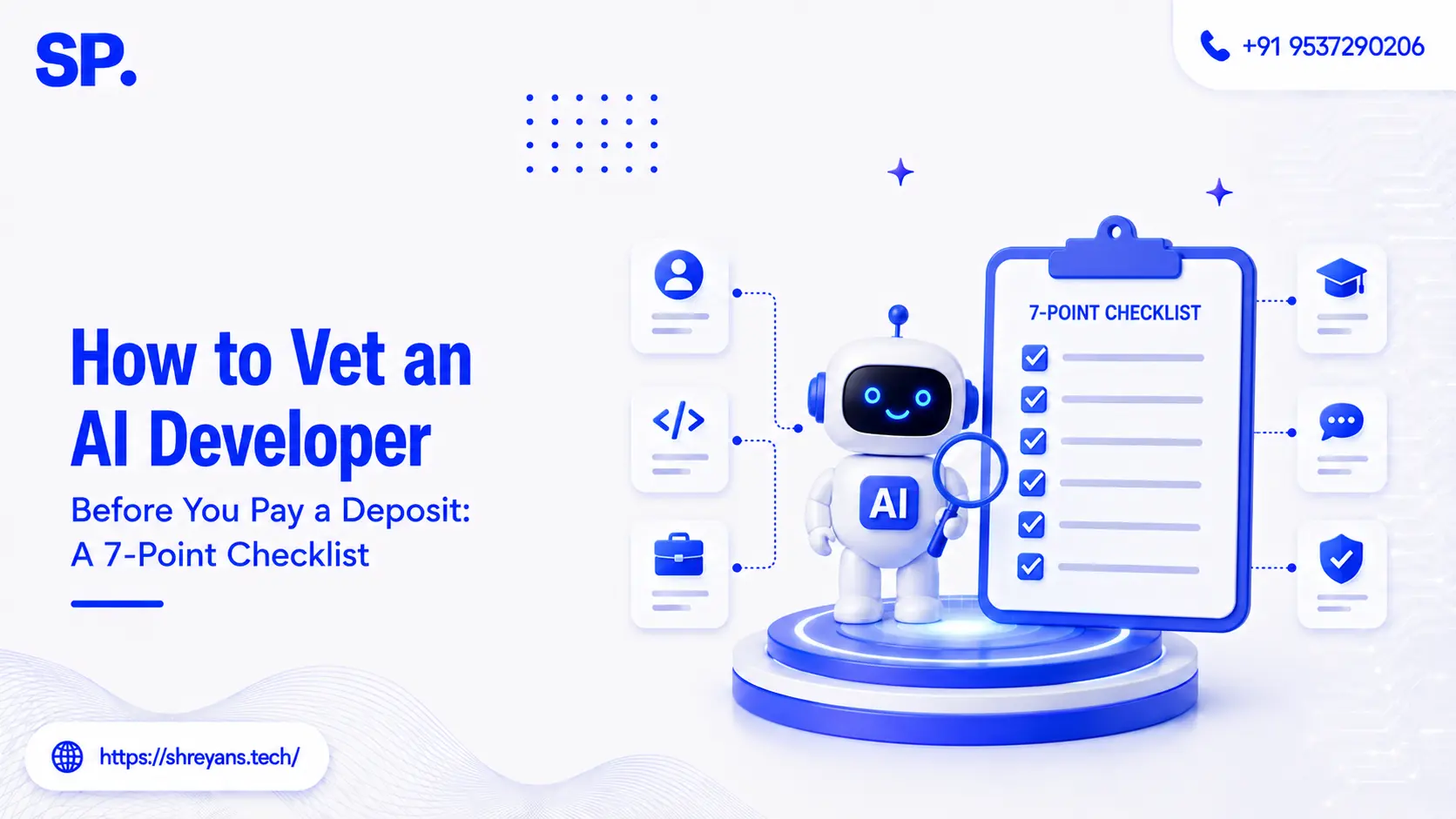
None of the seven checks below require a technical background to run, though a genuine technical conversation is one of them. Each is designed to surface a real signal before money changes hands, not after a deposit is gone and a deliverable never arrives.
1. Ask for One Specific System, Not a Portfolio of Demos
A polished portfolio of screenshots and dashboards is evidence of nothing, since dashboards are not evidence of methodology. Ask instead for one specific system the candidate built, what their exact role was on the team that shipped it, and what happened when it did not work as intended the first time. A recommendation engine serving millions of users involves data engineering, backend infrastructure and product teams alongside whoever built the model, so a case study that describes the whole system as a solo achievement is either inflated or imprecise, and both are worth pressing on directly.
The follow-up question exposes the gap fast: ask them to walk through the infrastructure of the specific piece they claim to have built. A candidate describing their real contribution answers in specific, confident detail. A candidate who inflated their role starts hedging or generalising, because they are describing work someone else actually did. The Gen AI portfolio red flags post covers the fuller pattern of inflated case studies specific to generative AI work.
Hire AI Developers
Expert AI talent with guaranteed results, get free proof-of-concept
Get Free POC Scoping2. Push Past Vague Impact Language
Phrases such as significantly improved performance or delivered strong results carry no verifiable content on their own. A defensible case study names a baseline, states what was actually measured, and is specific about what did not work, since every real project involves dead ends that an inflated one conveniently omits entirely. Ask directly: improved compared to what, and how was that measured?
This check also catches a subtler problem than outright fabrication: marketing copy repackaged as technical analysis, where a candidate has absorbed a former employer's public claims about a product and presents them as their own engineering assessment. The tell is usually that the language matches a company blog post more closely than it matches how an engineer actually talks about a system they built.
3. Run a Real Technical Conversation Before Any Commercial Talk
A structured technical conversation, even a single hour, catches most mismatches that survive a portfolio review, and it should happen before rate and timeline discussion rather than after. The strongest signal is not whether a candidate can name the right tools and frameworks, almost everyone can, but whether they can explain a real trade-off they made on a past project and why they made it that way rather than another way. The ML interview questions post is a solid starting checklist to run this conversation even without a deep technical background yourself.
Watch communication patterns during this stage as closely as the technical content. A candidate who takes four days to respond during vetting will take a week to respond when a production issue needs a same-day fix, and a candidate who says they understood a vague brief without asking a single clarifying question either did not read it carefully or does not care about getting the scope right before starting.
4. Request a Small Paid Trial Scoped to Your Actual Problem
A small, paid trial task tied to your real problem, not a generic take-home exercise, is the single highest-signal step in this whole process, because it is the only one that shows how a candidate actually works rather than how they describe having worked. Good freelancers understand exactly why a client wants this and propose the scope themselves; the ones who refuse outright, or push back hard on being paid for it, are disproportionately the ones who cannot deliver at the standard their portfolio implies.
The trial should be deliberately small, scoped to a few hours or a single day, and paid at the candidate's normal rate. Asking for a full unpaid deliverable disguised as a trial is a red flag running in the opposite direction, and it will cost you access to the strongest candidates, who correctly recognise it as an attempt to extract free work rather than a legitimate assessment.
5. Confirm the Deposit and Payment Structure Protects Both Sides
A deposit or partial upfront payment before work begins is standard, reasonable practice, and a freelancer who refuses one entirely on a substantial project is not automatically more trustworthy for it. What matters is the structure around it: milestone-based payment tied to specific deliverables protects you far better than a single large upfront payment against a vague acceptance timeline, because ownership and accountability accrue as work is delivered and paid for rather than transferring in one uncertain lump sum.
Be equally alert to the reverse pattern: a client-side scam where you receive an inflated payment and are asked to refund the difference, or a request to purchase equipment or software before work starts, are both classic fraud patterns that run in the opposite direction and are worth recognising if you are ever on the freelancer side of a similar negotiation.
6. Read the IP and Deliverables Clause Before Signing
This is the check most businesses skip because it feels like paperwork rather than vetting, and it is the one most likely to cause a seriously expensive problem later. Confirm the contract names an explicit assignment of rights, not just a work made for hire clause that may not apply to the work being commissioned, and confirm it lists the actual deliverables by name, model weights and training configuration included if the project involves custom model training, rather than a vague reference to the work. The freelance contract red flags post covers the specific clauses that most often leave a business without ownership of what it paid for.
A candidate who raises these questions unprompted, what happens to the training data, who owns the model weights, what happens to project materials at termination, is giving you useful information about how carefully they will run the engagement generally. Silence on these points from either side is a finding, not an absence of an issue.
Hire AI Developers
Expert AI talent for guaranteed results, get free proof-of-concept
Get Free POC Scoping7. Verify Claims Externally
Reverse-image-search a portfolio piece if anything about it looks generic or template-derived; copied work is discovered this way more often than people expect. Contact at least one reference directly, and if every case study is anonymised under a non-disclosure agreement, which is legitimate and common in AI work, ask enough process-level questions in the technical conversation that the account still has to hold together under scrutiny even without a name attached to verify. A story that stays consistent and specific under follow-up questions is a stronger signal than a name you can call but never actually contact.
Search the candidate's public work where it exists: repositories, published writing, conference talks. This evidence is harder to fabricate convincingly than a portfolio page and shows how someone actually reasons about a problem, which is a better predictor of engagement quality than any single credential.
|
Signal |
Green Flag |
Red Flag |
|---|---|---|
|
Case study specificity |
Names their exact contribution and what the team around them built |
Claims sole credit for an entire multi-person system |
|
Response to a paid trial |
Proposes a small, scoped, paid task tied to your problem |
Refuses any paid trial or insists on full scope unpaid |
|
Technical conversation |
Walks through a real production decision and its trade-offs |
Answers stay at the level of naming tools and frameworks |
|
Contract terms |
Names deliverables, IP assignment and payment milestones explicitly |
Vague deliverables clause or silence on model and data ownership |
The Hour That Saves the Engagement
Every check on this list takes minutes to hours, and together they take less time than recovering from a deposit paid to a developer who could not deliver, a portfolio piece that turned out to be someone else's work, or a contract that left the business without ownership of what it funded. The businesses that get burned are consistently the ones that skipped the technical conversation, the paid trial, or the contract review because a candidate's proposal looked polished enough to skip the check.
If you would rather work with a specialist whose track record you do not have to reconstruct from scratch, hire an AI developer who will walk you through their actual production work without needing to be asked twice. A developer who volunteers this checklist's answers before you request them is telling you something useful about the engagement ahead.
Frequently asked questions
Is it normal for an AI developer to ask for a deposit before starting?
Should I pay a freelancer for a trial task before hiring them?
What is the biggest red flag in an AI developer's portfolio?
How do I vet an AI developer if I am not technical myself?
What contract terms should I check before an AI project starts?
What is a reasonable response if a freelancer refuses a paid trial entirely?



Shreyans Padmani
Shreyans Padmani has 5+ years of experience leading innovative software solutions, specializing in AI, LLMs, RAG, and strategic application development. He transforms emerging technologies into scalable, high-performance systems, combining strong technical expertise with business-focused execution to deliver impactful digital solutions.