
Top automated valuation models now achieve median error rates of 2 to 3 percent on standard residential properties, down from 10 to 15 percent five years earlier, according to benchmarks reported by Zillow Research and CoreLogic. Research and Markets valued the AI in real estate market at 404.9 billion US dollars in 2026, projecting 1.3 trillion by 2030. Yet Deloitte's 2026 commercial real estate outlook found the share of operators reporting a transformative impact from AI fell from 12 percent to just 1 percent in a single year, largely because organisations deployed the technology before structuring their underlying data.
That gap between adoption and impact is the most useful thing a property company can understand before hiring. The firms getting real returns are not running the most pilots; they are picking a small number of well-defined problems where their own data is already good enough to train on. These are the six applications where property companies are currently getting developers to build something that works, and what each one actually demands.
1. Automated Valuation Models and Pricing
Automated valuation models estimate a property's market value from transaction history, property attributes and location data without a physical inspection. The better systems in 2026 use ensemble methods, typically combining random forest and gradient boosting approaches such as XGBoost, because the relationships in property pricing are sharply non-linear: a property three streets from a metro station can carry a materially different price than one five streets away, and a simple linear model never captures that. Building this properly is machine learning development services work on structured transaction data, and it lives or dies on the quality of the land registry and comparable sales records feeding it.
Accuracy expectations should stay realistic. Industry benchmarks put median AVM error at 2 to 3 percent for standard residential properties with sufficient comparable sales, but accuracy degrades noticeably for unique properties, rural locations and thin markets where comparables are scarce. The hybrid model most lenders have settled on, an AVM generating an initial estimate that a licensed appraiser reviews and adjusts, exists precisely because the pure-automation version struggles with exactly the properties where a valuation error is most expensive.
2. Property Imagery: Condition Scoring and Virtual Staging
Listing photographs are one of the most underused datasets in property. Computer vision models can classify rooms, score condition, flag features that materially affect value such as a renovated kitchen or visible damp, and generate virtually staged versions of empty rooms. Zillow's neural network, trained on millions of photographs alongside home values, is the most widely cited example of imagery being folded directly into valuation rather than treated as marketing collateral. This is computer vision development work in its most commercially direct form, and the main constraint is almost always annotation volume rather than model architecture.
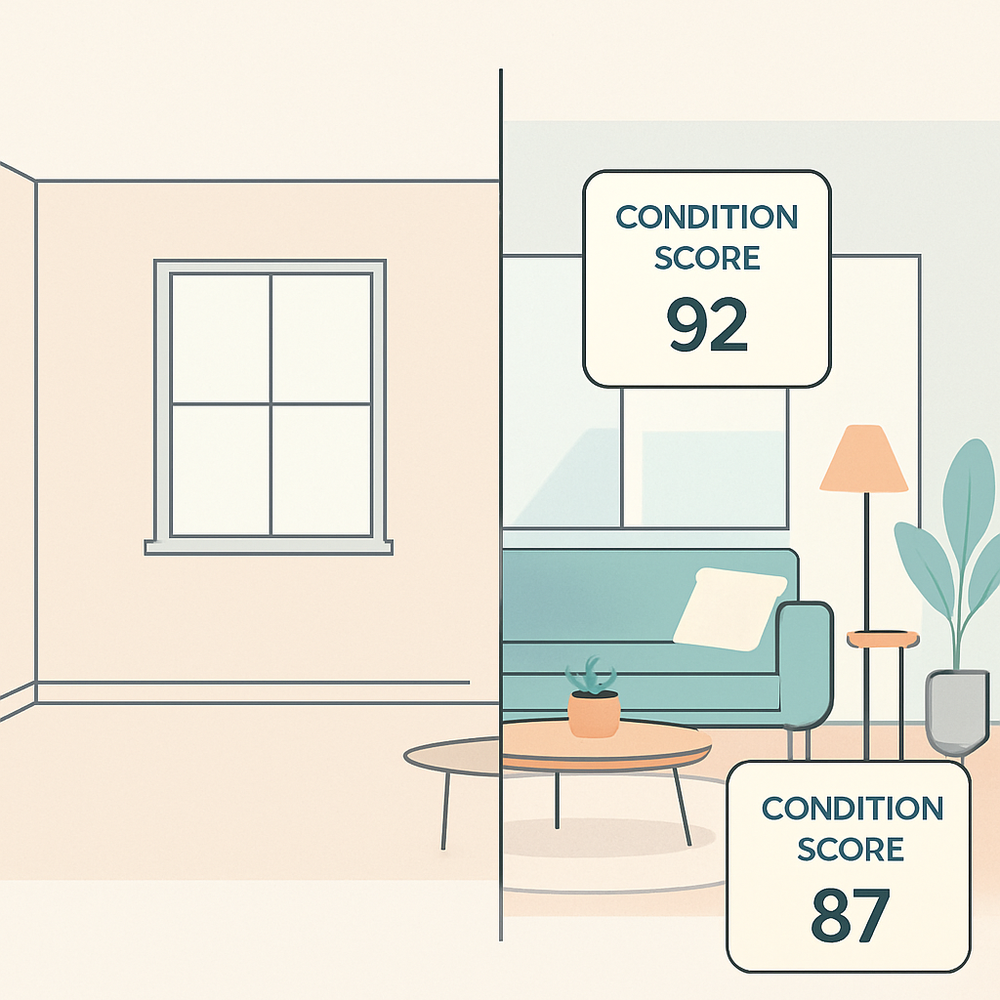
The commercial case is easiest to make on virtual staging, where the alternative is physically furnishing a property for photographs, and on condition scoring, where the alternative is a site visit. Both replace a recurring per-property cost with a one-time model build, which is why imagery projects tend to show a clearer payback calculation than more speculative applications.
3. Lead Scoring and Automated Follow-Up Agents
Property enquiries arrive in volume and decay fast, and the gap between a lead contacted in five minutes and one contacted in five hours is enormous. AI-powered lead nurturing has been reported to increase conversion rates by approximately 40 percent compared with manual follow-up, according to benchmark research from Inside Real Estate. The current generation of these systems goes beyond scoring: agents that qualify enquiries, answer initial questions and schedule viewings autonomously are a central focus of proptech development in 2026, which means hiring for AI agent development services rather than a scoring model alone. The AI agent use cases post covers the broader pattern of where agents reclaim hours across a working week.
The failure mode worth designing against from the start is an agent that qualifies aggressively and loses a serious buyer to a badly handled exchange. Companies including EliseAI have built products specifically around property enquiry handling, and the deployments that work well keep a clear escalation path to a human agent rather than treating full autonomy as the goal.
4. Lease Abstraction and Document Processing
Commercial property runs on documents: leases, rent rolls, title records, service charge schedules, and planning correspondence. Extracting structured data from them, break clauses, rent review dates, service charge caps, permitted use restrictions, is repetitive work that consumes analyst time and produces errors when done manually at volume. This is squarely why property firms hire an NLP developer rather than adding headcount, since the underlying task is information extraction from inconsistent documents rather than a language generation problem.
The most recent valuation systems are starting to fold this text back into pricing directly. Landlogic Solutions filed a multimodal spatio-temporal automated valuation model in 2026 that layers large language models over unstructured narrative property descriptions alongside official planning and geographic information system data, which points at where document processing and valuation converge rather than remaining separate workstreams.
5. Investment Screening and Market Forecasting
Investors and developers use predictive models to rank sites, forecast rental yields and flag markets shifting before the shift is obvious in headline transaction data. The stakes justify the modelling effort: a single poor site selection decision can cost a retail chain between 7 million and 10 million US dollars, which is a figure that makes a forecasting engagement look inexpensive by comparison. Skyline AI disclosed a system for generating value predictions of commercial real estate as early as 2019, and the approach has matured considerably since.
The honest limitation is that property markets are driven substantially by factors a model cannot see, interest rate decisions, planning policy changes and local politics among them, so these systems are best treated as a screening and ranking layer that narrows a shortlist rather than a system that makes the investment call. A developer who presents a market forecasting model as more certain than that is overselling it.
6. Portfolio Analytics and Predictive Maintenance
For companies holding property rather than transacting it, the recurring cost centre is the building itself. Predictive models trained on maintenance history, building management system data and sensor readings can forecast plant failures, heating, ventilation and lift systems in particular, before they become emergency callouts, and flag energy inefficiency that shows up as an avoidable operating cost every month. The approach is borrowed directly from industrial predictive maintenance and transfers well to large managed portfolios where the same asset types repeat across dozens of buildings.
This use case is usually the last one a property company reaches, and often the one with the most defensible business case, because unlike valuation or lead scoring it is measured against a cost line the finance team already tracks closely. It also has the lowest data barrier for firms already running a modern building management system, since the sensor history needed to train on is typically already being logged whether or not anyone is analysing it.
|
Use Case |
What It Predicts or Produces |
Data Required |
Typical Payback |
|---|---|---|---|
|
Automated Valuation |
Property price estimate without physical inspection |
Land registry transactions, property attributes, geospatial data |
Fast, once transaction data is clean |
|
Property Imagery |
Room classification, condition scoring, virtual staging |
Labelled listing photographs |
Medium, depends on annotation volume |
|
Lead Qualification |
Ranked leads plus automated follow-up |
CRM history, enquiry logs, conversion outcomes |
Fast, measurable in conversion rate |
|
Document Processing |
Structured data extracted from leases and contracts |
Historical lease and contract documents |
Medium, scales with document volume |
What These Projects Cost and Where to Start
Cost in property AI tracks the same drivers as other industries: how clean the historical data already is, how many systems the model needs to integrate with, and whether the output feeds a dashboard or a live decision. A lead scoring model built on an existing customer relationship management system is a materially smaller engagement than a valuation model that has to reconcile land registry records, listing data and geospatial layers into one pipeline. For a fuller breakdown of how pricing shifts by project type, the ML consultant cost post covers the ranges in detail.
The sequencing advice is consistent with what Deloitte's adoption-versus-impact finding implies: start with the use case where your own data is already structured, prove it, and expand from evidence. For most property companies that means lead scoring or document processing before valuation modelling, since the first two run on data a firm already controls end to end. A scoped freelance engagement suits a first project better than a long platform commitment, and the why startups hire freelance post covers the same reasoning that applies to a property firm running an initial pilot.
Hire AI Developers
Unlock real estate potential with expert AI solutions, get free proof-of-concept scoping
Get Free POC ScopingWhere Property AI Hiring Actually Pays Off
The one-percent transformative-impact figure in Deloitte's 2026 outlook is not evidence that property AI does not work; it is evidence that most firms bought technology before they organised the data it needed. The companies in that remaining share did the unglamorous part first, and their models work because of it, not because they picked a better vendor or a more advanced architecture.
If you are ready to scope a valuation, lead qualification or document processing project, hire an AI developer for real estate who will audit your data before proposing a model, because the constraint on almost every property AI project is the transaction and enquiry history you already hold, not the modelling technique applied to it.
Frequently asked questions
How accurate are AI property valuation models in 2026?
What data does a real estate company need before hiring an AI developer?
Can AI replace property appraisers and estate agents?
Which real estate AI project delivers the fastest return?
What does an AI developer for real estate cost?
Should a property company build custom AI or buy a proptech platform?



Shreyans Padmani
Shreyans Padmani has 5+ years of experience leading innovative software solutions, specializing in AI, LLMs, RAG, and strategic application development. He transforms emerging technologies into scalable, high-performance systems, combining strong technical expertise with business-focused execution to deliver impactful digital solutions.