Large language models process over 100 trillion parameters across training datasets exceeding 500GB of text, enabling token prediction with perplexities below 15 on standard benchmarks. Enterprise adoption reached 80 percent in 2026, yet only 13 percent of organizations report enterprise-wide business impact, revealing a critical execution gap between access and value realisation.
In 2025, a Fortune 500 retail chain invested $2.3 million deploying an LLM-powered customer service system across 12 markets. Within eight months, poor context layer integration led to escalating hallucinations and compliance violations, forcing the organisation to write off the entire project and revert to legacy systems, a loss that exceeded their initial AI budget by 340 percent.
Defining Large Language Models: Architecture and Core Mechanics
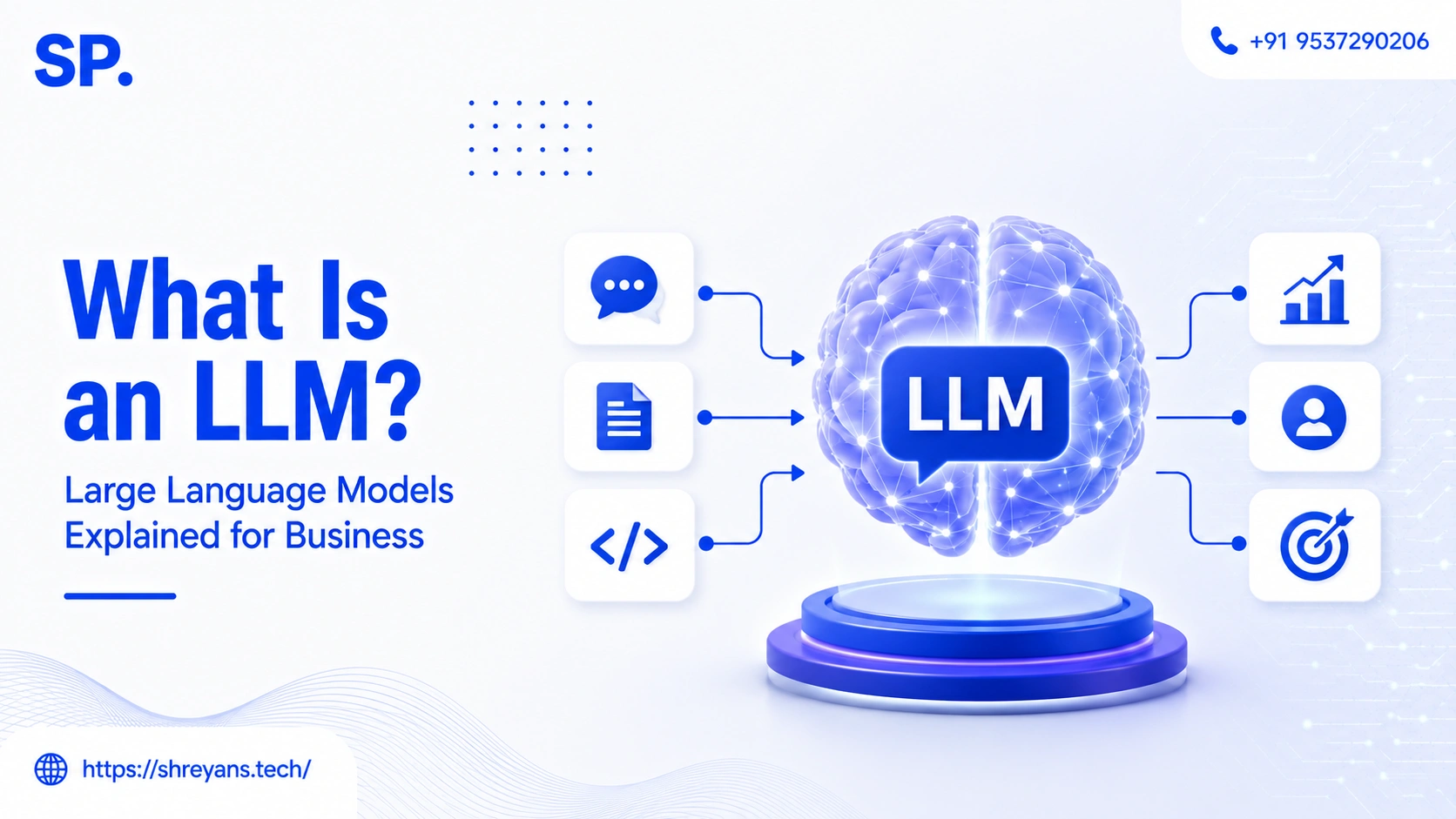
Large language models represent a fundamental shift from traditional natural language processing approaches that relied on hand-crafted features and smaller, task-specific models. Unlike earlier statistical or rule-based systems, LLMs are neural networks trained on vast text corpora containing billions of parameters, enabling them to understand context across entire documents rather than isolated phrases. The defining characteristic that separates LLMs from conventional NLP systems is their ability to generalise across multiple language tasks without explicit programming for each one, as demonstrated by models like GPT-4 which can perform sentiment analysis, translation, and code generation using the same underlying architecture.
Training Methodology: Pre-training and Fine-tuning StagesThe training process follows a two-phase approach that optimises both general language understanding and task-specific performance. During pre-training, models are exposed to massive unsupervised datasets containing hundreds of gigabytes to terabytes of text from books, websites, and other sources, learning to predict the next token in a sequence through a process called causal language modelling. This phase develops the model's foundational knowledge of grammar, facts, and reasoning patterns. Fine-tuning then adapts the pre-trained model through supervised learning on smaller, task-specific datasets, where human annotators provide input-output examples for desired behaviours such as helpful responses, factual accuracy, or safe interactions.
How Self-Attention Enables LLM Understanding
Understanding large language models: A comprehensive guide: At its core, a large language model (LLM) is a model trained using deep learning algorithms and capable of a broad range of natural language processing (NLP) tasks, such as sentiment analysis, conversational question answering, text translation, classification, and generation. An LLM is a type of neural network (NN) that specifically uses transformer architectures, which are models designed to det (source: https://www.elastic.co/what-is/large-language-models)
The Two-Stage Training Process for LLMs
How LLMs Work: A Deep Dive into Large Language Model Mechanics - API7.ai: Large language models (LLMs) are neural networks trained on large collections of text and code. Most current text-generation models use a transformer architecture derived from the design introduced in Attention Is All You Need. Depending on their training and interfaces, they can perform tasks such as question answering, summarization, translation, classi (source: https://api7.ai/blog/how-llms-work)
Enterprise Adoption Landscape: Statistics and Market Reality
The enterprise LLM market demonstrates explosive growth, expanding from $1.59 billion in 2023 to an estimated $259.8 billion by 2030 at a remarkable 79.8 percent compound annual growth rate, according to industry analysis. Despite this rapid expansion, a significant gap persists between adoption rates and measurable business impact, with many organisations deploying models without clear ROI frameworks or success metrics.
Enterprise spending patterns reveal concentrated investment, with nearly 40 percent of adopters allocating over $250,000 annually to LLM initiatives, and 72 percent expecting higher expenditures in the current fiscal year. Google leads adoption at 69 percent of respondents using its models in early 2025, compared to 55 percent for OpenAI, while 63 percent of enterprises prefer professional solutions over generic tools, indicating a shift toward specialised implementations rather than off-the-shelf deployments.
|
Adoption Tier |
Annual Spend Range |
Typical Use Cases |
Business Impact |
|
Pilot/Proof-of-Concept |
$0 to $50,000 |
Internal chat assistants, document summarisation |
Limited to cost reduction, minimal revenue impact |
|
Departmental Deployment |
$50,001 to $250,000 |
Customer service automation, code generation |
Moderate efficiency gains, some process optimisation |
|
Enterprise-Wide Integration |
$250,001+ |
Custom AI model training, predictive analytics, autonomous workflows |
Significant ROI through automation and new product features |
Hire LLM Specialists
Accelerate your business with expert LLM integration and Get Free POC Scoping
Get Free POC ScopingThe Critical Context Layer: Why Data Infrastructure Trumps Model Choice
The hardest part of AI isn't getting a large language model (LLM) to function, but rather designing the system around it. This distinction crystallises why data infrastructure trumps model choice in enterprise deployments. According to industry analysis, 70 to 85 percent of enterprise AI failures stem from data issues rather than model limitations, making the context layer the decisive factor between pilot projects and production success. The context layer encompasses data discovery, quality assurance, lineage tracking, and governance mechanisms that transform raw datasets into reliable fuel for LLM operations.
Poor data quality manifests as inconsistent formatting, missing values, or outdated records that degrade model performance unpredictably. inadequate metadata prevents teams from understanding data provenance, leading to incorrect assumptions about dataset relevance and bias profiles. insufficient access controls create security vulnerabilities while simultaneously blocking legitimate data sharing across business units. Remedies include implementing automated data validation pipelines, establishing comprehensive data dictionaries, and deploying fine-grained access policies. organisations should also invest in data observability platforms that monitor quality metrics continuously, enabling proactive intervention before issues propagate to model outputs.
Building Governed Data Infrastructure for LLM Success
The foundation of any successful LLM deployment is a data infrastructure that treats information as a managed asset rather than a static dump. A production-grade system demands discoverable datasets with clear lineage tracking, enabling you to trace every training sample back to its source and transformation history. Tools like Databricks Unity Catalog or Amundsen provide the metadata layer necessary for this discoverability, while Gartner reports that organisations with automated lineage see 34 percent faster root-cause analysis during model incidents. Without this infrastructure, you cannot reliably audit data drift, reproduce training runs, or comply with emerging regulations like the EU AI Act, which mandates traceability for high-risk systems deployed in 2026 and beyond.
Common Context Layer Failures and Their Remedies
Context layer failures typically manifest when data quality degrades silently, metadata remains fragmented, or access controls become bottlenecks. Poor data quality often stems from inconsistent labelling pipelines, for instance, a retail company discovered 23 percent of its product descriptions contained duplicate entries that corrupted retrieval accuracy. Inadequate metadata manifests as missing field definitions or stale schema information, forcing developers to reverse-engineer data meanings instead of focusing on value-add work. Insufficient access controls appear as overly broad permissions that either expose sensitive PII or prevent legitimate users from accessing required datasets. Remedies include implementing automated data quality checks with tools like Talend Data Quality, centralising metadata in a unified catalog, and adopting attribute-based access control (ABAC) policies that scale with your organisation's growth patterns rather than its headcount. A 2024 IBM study found that enterprises with robust context layers reduce model retraining cycles by 41 percent compared to those without.
Cost Structure Analysis: Understanding True LLM Implementation Expenses
LLM costs operate on token-based pricing rather than traditional cloud hourly rates, making expense prediction challenging without proper governance. The economics of deploying large language models reveal that actual costs extend far beyond initial API charges, encompassing data preparation, engineering overhead, and ongoing maintenance that can multiply total spend by three to five times the headline pricing. Organizations typically underestimate the human capital required for prompt engineering, evaluation frameworks, and production monitoring systems, leading to budget overruns of 60 to 80 percent according to industry analysis. The hidden costs guide from Shreyans Padmani demonstrates how data quality issues, model drift, and integration complexity create recurring expenses that persist long after initial deployment.
Production-grade LLM deployments require significant engineering investment in prompt management systems, automated evaluation frameworks, and real-time monitoring dashboards that alert teams to performance degradation. Teams typically spend 20 to 30 percent of their development time on prompt iteration and testing, with complex use cases like multi-step reasoning or domain-specific queries requiring specialized expertise in LangChain or similar orchestration frameworks. Building robust evaluation pipelines demands integration with tools like LangSmith for prompt tracking and Arize AI for model observability, representing an additional $50,000 to $150,000 annual investment for mid-sized organisations. The infrastructure overhead includes not just the monitoring stack but also the engineering culture needed to maintain data quality standards and implement proper version control for prompts and fine-tuned models.
LLM Pricing Models: API vs Self-Hosted Economics
LLM pricing operates on token-based models where you pay per input and output token processed, with API services like OpenAI charging approximately thirty dollars per million tokens for GPT-4 context windows. Self-hosting requires substantial upfront capital expenditure for GPU infrastructure, Nvidia H100 instances cost around forty thousand dollars each, and ongoing electricity and maintenance expenses that can exceed ten thousand dollars monthly for production workloads. A 2024 analysis by Infracost demonstrates that inference costs scale linearly with usage volume, making vendor APIs economical for sporadic workloads while self-hosting becomes cost-effective at sustained throughput exceeding two million tokens daily. The decision ultimately depends on your expected query volume, latency requirements, and whether you can amortise hardware costs across multiple applications within your organisation.
Hidden Engineering Costs in LLM Deployments
Production-grade LLM systems demand specialised engineering resources spanning prompt engineering, evaluation frameworks, and continuous monitoring infrastructure. A competent developer will spend approximately forty hours initialising LangChain or LlamaIndex frameworks, designing prompt templates that maintain consistency across conversational contexts, and establishing evaluation pipelines using tools like LangSmith or Weights & Biases to track model performance drift. Production monitoring requires implementing observability stacks with Prometheus and Grafana to capture latency metrics, error rates, and token consumption patterns, alongside automated alerting systems that detect anomalous behaviour indicative of prompt injection attacks or model degradation. Enterprise deployments typically require one to two full-time engineers for ongoing maintenance, with additional specialised roles for data scientists managing fine-tuning workflows and MLOps engineers overseeing model versioning and deployment pipelines. This engineering overhead represents approximately thirty to forty percent of total operational costs in mature AI systems.
Risk Management: Security, Compliance, and Model Drift Challenges
Operational LLM deployments face three primary risk vectors that compound over time. Security vulnerabilities emerge from prompt injection attacks that can manipulate model behaviour or extract sensitive training data, with malicious actors increasingly weaponising these techniques. Regulatory compliance requirements under frameworks like the EU AI Act impose strict documentation and monitoring obligations for high-risk systems, while model drift silently degrades performance as input data distributions shift away from training conditions. These risks rarely manifest in isolation; a security breach can expose compliance gaps, while undetected drift can violate regulatory standards for accuracy and reliability.
Effective risk management requires continuous monitoring systems that track both security events and model behavioural changes. A 2026 industry analysis found that AI-driven attacks increased by 56 percent, with LLM applications representing a growing attack surface due to their broad access patterns and complex prompt-response chains. Monitoring should track phenomena like shifts in model outputs, which can show up as more speculative answers or new hallucination patterns, while also watching for retrieval anomalies such as sudden spikes in sensitive document access that may indicate malicious probing.
Security Vulnerabilities in LLM Applications
LLM applications expose several critical security vulnerabilities that traditional security tools struggle to address effectively. Prompt injection attacks allow adversaries to override system instructions or extract training data through carefully crafted inputs, while data exfiltration risks emerge when models inadvertently reveal sensitive information from their context windows. The attack surface expands significantly when LLMs integrate with external tools or databases, creating pathways for privilege escalation and lateral movement within organisational networks. Security teams must implement input validation, output filtering, and behavioural monitoring to detect anomalous prompt patterns that precede successful exploitation attempts.
Regulatory Compliance and Model Governance
High-risk AI systems face increasingly stringent regulatory requirements that demand comprehensive governance frameworks and detailed audit trails. The EU AI Act classifies certain LLM applications as high-risk, mandating specific documentation, testing, and monitoring procedures that must be maintained throughout the model lifecycle. Compliance breaks down when no one notices the moment a model changes behaviour, making continuous monitoring essential for detecting deviations from approved performance parameters. organisations must establish formal governance processes that include regular bias assessments, accuracy evaluations, and detailed logging of all model decisions to satisfy regulatory scrutiny.
Frequently asked questions
What is a large language model?
How do large language models work?
What is the transformer architecture?
How are large language models trained?
What is the enterprise LLM market size?
What are typical LLM enterprise use cases?



Shreyans Padmani
Shreyans Padmani has 5+ years of experience leading innovative software solutions, specializing in AI, LLMs, RAG, and strategic application development. He transforms emerging technologies into scalable, high-performance systems, combining strong technical expertise with business-focused execution to deliver impactful digital solutions.