Zylos Research puts 2026 enterprise spending on agent-based copilot systems at 7.2 billion US dollars, with the broader agentic AI market projected to reach somewhere between 8.5 billion and 45 billion US dollars by 2030 depending on how fast orchestration frameworks mature. Presenc AI's 2026 framework survey finds LangGraph now holds the largest production deployment footprint of any orchestration framework, while Microsoft has moved AutoGen into maintenance mode in favour of the newer Microsoft Agent Framework. The choice is not cosmetic: Presenc AI also reports that 28 percent of production multi-agent deployments in 2026 still use custom orchestration instead of any framework, largely because a team picked the wrong one first and never recovered the time.
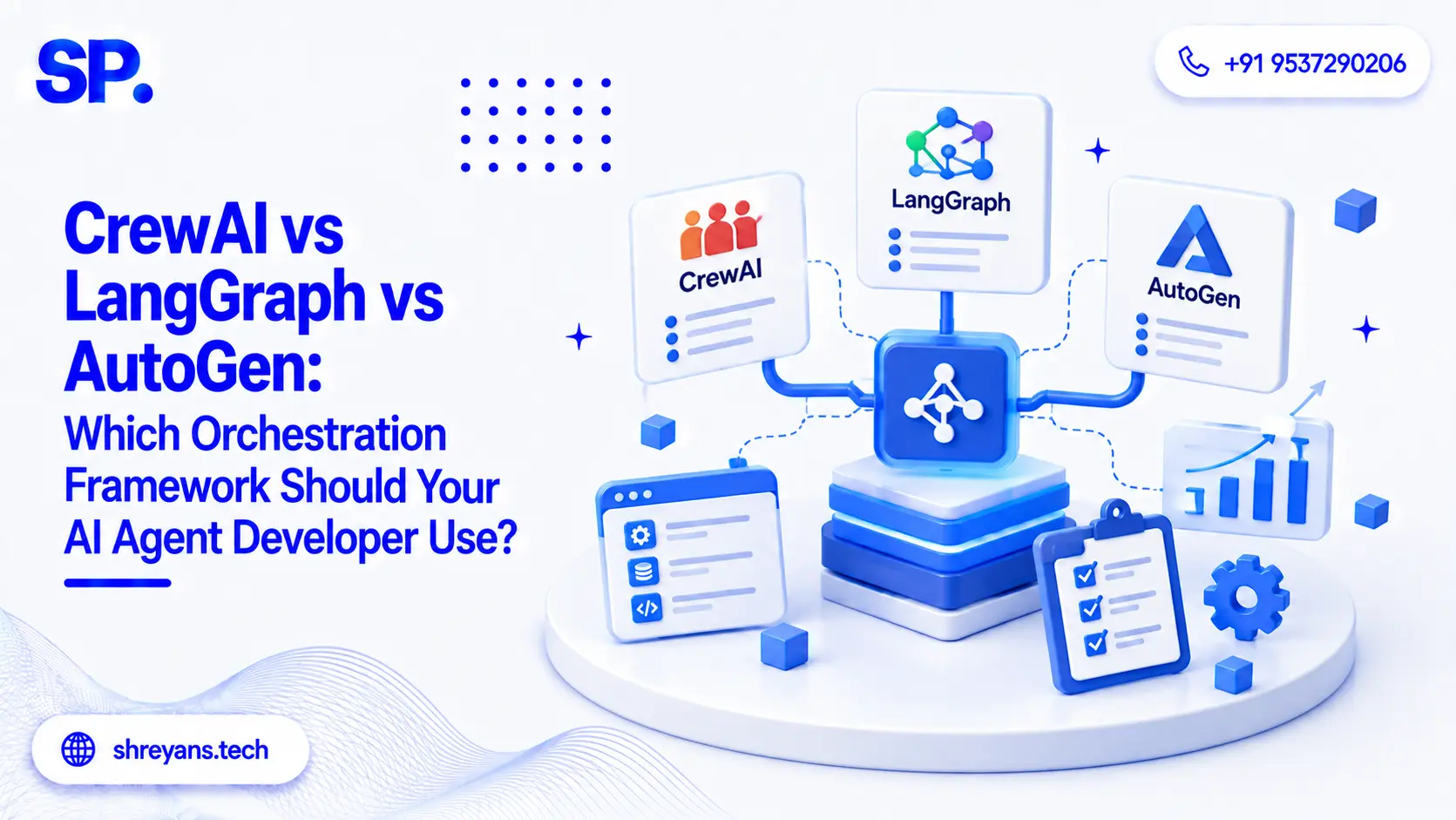
This comparison breaks down where CrewAI, LangGraph, and AutoGen actually differ: task complexity, memory handling, debugging tooling, production stability, and cost per agent run, so you can brief an AI agent development services engagement with the framework decision already made instead of discovering the mismatch six months into a build.
1. Task Complexity: Role-Based Crews vs State Graphs vs Group Conversation
CrewAI organises work around role-based crews: a researcher agent, a writer agent, a reviewer agent, each with a defined role and a process type that governs how tasks pass between them. This fits work that already splits naturally into specialist roles, and Pickaxe's 2026 comparison notes teams can follow CrewAI's quickstart and have a working crew running within 30 minutes. LangGraph instead models the workflow as a directed graph with conditional edges, which suits processes with many branching decision points, approvals, retries, or parallel paths that a linear crew struggles to express cleanly.
AutoGen takes a third approach: conversation-first orchestration built around multi-party GroupChat, where agents debate, build consensus, or negotiate a shared answer across several turns. Gurusup's 2026 framework guide describes this as the most diverse set of conversation patterns among the major frameworks, which makes AutoGen or its successor a stronger fit for tasks like automated code review debates than for a linear, single-pass pipeline. Projects that touch generative AI and AI agent builds with a real multi-perspective requirement are the clearest AutoGen use case; most linear business workflows are not.
2. Memory and State Handling
LangGraph keeps state explicit and inspectable at every node, with checkpointing that supports time-travel debugging: a developer can rerun a workflow from any saved checkpoint with a different model or prompt and compare the outcome directly. This is the feature enterprise teams cite most often when LangGraph wins a production evaluation, since it turns an incident postmortem into a replay rather than a guessing exercise. CrewAI's memory model is simpler to set up initially, which speeds up prototyping, but offers less granular control once a crew's context grows across many sequential tasks.
AutoGen and its successor lean on conversational memory carried through the GroupChat history itself, which works well for shorter multi-agent debates but adds token overhead as a conversation lengthens. Teams choosing between these three should map memory needs to the actual failure mode they are most worried about: silent state corruption favours LangGraph's explicit checkpoints, while fast iteration on a role-based task favours CrewAI's lighter memory model.
3. Debugging Tooling and Observability
Examcert's 2026 framework breakdown ranks LangGraph as the clear leader on debuggability once a team has climbed its learning curve, since LangSmith traces show every node execution, intermediate state, and LLM call, with time-travel replay for incident postmortems. CrewAI's verbose mode prints every agent's reasoning and CrewAI Enterprise adds a tracing UI, which BuildMVPFast's 2026 comparison describes as easy to learn but harder to debug specifically when agents pass each other bad instructions mid-crew.
AutoGen fares worst on this dimension in independent comparisons: BuildMVPFast calls it hard to learn and hard to debug conversation loops at the same time, a combination that shows up most often when a GroupChat runs long and no single agent's reasoning is easy to isolate from the group. This is the dimension worth weighing most heavily if your team expects to run this orchestration layer in production for years rather than a single pilot.
4. Production Stability and Ecosystem Maturity
LangGraph has the largest production deployment footprint of the three frameworks as of 2026, according to Presenc AI, and reduces time-to-production by an estimated three to six months compared with building custom orchestration from scratch. CrewAI continues active development with a growing ecosystem, though OpenAgents' 2026 comparison notes its Enterprise platform creates a degree of vendor dependency that LangGraph and AutoGen do not carry in the same way.
AutoGen's production story changed meaningfully in 2026: Microsoft has shifted it to maintenance mode and points new projects toward the Microsoft Agent Framework, which combines AutoGen's conversational simplicity with Semantic Kernel's enterprise features, thread-based state, type safety, and telemetry. Teams starting fresh in 2026 should evaluate the Microsoft Agent Framework rather than AutoGen itself, and factor migration cost into the decision if an existing AutoGen codebase is already in production. The hidden costs guide covers migration and framework-switching costs that rarely appear in an initial project quote.
5. Cost Per Agent Run
Token cost varies meaningfully across the three frameworks for functionally equivalent tasks. Examcert's 2026 comparison finds CrewAI's role-based prompt structure inflates token count by approximately 30 to 50 percent versus a hand-tuned LangGraph implementation, a real but often acceptable trade-off for the productivity gain of CrewAI's simpler setup. AutoGen's multi-turn conversational pattern inflates token usage further still, which is expensive when a task does not actually need multi-party debate and reasonable when it does.
The practical takeaway for budgeting is to price the orchestration framework as a recurring inference cost, not a one-time build cost. A AI agent development cost estimate that only accounts for development hours and skips projected token spend under the chosen framework will understate the true 12-month cost of running the system, sometimes significantly.
Decision Matrix: Which Framework for Which Situation
|
Framework |
Best For |
Debugging |
Production Maturity |
Token Cost |
|---|---|---|---|---|
|
CrewAI |
Rapid prototyping, role-based specialist tasks |
Easy to learn, harder once crews scale |
Solid, growing ecosystem |
30 to 50 percent higher than LangGraph |
|
LangGraph |
Complex conditional workflows, enterprise scale |
Most granular, LangSmith traces and time-travel |
Largest production footprint in 2026 |
Most token-efficient of the three |
|
AutoGen / Microsoft Agent Framework |
Multi-party debate, consensus-building tasks |
Historically hardest to debug |
AutoGen in maintenance mode, successor is production-focused |
Highest overhead of the three |
The Framework Decision Comes Before the Build
None of these three frameworks is objectively best. The right choice depends on whether your workflow splits naturally into specialist roles, needs explicit conditional branching, or actually requires multi-party debate, and on how much weight your team puts on debuggability versus setup speed. Making this decision before development starts avoids the two-to-three week rewrite that teams commonly hit when they outgrow their first framework choice.
If you are still working through which pattern fits your product, the how to hire an agent dev guide covers the vetting questions to ask before committing to a framework and a developer at the same time. Hire an AI developer who has shipped production systems on more than one of these frameworks, so the recommendation reflects your workflow rather than whichever tool they know best.
Frequently asked questions
Which orchestration framework is best for a solo founder building an MVP?
Is AutoGen still a good choice for new projects in 2026?
Why does LangGraph have a steeper learning curve than CrewAI?
Can I mix CrewAI, LangGraph, and AutoGen in one system?
Which framework is cheapest to run at scale?
Do I need an AI agent developer to choose the right framework, or can I evaluate this myself?



Shreyans Padmani
Shreyans Padmani has 5+ years of experience leading innovative software solutions, specializing in AI, LLMs, RAG, and strategic application development. He transforms emerging technologies into scalable, high-performance systems, combining strong technical expertise with business-focused execution to deliver impactful digital solutions.