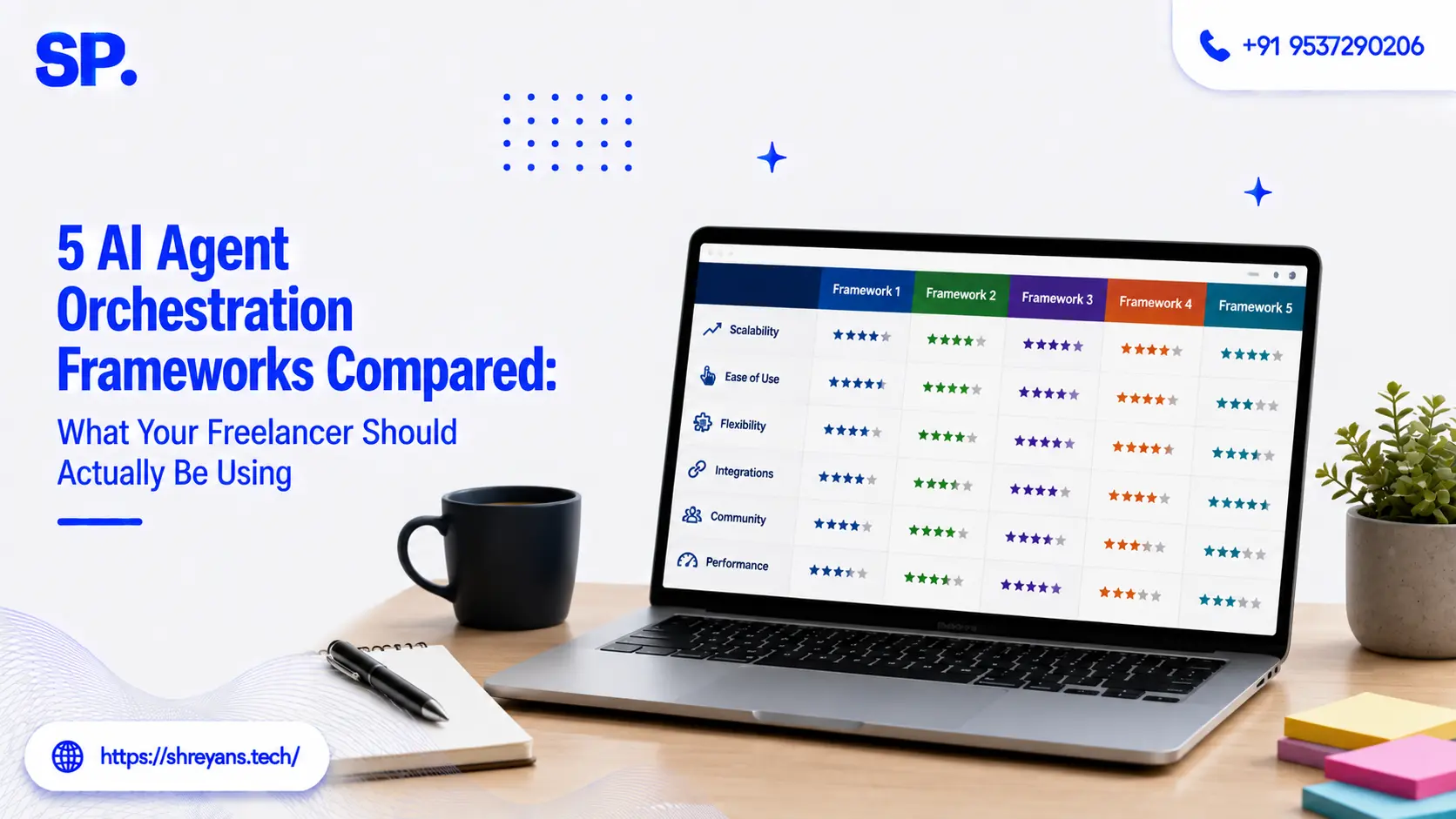
LangGraph reached version 1.0 in October 2025 and overtook CrewAI in GitHub stars during early 2026, driven largely by enterprise adoption of its graph-based architecture. Microsoft shipped Agent Framework 1.0 in April 2026, merging Semantic Kernel and AutoGen into a single SDK. Meanwhile, an analysis of production multi-agent deployments published in May 2026 found that approximately 28 percent still use custom orchestration with no framework at all.
That last figure is the useful one, because it undercuts the premise that framework choice is the decisive factor. Practitioners shipping multi-agent systems consistently report that the gap between a good agent system and a bad one is almost never the framework; it is the evaluation pipeline, the observability setup and the failure recovery logic. This comparison covers what each option is actually good at, and more importantly, what a client should expect a freelancer to justify when they pick one.
1. LangGraph: The Production Default
LangGraph models agent workflows as a directed graph with conditional edges, where agents, tools and checkpoints are nodes and transitions between them are edges that you define explicitly. It manages state persistence and uses reducer logic to merge concurrent updates, which is what makes it suitable for workflows needing precise control over execution order, branching and error recovery. It has the largest production deployment footprint of any agent framework in 2026 and has become the default runtime for LangChain agents, with support for both Python and JavaScript. Most serious AI agent development services engagements default here unless there is a specific reason not to.
The trade-off is verbosity. A simple ReAct-style agent that takes roughly 40 lines in a lightweight framework such as Smolagents runs to approximately 120 lines in LangGraph, and that boilerplate is the price of the explicit control. For a two-week prototype that cost is hard to justify; for a system that has to be debugged at two in the morning eighteen months from now, it is the reason the framework won.
2. CrewAI: Fastest Path to a Working Prototype
CrewAI takes the opposite approach, organising work into role-based crews where you define each agent's role, backstory and goal, assemble them with a set of tasks, and let the framework infer coordination. The code reads close to plain English: define a researcher, a writer and a reviewer, hand them tasks, and CrewAI resolves who does what in what order. No graph theory required, which is exactly why it has the strongest demo-to-prototype ergonomics of any current option.
Two limitations matter for production. Benchmarks published in 2026 put CrewAI's token overhead at roughly 18 percent against a comparable LangGraph implementation for a three-agent ticket triage and resolution workflow, which compounds meaningfully at volume. More significantly, the abstraction that makes it fast to write becomes opaque when a failure has to be diagnosed inside a five-agent pipeline. Using CrewAI to validate a multi-agent design before committing to a LangGraph implementation is a legitimate and common pattern.
3. Microsoft Agent Framework: The Enterprise Stack Answer
Microsoft Agent Framework 1.0, generally available from April 2026, merges the enterprise features of Semantic Kernel, session state, type safety, middleware and telemetry, with the multi-agent orchestration of AutoGen into one SDK, shipping native Model Context Protocol and agent-to-agent support. For a team already committed to the Microsoft ecosystem, this is the sensible starting point for new projects rather than adopting a framework that sits outside the stack their infrastructure and compliance tooling already covers.
Teams running existing production systems on Semantic Kernel should note that Microsoft committed to critical bug fixes for at least one year following the April 2026 general availability, which makes migration a planned project rather than an emergency. The general caution applies as it does to any vendor-aligned framework: the convenience comes with architectural coupling to one ecosystem, which is a reasonable trade for some organisations and a serious constraint for others.
4. AutoGen and AG2: Strong in Research, Smaller in Production
AutoGen leads research and academic adoption, with the most mature multi-agent debate and verification patterns of any framework, where multiple agents critique and check one another's reasoning rather than executing a fixed workflow. Those patterns are valuable for problems where correctness benefits from adversarial review, and the research literature around them is the deepest in the field. Microsoft has since rewritten the project, and the AutoGen and AG2 split during 2025 is worth understanding before adopting either.
Production adoption is smaller than LangGraph's by a clear margin, and for new Microsoft-stack work the vendor's own guidance now points at Agent Framework instead. That does not make AutoGen a poor choice for the problems it suits, but a freelancer proposing it for a standard production workflow should be able to explain why the debate and verification patterns specifically matter for the use case rather than defaulting to it out of familiarity.
5. Custom Orchestration: Still 28 Percent of Production
Roughly 28 percent of production multi-agent deployments in 2026 use custom Python or TypeScript orchestration rather than a framework, and this is not a legacy statistic. Custom orchestration is the appropriate choice when requirements are unusual enough that a framework's assumptions get in the way: bespoke observability requirements, a custom state model, or regulatory constraints that demand full control over what is logged, retained and replayed. Teams at the upper end of production scale still favour it more often than the framework marketing suggests.
The honest counterweight is that adopting a framework typically reduces time-to-production by three to six months compared with building the equivalent scaffolding yourself, so custom orchestration should be a decision defended on specific requirements rather than a default preference for control. A freelancer proposing to build orchestration from scratch on a standard workflow is usually adding months of maintenance burden the client will inherit.
|
Framework |
Orchestration Model |
Strongest For |
Main Trade-Off |
|---|---|---|---|
|
LangGraph |
Directed graph with conditional edges and explicit state |
Production systems needing audit trails and error recovery |
Boilerplate; a simple agent takes far more code than lighter options |
|
CrewAI |
Role-based crews with inferred coordination |
Rapid prototyping and validating a multi-agent design |
Abstraction becomes opaque when debugging larger pipelines |
|
Microsoft Agent Framework |
Unified successor merging Semantic Kernel and AutoGen |
Teams already committed to the Microsoft stack |
Ties architecture to one vendor ecosystem |
|
AutoGen / AG2 |
Multi-agent conversation, debate and verification patterns |
Research and academic multi-agent work |
Smaller production footprint than LangGraph |
|
Custom orchestration |
Plain Python or TypeScript with no framework |
Unusual observability, state or regulatory requirements |
You build and maintain everything the frameworks give free |
Where Retrieval and Evaluation Fit Around the Framework
Agent frameworks orchestrate; they do not solve retrieval quality. Most production agents call a retrieval layer as a tool, and a common architecture pairs LlamaIndex for ingestion, indexing and query engines with LangGraph handling the orchestration logic on top, precisely because the two solve different problems well. Getting the retrieval half right is generative AI development services work, and a system with excellent orchestration over poor retrieval will fail in ways the framework cannot fix.
The same applies to evaluation and observability, which is where practitioners consistently locate the actual difference between systems that work and systems that do not. Building an evaluation pipeline that catches the wrong tool being selected, a long-running conversation losing context, or token spend tripling because an agent entered an unreproducible loop is ordinary machine learning development services engineering discipline, and it is the work most likely to be missing from a proposal that leads with framework choice.
Hire AI Agent Orchestration
Expert developers for custom solutions, get free code review
Get Free Code ReviewWhat Framework Choice Costs You
Framework selection has real cost consequences even though it is not the decisive quality factor. Token overhead differences of the kind benchmarked between CrewAI and LangGraph compound directly into running costs at volume, and migrating between frameworks after launch means rewriting the orchestration layer even though the data pipeline usually survives. For a fuller picture of what agent projects cost overall, the AI agent development cost post covers the ranges, and the hidden costs guide covers the budget categories most quotes leave out, observability and evaluation among them.
What Your Freelancer Should Actually Be Using
The correct answer is almost always LangGraph for production work, CrewAI for a prototype that will be rebuilt, Microsoft Agent Framework if the organisation is already on that stack, and custom orchestration only where a specific requirement rules the frameworks out. What matters more than which one they name is whether they can articulate the trade-off they accepted and what they will build around it. A freelancer who leads with a framework preference rather than with how they will evaluate and monitor the system is optimising the least important variable, and the AI agent hiring red flags post covers the wider signals worth watching during vetting.
The Variable That Actually Decides Outcomes
Framework debates absorb attention out of proportion to their impact. The teams shipping reliable agents are not the ones who picked the best framework; they are the ones who built evaluation pipelines, instrumented their systems properly, and wrote deliberate failure recovery logic, then used whichever framework stayed out of the way while they did it.
If you are scoping an agent project and a proposal leads with framework choice rather than with evaluation and monitoring, hire an AI developer who treats the framework as the least interesting decision on the project. The system you deploy will be judged on how it behaves when something breaks, not on which library it imports.
Frequently asked questions
Which AI agent framework is best for production in 2026?
Is CrewAI good enough for production, or only prototyping?
Should a freelancer build custom orchestration instead of using a framework?
How hard is it to migrate between agent frameworks later?
What should I ask a freelancer about their agent framework choice?
Do agent frameworks handle retrieval, or is that separate?



Shreyans Padmani
Shreyans Padmani has 5+ years of experience leading innovative software solutions, specializing in AI, LLMs, RAG, and strategic application development. He transforms emerging technologies into scalable, high-performance systems, combining strong technical expertise with business-focused execution to deliver impactful digital solutions.