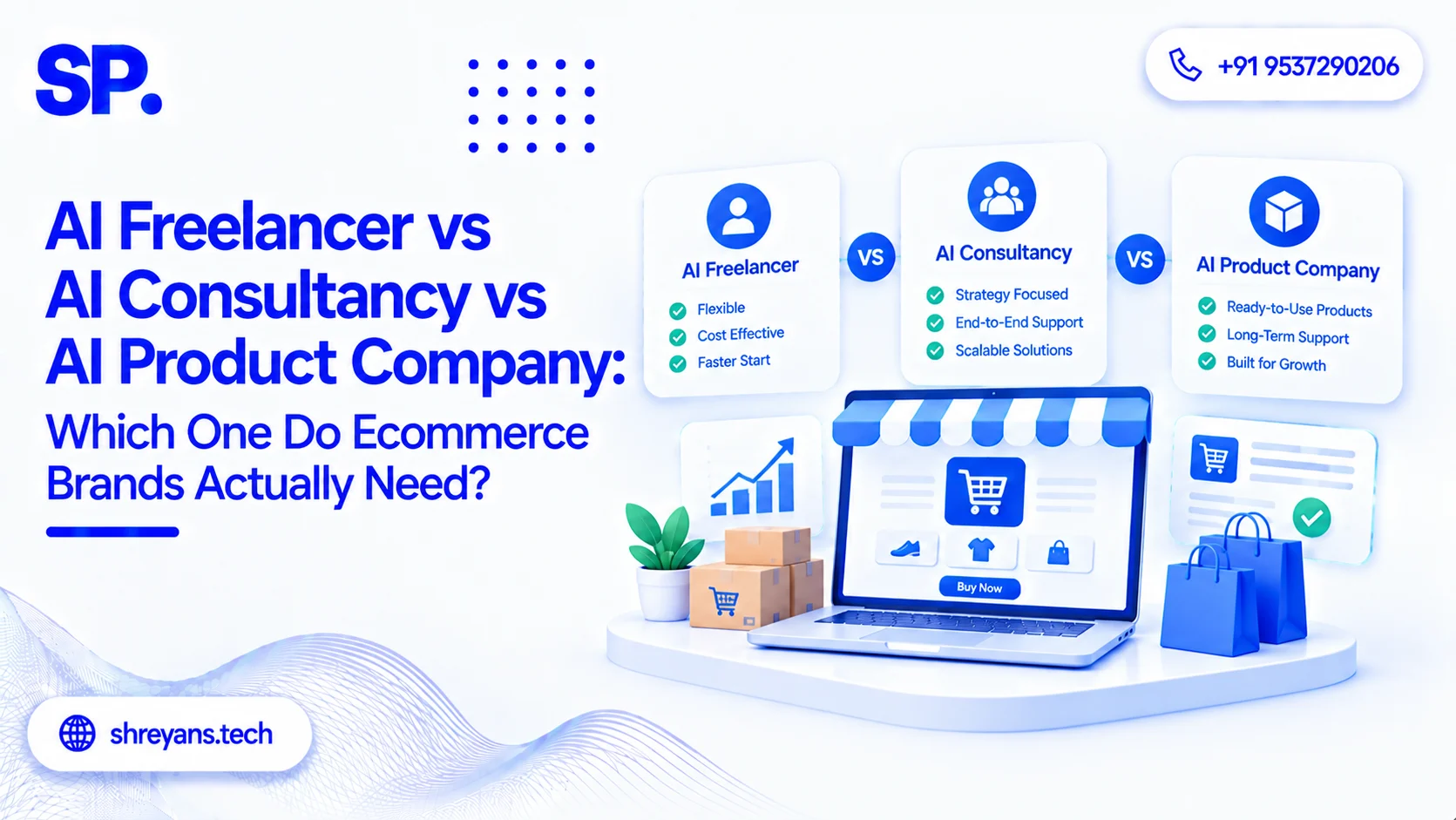
AI Freelancer vs AI Consultancy vs AI Product Company: Which One Do Ecommerce Brands Actually Need?
AI Smart Ventures' 2026 research draws a distinction that gets conflated constantly: an AI freelancer is a task executor who builds, configures, or integrates a specific tool against a brief that already exists, while a consultant produces a workflow audit and a prioritised use case list even with no brief at all. Digital Applied's 2026 ecommerce build-vs-buy research adds the third option most comparisons skip entirely: below roughly 1 million US dollars in annual GMV, the platform-native recommendation engine baked into a hosted platform like Shopify is free and good enough, and through the 1 million to 50 million US dollar GMV range, a specialist SaaS product wins on speed and total cost of ownership over either a freelancer or a consultancy building something custom.
Getting this choice wrong is expensive in both directions: a freelancer hired to fill a strategy gap they were never scoped to fill, or a custom build commissioned for a problem an off-the-shelf tool already solves for a couple hundred dollars a month. This guide covers how to match your ecommerce AI need to the right one of these three options, and where AI developer for ecommerce work actually fits against the alternative of buying a product instead.
1. What Each Option Actually Is
AI Smart Ventures' research gives a practical test for telling a freelancer and a consultant apart that has nothing to do with price: ask what the provider produces if given no brief at all. A consultant produces a workflow audit and a prioritised use case list as their primary deliverable; a freelancer requires a defined task before they can begin work at all. A business without a completed AI roadmap that hires a freelancer instead of a consultant ends up spending the engagement defining the scope a consultant would have produced from the start.
An AI product company, in this context, is not a services provider at all, it is a SaaS tool built for a specific ecommerce function, personalisation, customer support automation, predictive analytics, that you configure rather than commission. Veritly's 2026 ecommerce AI tools guide names Bloomreach and Nosto for personalisation, Tidio Lyro and Gorgias AI for support automation, and Triple Whale for predictive analytics as established products in this category, each priced and packaged for self-service adoption rather than a custom engagement.
2. When a Product (SaaS) Tool Is Actually the Right Answer
Digital Applied's 2026 recommendation engine research gives a specific GMV-based framework worth applying directly: below roughly 1 million US dollars in annual GMV, a platform-native engine is free and good enough, and through the growth and mid-market tiers, 1 million to 50 million US dollars in GMV, a specialist SaaS app or a managed ML service wins on speed and total cost of ownership over a custom build. Orangemantra's 2026 cost research reaches a similar threshold from a different angle: below roughly 5 million US dollars in annual GMV, a managed API or mid-tier SaaS tool almost always costs less than a custom build once engineering time is fully counted.
Veritly's 2026 pricing data puts real numbers on this option: SaaS AI tools for ecommerce typically start from 200 to 2,000 US dollars a month, a fraction of even a modest custom development budget, which is why most stores below the enterprise tier should treat a well-configured SaaS stack as the default starting point rather than the fallback option.
Hire Edge Computer Vision
3. When Custom Development Actually Pays Off

The threshold where custom development starts winning is specific, not a matter of preference. Orangemantra's research identifies the pattern directly: the math changes once a catalog has patterns a generic collaborative-filtering model cannot pick up well, apparel with heavy visual and attribute overlap, B2B catalogs with account-specific pricing, or marketplaces where new sellers and products appear faster than a SaaS tool's cold-start logic can adapt. Digital Applied's research confirms custom development only pays off at enterprise scale specifically when recommendations are a genuine revenue pillar, when full algorithm control matters, or when data ownership itself is a strategic requirement.
Veritly's guide gives a practical signal worth checking before committing to a custom build: consider it when you are managing six or more tools that do not talk to each other, when your product engine does not understand how your items actually relate to one another, or when off-the-shelf tools have visibly hit a ceiling on your specific catalog. Machine learning development services scoped around one of these three specific triggers is a far better-defined engagement than one scoped around a general sense that "custom would be better."
4. Freelancer or Consultancy: Do You Already Have a Brief?
Once custom development is the right call, the freelancer-versus-consultancy decision usually comes down to whether a defined brief already exists. AI Smart Ventures' research sets the minimum viable budget for a complete AI consulting engagement with a boutique firm at 7,500 US dollars, covering a single-function workflow audit, a ranked use case list, and a 90-day roadmap, which is the deliverable a business without a clear starting point actually needs before hiring anyone to build.
SFAI Labs' 2026 comparison gives a workable rule of thumb once a brief exists: freelancers make sense for projects under roughly 50,000 US dollars with clear requirements, while an agency or consultancy fits better for complex products, tight timelines, or situations where the buyer lacks the technical oversight to manage a freelancer directly. The ML consultant cost breakdown covers how this pricing scales by project type in more detail.
Hire Edge Computer Vision
5. The Real Cost Gap Between a Freelancer and an Agency
Ergini's 2026 comparison, written from inside the freelance consulting market, gives specific numbers worth anchoring a budget conversation around: a senior AI engineer billing direct in 2026 charges roughly 120 to 250 US dollars an hour depending on geography and seniority, while that same calibre of engineer sitting inside an agency gets billed out to the client at 250 to 500 US dollars an hour. On a 16-week build, this gap commonly totals 100,000 to 150,000 US dollars between a senior freelancer and a mid-market agency for comparable scope.
The why startups hire freelance post covers what that price difference is actually paying for beyond the hourly rate, project management overhead, backup resourcing, and institutional risk mitigation, so the comparison is not simply about who is cheaper on paper.
6. The Hidden Cost of Getting the Match Wrong

Each option carries a specific risk that only shows up after the decision is made. Ergini's research names the freelancer-specific risk directly: freelancers carry bus-factor risk, and a small independent consulting business can hit a cash crunch between clients that leaves an engineer suddenly juggling three jobs to catch up on your project. The freelancer vs full-time team post covers how to structure a freelance engagement to reduce this specific risk rather than avoiding freelancers altogether.
The SaaS product option carries a different, less visible risk: Digital Applied's 2026 build-vs-buy research cites trade-press analysis finding organisations trapped in vendor lock-in face switching costs roughly 16 times higher than those that planned for portability from the start, and notes SaaS pricing has repeatedly been restructured mid-contract as vendors layer new consumption charges onto existing subscriptions. Neither risk is a reason to avoid the option entirely, but both are worth pricing into the decision rather than discovering after the fact.
7. A Simple Framework for Choosing
Combining the GMV thresholds and the brief test above into one sequence: first, check your GMV against the roughly 1 million to 5 million US dollar range where a SaaS product almost always wins on cost and speed. If you are above that range, or your catalog has a pattern (heavy visual overlap, account-specific B2B pricing, fast-changing marketplace inventory) that a generic SaaS model cannot handle well, custom development is worth evaluating. From there, check whether you already have a defined brief: if not, a consultancy or a boutique audit engagement produces the roadmap you need before a freelancer or a larger build should start; if you do have a brief and the project is under roughly 50,000 US dollars, a freelancer is usually the fastest and most cost-effective path to a working result.
Hire Edge Computer Vision
Freelancer vs Consultancy vs Product Company: Quick Reference
|
Option |
Best For |
Typical Cost Signal |
|---|---|---|
|
AI product company (SaaS) |
GMV under roughly $1M to $5M, standard catalog patterns |
$200 to $2,000 per month |
|
AI freelancer |
A defined brief, project under roughly $50,000 |
$120 to $250 per hour billed direct |
|
AI consultancy or agency |
No brief yet, complex product, tight timeline, need oversight |
$250 to $500 per hour, or $7,500+ for an audit engagement |
Match the Option to the Problem, Not the Other Way Around
The mistake that costs ecommerce brands the most money is not choosing the wrong option outright, it is choosing based on which option they heard about first rather than what their GMV, catalog complexity, and brief-readiness actually call for. A SaaS product, a freelancer, and a consultancy solve distinctly different problems, and the framework above is meant to shortcut the trial-and-error most brands go through to learn that the hard way.
Hire an AI developer for a conversation that starts with which of these three options fits your specific GMV, catalog, and current brief, before any specific project gets scoped or quoted.
Hire Edge Computer Vision
Frequently asked questions
How do I know if my ecommerce store needs a custom AI build instead of a SaaS tool?
What is the actual difference between an AI freelancer and an AI consultant?
How much does a freelance AI developer cost compared to an agency in 2026?
What does a minimum AI consulting engagement typically cost?
What is the biggest risk of choosing a SaaS AI product over custom development?
Can I start with a SaaS AI tool and move to custom development later?



Shreyans Padmani
Shreyans Padmani has 5+ years of experience leading innovative software solutions, specializing in AI, LLMs, RAG, and strategic application development. He transforms emerging technologies into scalable, high-performance systems, combining strong technical expertise with business-focused execution to deliver impactful digital solutions.