Salesforce's Einstein platform makes over one trillion predictions weekly across its Commerce Cloud customer base, and Adobe reports a 6 percent revenue-per-visitor impact from its Sensei AI features across a 71 percent cloud tenant adoption rate. McKinsey's research puts the average revenue uplift from AI-driven personalisation at 10 to 15 percent, with fast-growing retailers pulling roughly 40 percent more of their revenue from personalisation than slower-growing competitors. By March 2026, Adobe found AI-referred shoppers converting 42 percent better than other traffic, a sharp reversal from a year earlier when the same traffic converted worse.
Ecommerce AI hiring is usually treated as a single job description, personalisation, recommendations, and search bundled under one generalist title, when it is actually three different problems with three different data shapes. This guide separates the hiring decision into the tracks that actually appear in ecommerce job specifications and sets out what each one requires, plus where generative AI and shopping agents now sit around them.
What Personalization Engine Hiring Requires
Personalisation sits upstream of recommendations: it decides which version of a page, offer or email a given shopper sees, using session behaviour, purchase history and segment membership to adjust the experience in real time rather than after the fact. The developers who do this well work with feature stores, real-time inference serving, and the kind of ranking models that recommendation systems also depend on, which is why personalisation and recommendation hiring overlap so heavily in practice. This is machine learning development services work built around ranking and retrieval, and the two most common mistakes are treating a recommendation widget as the whole of personalisation, and building a model that performs well on returning customers while ignoring the much larger population of first-time visitors.
The cold-start problem is where most personalisation projects underperform in practice, since a model tuned on rich purchase history degrades badly against a shopper with none. Falling back cleanly to popularity, category, and referral-source signals for unknown visitors is simple to implement and easy to omit under deadline pressure, and it is the single most common gap between a personalisation system that demos well and one that performs well against real, mostly-anonymous traffic.
Recommendation Engines: Ranking, Not Just Filtering
A production recommendation system is a candidate generation stage, typically collaborative filtering or embedding similarity, followed by a ranking stage that re-scores those candidates against the shopper's live context. Amazon's recommendation engine remains the most cited proof point in the industry, credited with driving approximately 35 percent of the company's total sales, and industry analysis puts recommendation engines at 25 to 35 percent of total ecommerce revenue more broadly, not only at the largest platforms. That revenue weight is why this track deserves a specialist rather than a generalist assembling a single similarity model.
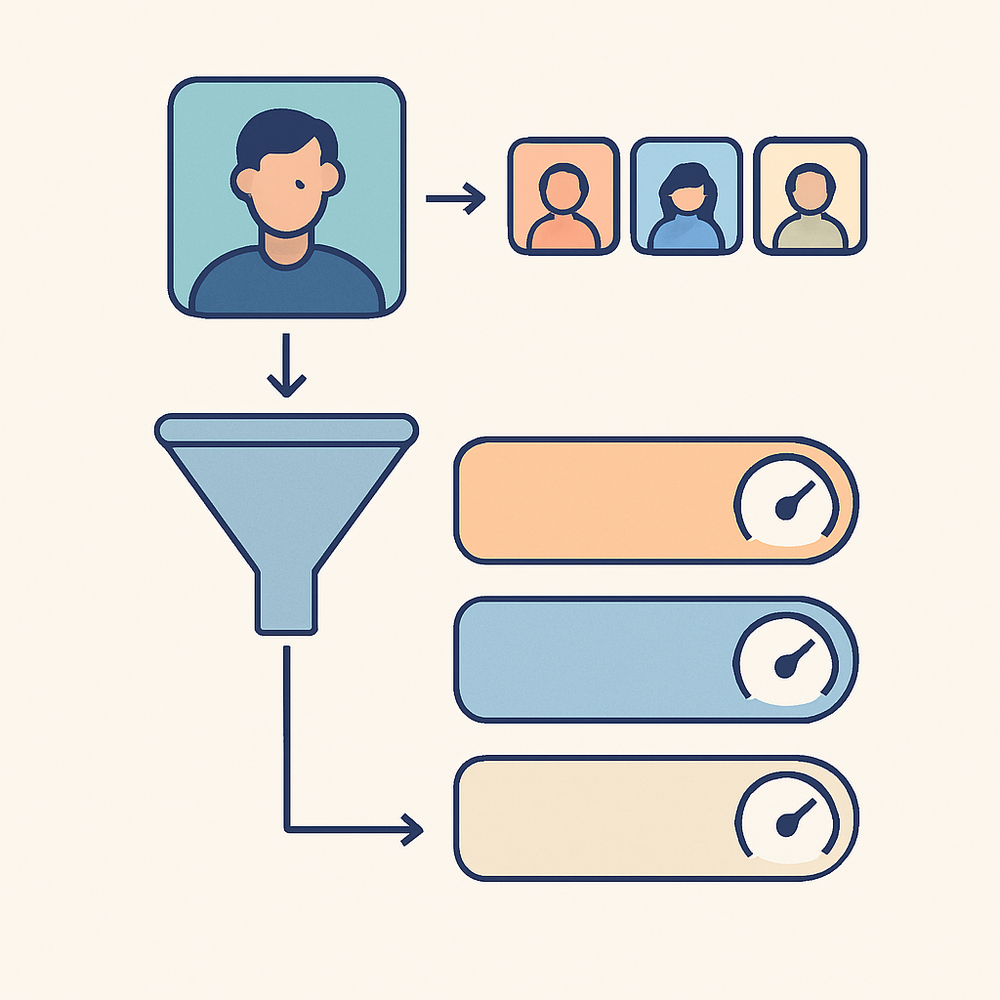
Latency constraints shape the entire system, since a recommendation that arrives after the page has already rendered is a recommendation nobody sees. The developers who handle this well design the feature pipeline around pre-computed embeddings and low-latency serving from the outset rather than retrofitting speed onto a batch-oriented system once it proves too slow in production.
Semantic and AI-Ready Search
On-site search has quietly become two separate problems. The first is a shopper typing into a search box and expecting results that understand intent, not just keyword overlap, which is a retrieval problem solved with embedding-based semantic search rather than traditional text matching. The second is external: AI shopping surfaces including ChatGPT Shopping, Perplexity, and Google's AI shopping experiences, draw from the same overlapping product-attribute requirements, so making a catalogue machine-readable functions as a single investment across both. This is squarely why ecommerce teams hire an NLP developer for search and catalogue work specifically, since the underlying task is structured information extraction and retrieval rather than a general machine learning hire's usual territory.
The dominant failure mode is a catalogue with thin or inconsistent attribute coverage, which undermines both on-site semantic search and external AI-surface visibility simultaneously. Merchants who treat attribute enrichment as a one-time content project rather than an ongoing pipeline typically watch search quality degrade again within a season as new products outpace manual tagging.
Where Generative AI Fits: Content and Product Discovery
Recommendation engines decide what to show; generative AI increasingly decides how to describe it, generating product descriptions, personalised email content and merchandising copy at a volume no content team can match manually. This needs a developer who understands retrieval grounding against the live product catalogue and brand voice consistency at scale, which is a different skill set from the ranking-model work in the recommendation track, and it is why ecommerce teams bring in generative AI development services specifically for the content and discovery layer.
The failure mode to design against is generative content drifting from the actual catalogue, price, or availability, which erodes shopper trust faster than no personalisation at all. Grounding every generated claim in live product data, rather than the language model's general knowledge, is the difference between a system that scales content production and one that quietly manufactures product misinformation.
Agentic Commerce: Discovery and Checkout Assistance
Shopify projects roughly 33 percent of online retailers will use advanced AI agents by 2028, up from under 1 percent at the start of this decade, and Morgan Stanley projects agentic AI could influence up to 385 billion US dollars of US ecommerce by 2030. The current generation of shopping agents browses, compares and increasingly initiates checkout on a shopper's behalf across surfaces such as ChatGPT Shopping and Perplexity's Buy with Pro, which means merchants now need to think about being discoverable and transactable by an agent, not only by a human visitor. Building for this is AI agent development services work rather than a search or content project.
Trust remains the binding constraint on how fast this moves. Only 14 percent of consumers currently trust AI for autonomous purchasing even though 73 percent use AI somewhere in their shopping journey, and roughly half of US consumers say they prefer brands that avoid generative AI in customer-facing messages. The practical implication is that agentic commerce infrastructure is worth building now, feed quality, structured checkout data, clear escalation paths, even though full autonomous purchasing adoption on the consumer side is still catching up to the infrastructure.
|
Track |
Core Technique |
Common Tools |
Typical Signal |
|---|---|---|---|
|
Personalization and Recommendations |
Ranking on real-time session and purchase context |
Embedding retrieval, gradient boosting, collaborative filtering |
25 to 35 percent of ecommerce revenue attributed to recommendations |
|
Semantic and AI-Ready Search |
Embedding-based retrieval plus structured product attributes |
Vector search, entity extraction, schema markup |
Higher conversion from AI-referred and AI-search traffic |
|
Agentic Commerce |
Autonomous product discovery and checkout assistance |
Tool-calling agents, structured product feeds |
Early but rapidly growing share of transaction volume |
The Interview and Vetting Process
A candidate's recommendation demo built on a public dataset such as MovieLens reveals little about whether they can handle a merchant's actual constraints: sparse purchase histories, a catalogue that changes weekly, and gift-purchase behaviour that breaks the assumption a shopper is buying for themselves. A stronger technical round asks the candidate to design explicitly for cold start, explain how they would evaluate a ranking model against an offline metric that correlates with real revenue rather than accuracy alone, and describe how they would monitor a semantic search system's relevance as the catalogue evolves. The blog's ML interview questions post is a solid starting checklist before layering ecommerce-specific scenarios on top.
Portfolio review deserves particular scrutiny for the generative content and agentic commerce tracks, since both are easy to demo impressively on a handful of curated examples and hard to verify at catalogue scale. Ask specifically how a candidate validated output across an entire product range rather than a favourable sample, and how they would catch a generated description or agent response that drifted from the actual product data.
Hire Ecommerce AI Developers
Expert ecommerce AI solutions with a free proof-of-concept scoping session
Get Free POC ScopingCost and Engagement Models
Cost tracks the same drivers across all three tracks: how much clean historical session, purchase and catalogue data already exists, how tight the latency requirement is, and how many systems the model needs to integrate with. A personalisation prototype on an existing customer data platform is a smaller engagement than a semantic search rebuild spanning catalogue enrichment, embedding infrastructure and a new retrieval index. For a fuller breakdown of how pricing shifts by project type, the ML consultant cost post covers the ranges in detail.
Most merchants are better served starting with a freelance specialist scoped to one track than committing to a broad platform contract before proving value on a single measurable metric, conversion rate, average order value or search relevance. The why startups hire freelance post covers the same reasoning that applies to an ecommerce team running its first AI project rather than a full platform migration.
Where Ecommerce AI Hiring Actually Pays Off
The merchants seeing the strongest returns are matching a specialist to each track rather than asking one generalist to own personalisation, search and agentic commerce simultaneously. A personalisation hire who has never handled cold start, a search hire unfamiliar with catalogue attribute drift, or a generative content system with no grounding check will each cost more in rework than a properly scoped interview process saves in time.
If you are ready to scope a personalisation, recommendation or search project, hire an AI developer for ecommerce who has already built for these specific constraints, sparse data, shifting catalogues, and the growing share of traffic arriving from AI surfaces rather than a search engine result page.
Frequently asked questions
What does an AI developer for ecommerce actually build?
Personalization vs recommendation engines: what is the hiring difference?
Do we need to prepare for AI shopping agents right now?
What should a technical interview for a semantic search hire include?
What determines the cost of an ecommerce personalisation or search build?
Should generative AI write our product descriptions without human review?



Shreyans Padmani
Shreyans Padmani has 5+ years of experience leading innovative software solutions, specializing in AI, LLMs, RAG, and strategic application development. He transforms emerging technologies into scalable, high-performance systems, combining strong technical expertise with business-focused execution to deliver impactful digital solutions.