Most production-grade computer vision projects land between 50,000 and 250,000 US dollars, per Azilen's 2026 cost guide, while a basic pretrained-model deployment can start under 60,000 and an enterprise defect-detection system with proprietary training data and edge deployment can exceed 500,000, according to Halkwinds' 2026 enterprise pricing breakdown. The gap between those numbers is rarely the model itself.
Six specific decisions, made early and often without full information, explain almost all of that spread. Understanding them before scoping computer vision development work is what keeps a quote honest instead of quietly expanding once development starts. For a wider view of where computer vision pays off fastest by sector, the computer vision ROI by industry breakdown is a useful companion to this one.
1. Data Annotation and Labelling Volume

Labelling is consistently the single largest line item in a computer vision budget, running 30 to 50 percent of total project spend according to Halkwinds' 2026 pricing data. Simple image classification runs 0.05 to 0.10 US dollars per image, bounding box labelling 0.15 to 0.50, and segmentation masks 0.50 to 2.00, with video annotation costing two to five times the equivalent image rate per frame.
A dataset of 100,000 or more images can require 30,000 to 100,000 US dollars in annotation alone, and medical or other technical domains that need expert annotators see rates increase three to eight times over general-purpose labelling. Businesses that assume annotation is a rounding error on top of the model-building cost are the ones most likely to see their quote double once the labelling scope is actually defined.
2. Real-Time Inference vs Batch Processing
A system that scores images overnight in a batch job is a fundamentally different engineering problem from one inspecting units at production line speed. Real-time inference demands optimisation work, model quantisation, latency budgeting, hardware selection, that a batch pipeline simply does not need, and Azilen's 2026 guide names real-time inference as one of the five biggest factors affecting computer vision cost for exactly this reason.
Production defect-detection systems built for line speed routinely inspect 1,000 or more units per minute while holding accuracy well above human inspection performance, and hitting that throughput reliably is what separates a demo notebook from a system a factory can actually run a shift on.

No account-manager layer
Hire Computer Vision Experts
Optimize project costs with expert consultants, schedule a consultation
100% Upwork JSS Microsoft AI certified 5+ years shipping CV
3. Edge Deployment vs Cloud Inference
Cloud-based inference through services such as AWS Rekognition, Azure Cognitive Services or Google Cloud AI Vision keeps initial infrastructure costs lower, but it sends every frame to a remote server and pays a per-call API cost that scales with volume. Edge deployment, running the model directly on factory floors, retail cameras or autonomous systems, changes the economics entirely by introducing hardware, networking and on-device optimisation costs that a cloud-only architecture avoids, per Azilen's 2026 analysis.
Neither option is categorically cheaper. Cloud inference wins on low initial spend for low-volume use cases; edge deployment wins on long-run unit economics once volume and latency requirements make per-call cloud pricing unsustainable. The choice needs to be made against a real volume forecast, not a demo's traffic.
4. Accuracy and Precision Requirements
High-precision use cases such as facial recognition or medical imaging demand carefully labelled datasets with strict accuracy verification, per Biz4Group's 2026 analysis, and that verification cycle adds engineering time no amount of raw compute can substitute for. Using a pretrained foundation model such as YOLO, ResNet or CLIP with fine-tuning is three to five times cheaper than training a custom architecture from scratch, but specialised domains like pathology or satellite imagery require the more expensive custom route because no general-purpose foundation model covers them adequately, work that sits firmly inside machine learning development services rather than a quick API integration.
GPU training hours range from around 500 US dollars for fine-tuning a foundation model to 50,000 or more for training a large model from scratch, per Halkwinds' 2026 figures, which is why the accuracy bar a client actually needs, not the accuracy bar that sounds impressive, should be the first question in any scoping conversation.
5. System Integration Complexity
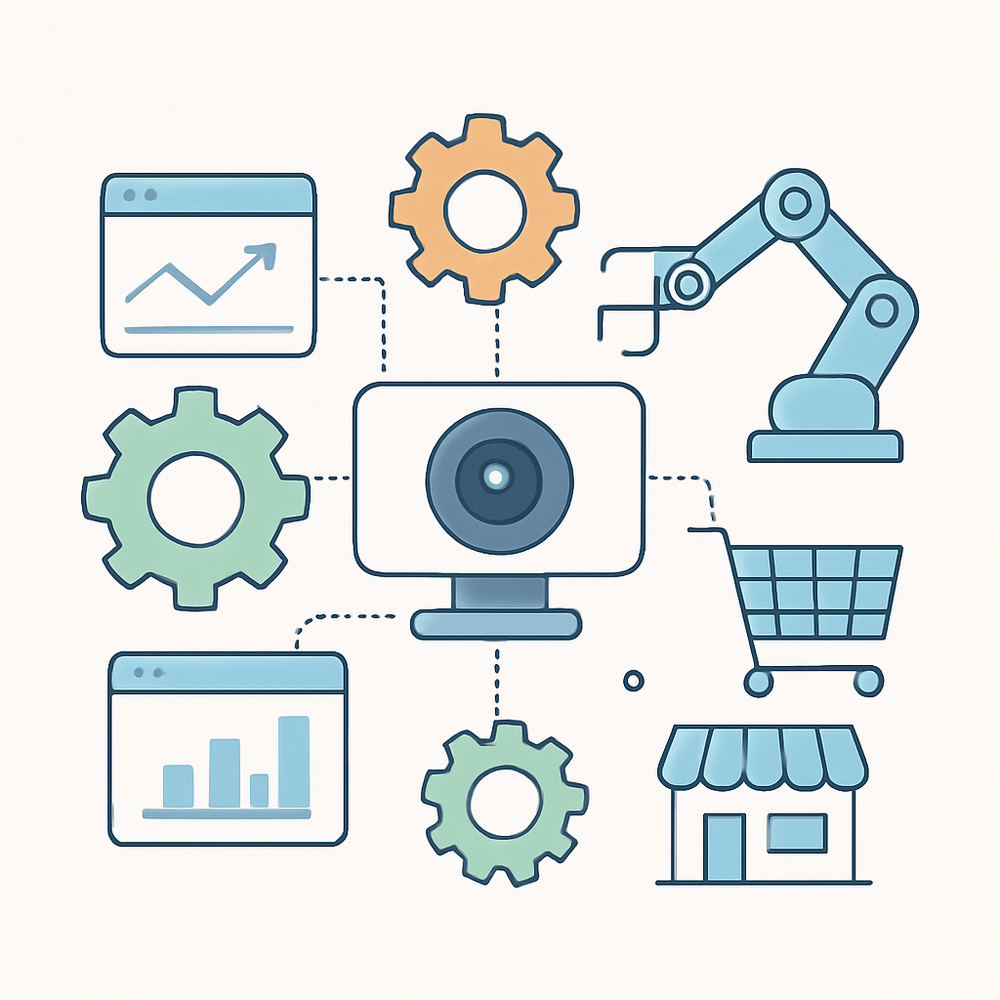
Most computer vision systems have to connect to ERPs, manufacturing execution systems, POS software or existing cloud platforms, and Azilen's 2026 guide flags integration engineering as one of the most consistently underestimated parts of the entire cost structure. A model that performs well in isolation still has to trigger a work order, update inventory, or flag a compliance record, and building those connections is often as much engineering effort as the vision model itself.
The gap between a standalone prototype and a system embedded in existing business workflows is where most fixed-bid quotes go wrong, because a proposal scoped around the model rarely accounts for the weeks of integration work that make the model actually useful on the factory floor or in the retail store.
6. Ongoing Retraining and Monitoring
A computer vision system is not a one-time build. Ongoing costs typically include GPU compute for periodic retraining, monitoring infrastructure to catch model drift, cloud storage for new training data, and security maintenance, all of which Azilen's 2026 breakdown treats as recurring costs distinct from the initial build. Poor-quality input images in production increase retraining rounds, which compounds both engineering time and infrastructure spend well after the original launch date. The training approaches by budget comparison covers how to plan for this ongoing cost rather than treating the initial deployment as the finish line.
Budgeting a maintenance and monitoring line from day one, rather than discovering it after the first drift incident, is what separates a computer vision system with a real multi-year lifespan from one that quietly degrades until someone notices the defect rate creeping back up.
Scoping the Real Cost Before It Surprises You
Every one of these six drivers is knowable before development starts, which means every one of them is avoidable as a surprise. The projects that stay on budget are the ones where annotation volume, deployment target, accuracy bar and integration scope were priced honestly from the first conversation.
Shreyans Padmani builds production computer vision systems, from defect detection to real-time inspection, scoped against the accuracy and deployment target that actually matters for the business. Hire an AI developer to get an honest cost range for your computer vision project.
Frequently asked questions
What is the biggest cost driver in a computer vision project?
How much does a typical computer vision project cost in 2026?
Is edge deployment more expensive than cloud-based computer vision?
Why does using a pretrained model reduce computer vision costs?
What ongoing costs come after a computer vision system is deployed?
Why do computer vision project quotes often exceed the original estimate?



Shreyans Padmani
Shreyans Padmani has 5+ years of experience leading innovative software solutions, specializing in AI, LLMs, RAG, and strategic application development. He transforms emerging technologies into scalable, high-performance systems, combining strong technical expertise with business-focused execution to deliver impactful digital solutions.