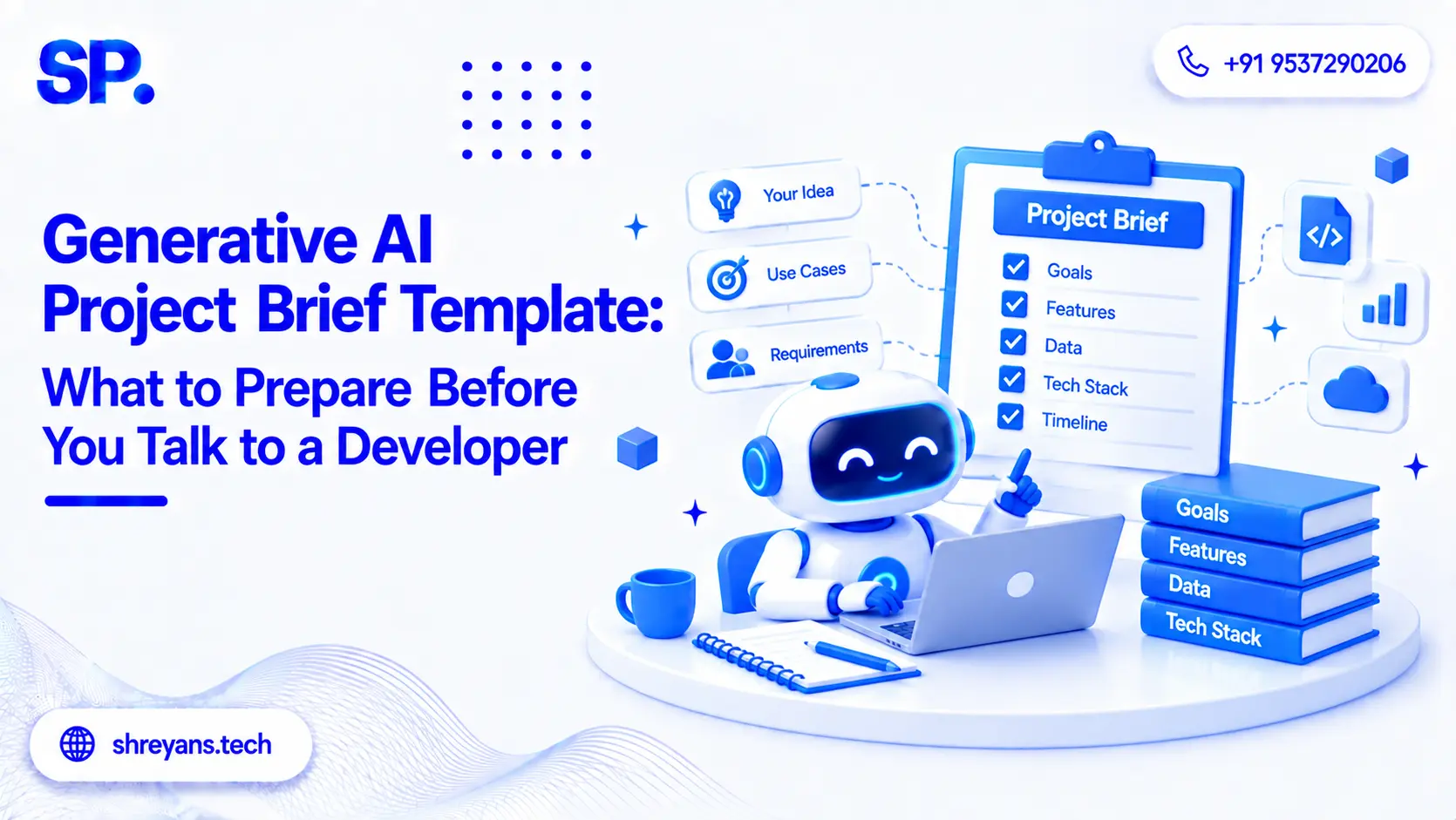
Generative AI Project Brief Template: What to Prepare Before You Talk to a Developer

McKinsey's 2024 State of AI report found that organisations with clearly defined AI project requirements before development begins are 2.4 times more likely to reach production deployment. The most common cause of AI project failure is not a weak model; it is a vague brief that forces a developer to make architectural decisions that should have been business decisions. A generative AI project that starts without defined success metrics, data inventory, and integration constraints routinely costs 40 to 60 percent more to correct than to have specified correctly from the beginning.
This template gives you every section a developer needs before work begins. It is written for founders, product managers, and technical buyers who are preparing to engage a developer for an LLM, RAG, or AI agent project. Use it to complete your brief before the first conversation. A developer receiving a well-constructed brief can scope accurately, surface blockers early, and avoid the discovery calls that stretch timelines by weeks.
Why Most AI Briefs Fail Before Development Starts
The typical AI brief a developer receives describes a desired output ("a chatbot that answers customer questions") without specifying the inputs that make that output achievable. What data does the chatbot draw from? What is the latency requirement? Who authenticates the end user? What happens when the model produces a wrong answer? These are not development decisions; they are business and product decisions that must exist in the brief before a developer can scope the work.
IBM's Institute for Business Value published research in 2025 showing that 62 percent of AI project overruns stem from underdefined requirements at the start, not from technical failure mid-build. The architectural consequences of a vague brief compound quickly: a RAG system built without a defined retrieval corpus requires a rebuild when the corpus changes. An LLM-powered workflow built without a defined fallback path fails in production the first time the model returns an unexpected response. Generative AI development services at a production level require a brief that specifies these decisions upfront.
Hire Edge Computer Vision
Section 1: Business Problem Statement (Not the AI Solution)

The first section of your brief describes the problem you are solving, not the technology you want to use. "We want to build a RAG chatbot" is not a problem statement. "Our support team spends 18 hours per week answering questions that are already answered in our product documentation, and first response time is 4.2 hours" is a problem statement. The developer needs the business pain to make sensible architectural choices.
Include: the workflow that is currently broken or slow, who is affected and how frequently, the measurable cost of the current state (time, money, error rate), and why the timing for an AI solution is right now. If a regulatory change, a competitive shift, or a new data asset is the trigger, say so. That context shapes the architecture, the urgency, and the acceptable risk level of the approach.
Developers who receive a problem statement rather than a solution prescription can propose alternatives you have not considered. A workflow automation that seemed to require a fine-tuned model may be solvable with a well-designed RAG pipeline at a fraction of the cost. That option only surfaces if the brief describes the problem.
Section 2: Data Inventory and Access
Every generative AI system either retrieves from data at runtime (RAG, tool call) or was trained on data before deployment (fine-tuning, pre-training). Your brief needs to specify what data exists, in what format, in what volume, and under what access conditions. A developer who does not have this information cannot produce an accurate scope.
For RAG systems: list every document source (PDFs, database tables, wikis, ticketing systems), its approximate size, its update frequency, and whether a developer can access it during build. For fine-tuning projects: specify the training corpus (labelled examples, logs, structured outputs), its volume in rows or tokens, and whether it has been reviewed for quality. For custom AI model training engagements, data quality is the primary cost driver, and a brief that cannot describe the training corpus will result in a scoping estimate with a wide, unreliable range.
Include data sensitivity. If any source contains personally identifiable information, protected health information, or regulated financial data, say so. This determines whether the system can use a third-party hosted model (OpenAI, Anthropic) or requires a self-hosted or private-cloud deployment.
Hire Edge Computer Vision
Section 3: Success Metrics and Acceptance Criteria
A generative AI project with no defined success metric cannot be completed. "It should work well" is not an acceptance criterion. Your brief needs a quantified target and a baseline to measure against. The baseline is the current state performance: current error rate, current processing time, current cost per transaction.
Concrete success metrics by project type: for a RAG-powered support chatbot, precision at k (the percentage of retrieved chunks that are relevant) and deflection rate (the percentage of queries resolved without human escalation); for a document extraction pipeline, field-level accuracy against a labelled test set (e.g. 97 percent on invoice line items); for an AI agent, task completion rate and average steps to completion versus a human baseline. These targets drive evaluation design, which determines the test set the developer builds before a single line of production code is written.
If you cannot define the success metric before the project starts, the first milestone of the project should be a discovery sprint to establish one. Do not proceed to architecture or build without it.
Section 4: Integration Points and Architecture Constraints
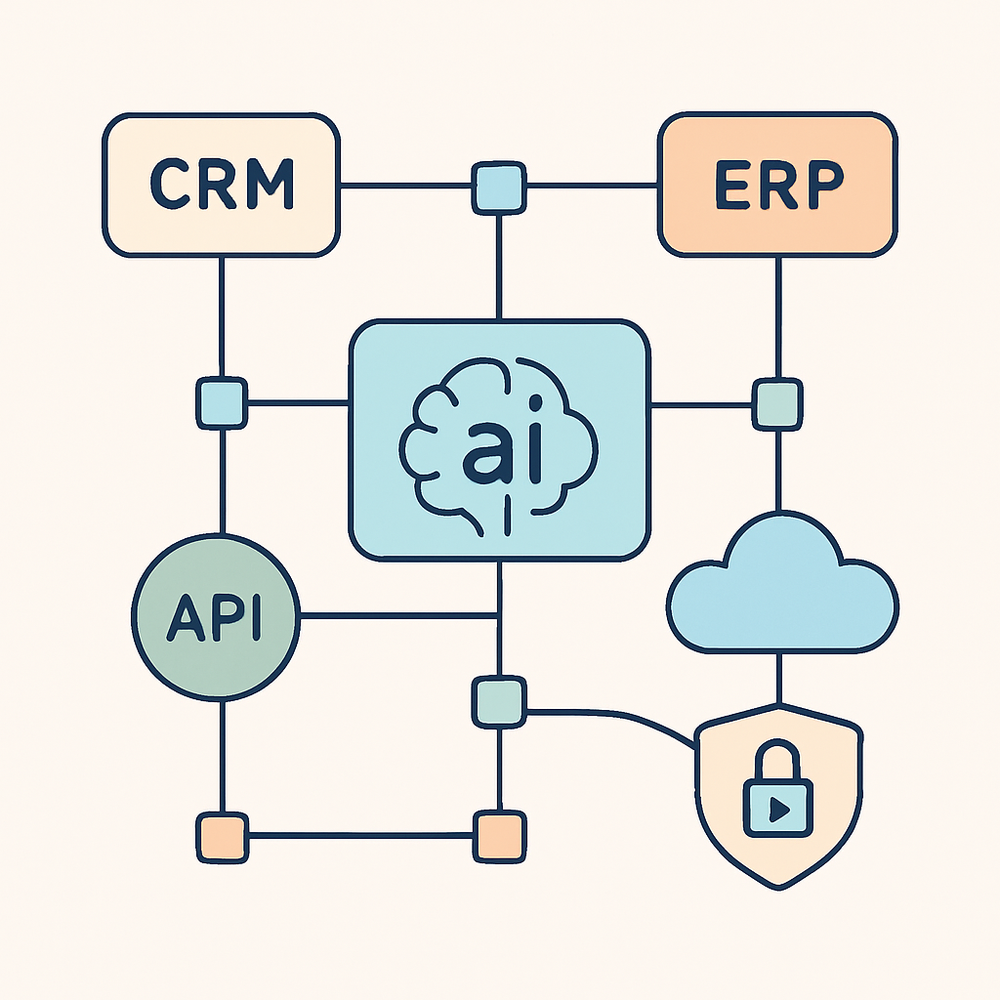
Generative AI systems do not exist in isolation. They connect to CRMs, ERPs, document stores, authentication providers, and user interfaces. Every integration point is a dependency that affects timeline, latency, and cost. Your brief should list every system the AI component must read from or write to, the API or access method for each, and whether that access already exists or must be built.
For agentic architectures, where the AI must take actions (send emails, update records, call external APIs), the scope of permitted actions must be explicit. A developer building AI agent development services for a production environment needs to know the permission boundary before designing the tool manifest. Agents built without a defined permission boundary in the brief routinely require architectural rework when the security review happens before go-live. For a deeper look at what agent scoping requires, the AI agent hiring guide covers the brief-to-build sequence for agent projects specifically.
Include the deployment target: cloud provider preference (AWS, Azure, GCP), containerisation requirements (Docker, Kubernetes), and whether the system must run on-premise or in a private cloud. These constraints can eliminate entire classes of models or hosting options and should not be discovered mid-build.
Section 5: Regulatory and Compliance Requirements
The EU AI Act, which came into force progressively through 2024 and 2025, classifies AI systems by risk level and imposes documentation, transparency, and human oversight requirements on high-risk applications. Healthcare AI in the United States is subject to HIPAA, which restricts what data can be sent to third-party APIs. Financial AI in the United Kingdom is subject to FCA guidance on model explainability and audit trails. Your brief must state which regulatory frameworks apply.
Three questions your brief should answer: Can user queries or system inputs be logged and retained, and if so for how long? Does the model's output need to be explainable to a regulator or end user? Is there a human-in-the-loop requirement for high-stakes decisions? A developer who does not know the answers to these questions before architecture begins will make choices (cloud hosting, model selection, logging infrastructure) that require expensive reversal.
Hire Edge Computer Vision
Section 6: Developer Selection Context

The final section of your brief helps you select the right developer for the project. Include your preferred engagement model (fixed-price milestone, time and materials, retainer), your expected timeline, the availability window for stakeholder reviews, and any specific technical constraints (preferred programming language, existing tech stack the developer must interface with).
Before handing over the brief, review the developer's relevant production experience. The questions to ask before hiring a generative AI developer covers the vetting layer that complements a well-prepared brief. If reviewing a developer's portfolio alongside the brief, the Gen AI portfolio red flags guide identifies the difference between a production track record and a demos portfolio.
Brief Sections at a Glance
|
Brief Section |
What to Include |
What It Unlocks |
|
Business problem |
The specific pain point, not the AI solution |
Why the system exists |
|
Success metric |
Quantified target with a baseline |
How completion is measured |
|
Data inventory |
Source, format, volume, access method |
Whether training or RAG is feasible |
|
Integration points |
Systems the AI must connect to |
Scope and latency constraints |
|
User or caller |
Who or what invokes the system |
UI, API, or agent architecture |
|
Regulatory constraints |
GDPR, HIPAA, EU AI Act exposure |
Data handling and audit requirements |
|
Timeline and budget |
Deadline and cost ceiling |
Phasing and trade-off decisions |
Where Strong Projects Begin
Every production AI project that has delivered measurable results started with someone writing down the problem clearly before writing code. The template above is not bureaucracy; it is the information a developer needs to build the right thing at the right cost in the right timeframe. Skip any section and you create a gap that the developer will fill with an assumption, and that assumption will eventually need to be corrected.
If you are ready to share a completed brief and explore what a well-scoped generative AI project looks like in practice, the next step is to hire an AI developer with production experience across RAG systems, LLM workflows, and agentic architectures. Bring the brief; the build follows from there.
Hire Edge Computer Vision
Frequently asked questions
How long should a generative AI project brief be?
Do I need to know which model I want before writing the brief?
What happens if my data is not ready when I engage a developer?
Should the brief describe the UI or just the AI component?
What regulatory frameworks apply to most generative AI projects in 2026?
Can I send this brief template directly to a developer?



Shreyans Padmani
Shreyans Padmani has 5+ years of experience leading innovative software solutions, specializing in AI, LLMs, RAG, and strategic application development. He transforms emerging technologies into scalable, high-performance systems, combining strong technical expertise with business-focused execution to deliver impactful digital solutions.