The AI Project Lifecycle: From Idea to Production
An unmonitored production model typically takes six to nine months to show measurable performance degradation. With monitoring in place, most drift is caught within days or weeks.
The distance between those two numbers explains most of what goes wrong in AI projects. As one 2026 analysis put it, the majority of production AI failures are not launch failures, they're lifecycle failures: models that worked perfectly on day one and silently decayed over months because nobody owned what happened next. Understanding the ai project lifecycle properly means understanding that it doesn't end where a software project would.
Why This Isn't a Software Lifecycle With Extra Steps
Traditional software is deterministic: the same input produces the same output, and once deployed the system stabilises. Code doesn't rot on its own. If nothing changes, nothing breaks.
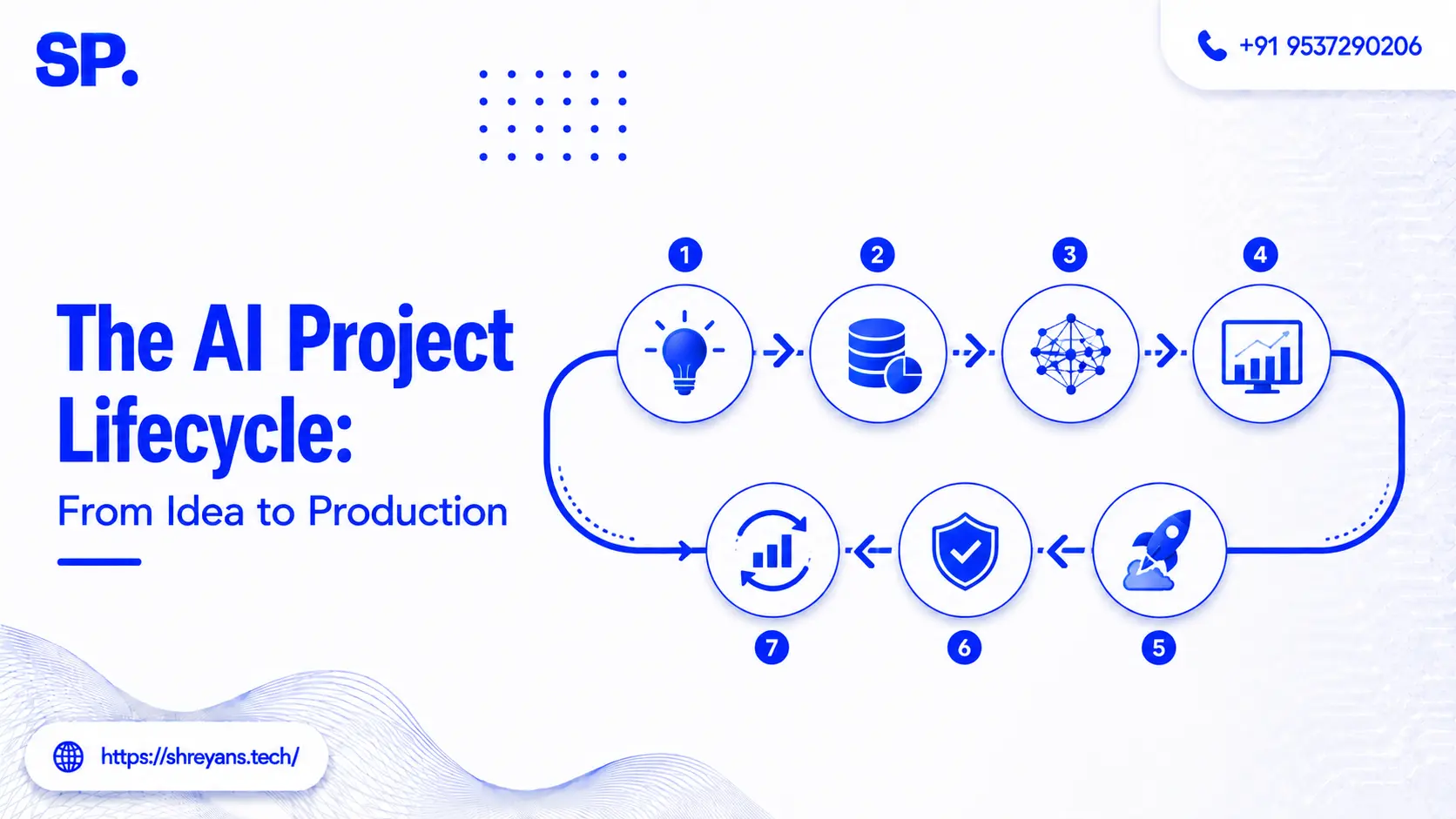
AI systems are probabilistic and they evolve with data they don't control. A model can degrade while its code stays byte-for-byte identical, because the world it was trained on moved. That single property changes the shape of the project: the lifecycle is a loop rather than a line, and deployment sits roughly in the middle of it rather than at the end.
It also changes what "done" means. Software passes or fails a test. A model meets a threshold, and choosing that threshold is a business judgement about the relative cost of different errors, not a technical fact.
Hire Edge Computer Vision
The Phases, and What They Actually Take
|
Phase |
Typical duration |
What it produces |
|---|---|---|
|
Problem definition and alignment |
2–4 weeks |
Scope document and agreed success metrics |
|
Data collection and preparation |
8–16 weeks |
Clean, labelled, accessible training data |
|
Model selection and architecture |
2–6 weeks |
An approved technical approach |
|
Training, testing, evaluation |
4–12 weeks |
A model meeting the agreed acceptance criteria |
|
Deployment and integration |
6–12 weeks |
The model running against real traffic |
|
Monitoring and retraining |
Ongoing |
Sustained performance as conditions change |
Two things stand out. Data preparation is the longest single phase and commonly consumes 60% to 80% of total project effort, which is why projects that budget for modelling and treat data work as a preliminary run out of runway before they reach the interesting part. And deployment is not a final step measured in days, it's a six-to-twelve-week phase in its own right, frequently extended by security reviews, approvals, and cross-team handoffs that nobody scheduled.
The Gate Most Teams Never Build
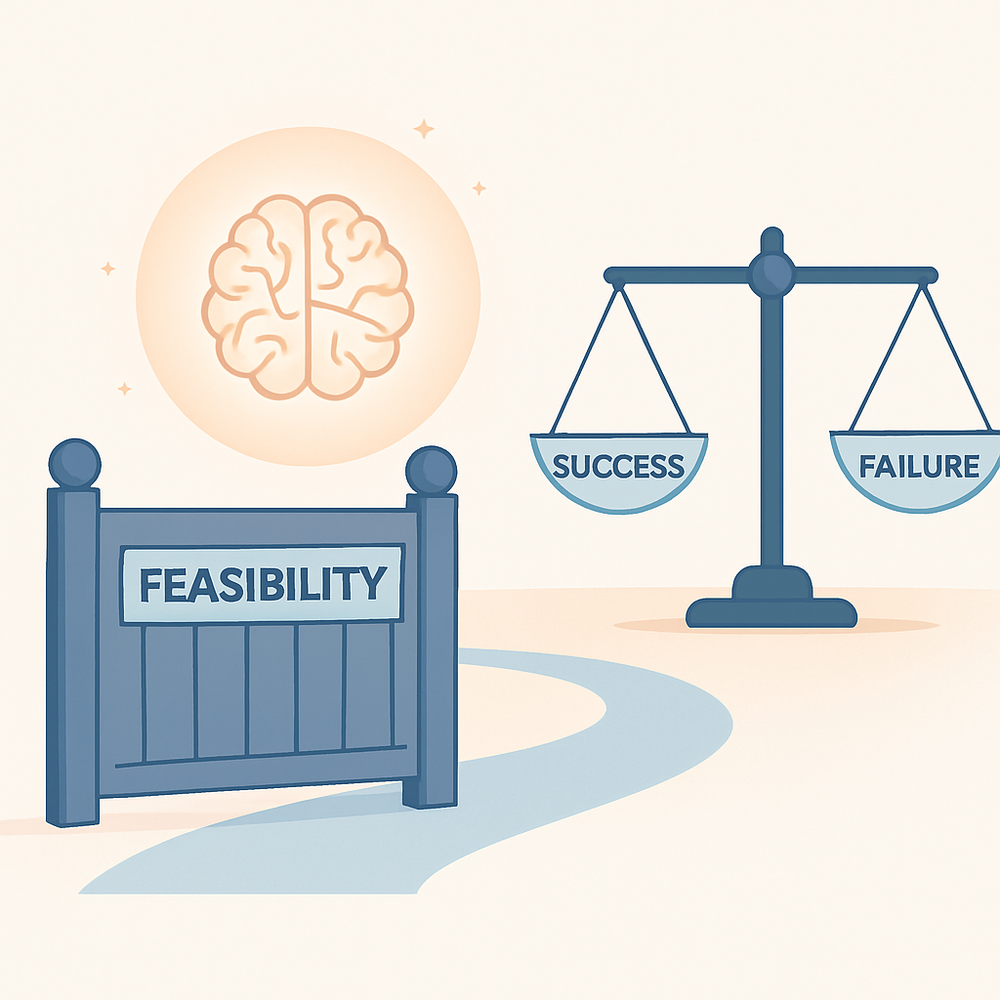
Software projects rarely need a formal mechanism for concluding the thing can't be built. AI projects do, because feasibility genuinely isn't knowable in advance: you cannot tell whether the signal exists in your data until you look.
A feasibility gate answers one question with a real number, on real data, before the full build is funded: can a model beat the current process by enough to matter? Running that as a scoped proof of concept with a pre-agreed success threshold is what converts a hopeful project into a decision. building an AI PoC covers how to structure that so it produces evidence rather than a demo.
The gate only works if failing it is an acceptable outcome. A proof of concept that cannot end the project is not a gate, it's a formality, and it converts a cheap early exit into an expensive late one.
Hire Edge Computer Vision
The Second Gate: Evaluation Before Promotion
The other checkpoint worth building deliberately sits between training and production. A mature pipeline compares any new model against the current production champion and refuses to promote a challenger that performs worse, automatically, rather than relying on someone remembering to check.
This matters more than it sounds, because retraining is not automatically improvement. A model retrained on recent data can be worse than its predecessor if that data was unrepresentative, mislabelled, or contaminated by the previous model's own outputs. Without a gate, the pipeline will cheerfully ship the regression.
Deployment Is the Middle, Not the End
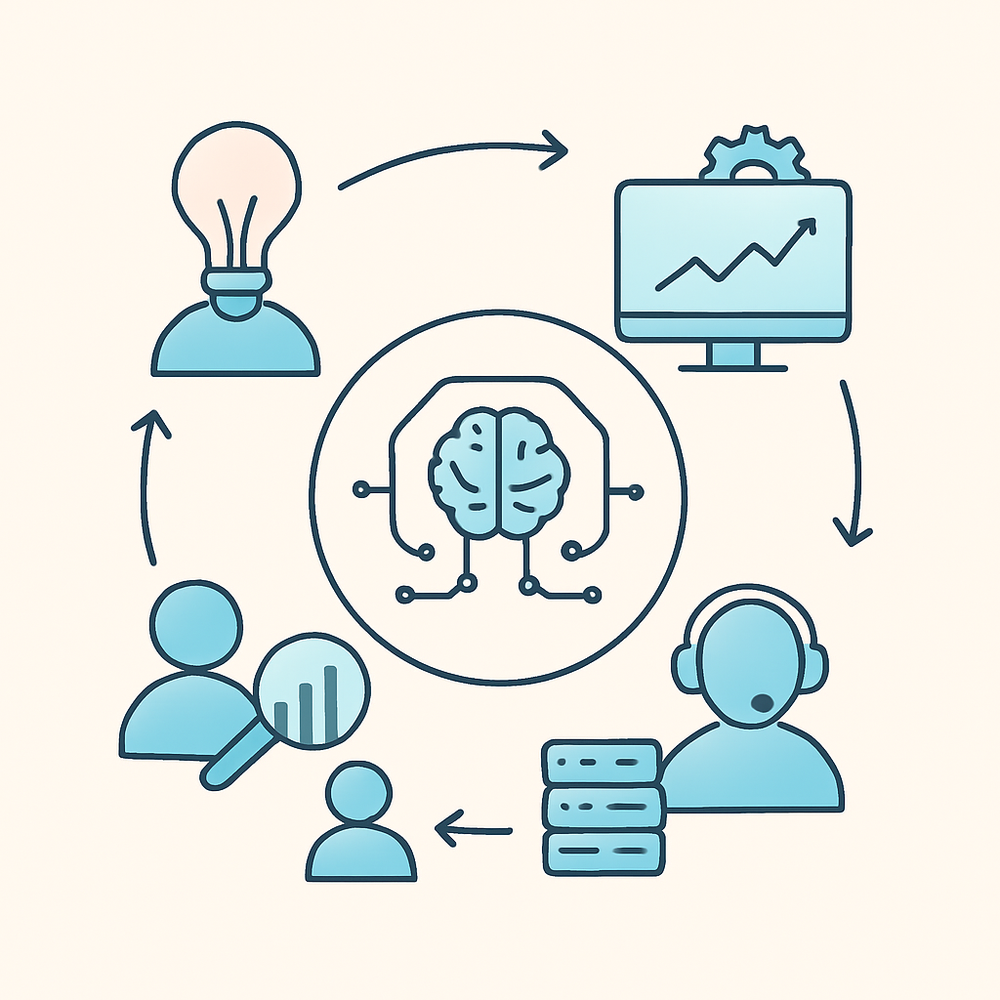
Getting a model into production is where a software project would finish. Here it's where the recurring work starts.
Enterprise LLM applications now typically refresh every three to six months. Classical models vary more, but the principle holds: a deployed model needs monitoring on prediction distributions, input feature drift, and business outcomes, with thresholds that trigger retraining rather than waiting for someone to notice. Teams running automated retraining pipelines report up to 45% less engineering time than manual retraining, which is the difference between maintenance being sustainable and being the reason nobody wants to own the model. ML web app development covers what this integration and monitoring layer looks like in a working system.
Ownership is the part that's organisational rather than technical. A model with no named owner will drift, because drift produces no alert, no error log, and no complaint until the damage is already commercial. Many teams pair internal domain ownership with external engineering capacity for the recurring work, and dedicated ML hiring covers how to structure that without paying for continuous capacity you only need periodically.
The Stage Almost Nobody Plans: Retirement
Fewer than 30% of organisations have a formal model retirement policy, and an estimated 42% of enterprise AI deployments are running past the point where they should have been retired.
Models outlive their usefulness in unglamorous ways: the business process they supported changed, a better approach superseded them, or the data source they depend on was deprecated. A model still serving predictions into a workflow nobody reviews is a quiet liability, and one that no accuracy dashboard will flag, because it may still be accurate at a task that no longer matters.
A retirement policy needs three things: a documented owner, a review cadence, and defined conditions that trigger decommissioning. It's the least interesting part of the lifecycle and one of the cheapest to put in place at the start, versus discovering during an audit that nobody knows what a production model is being used for.
Hire Edge Computer Vision
Frequently asked questions
What are the stages of the AI project lifecycle?
How is the AI project lifecycle different from software development?
Which phase of an AI project takes the longest?
How quickly does a production AI model degrade?
What is a feasibility gate and why does an AI project need one?
Do AI models need a retirement plan?



Shreyans Padmani
Shreyans Padmani has 5+ years of experience leading innovative software solutions, specializing in AI, LLMs, RAG, and strategic application development. He transforms emerging technologies into scalable, high-performance systems, combining strong technical expertise with business-focused execution to deliver impactful digital solutions.