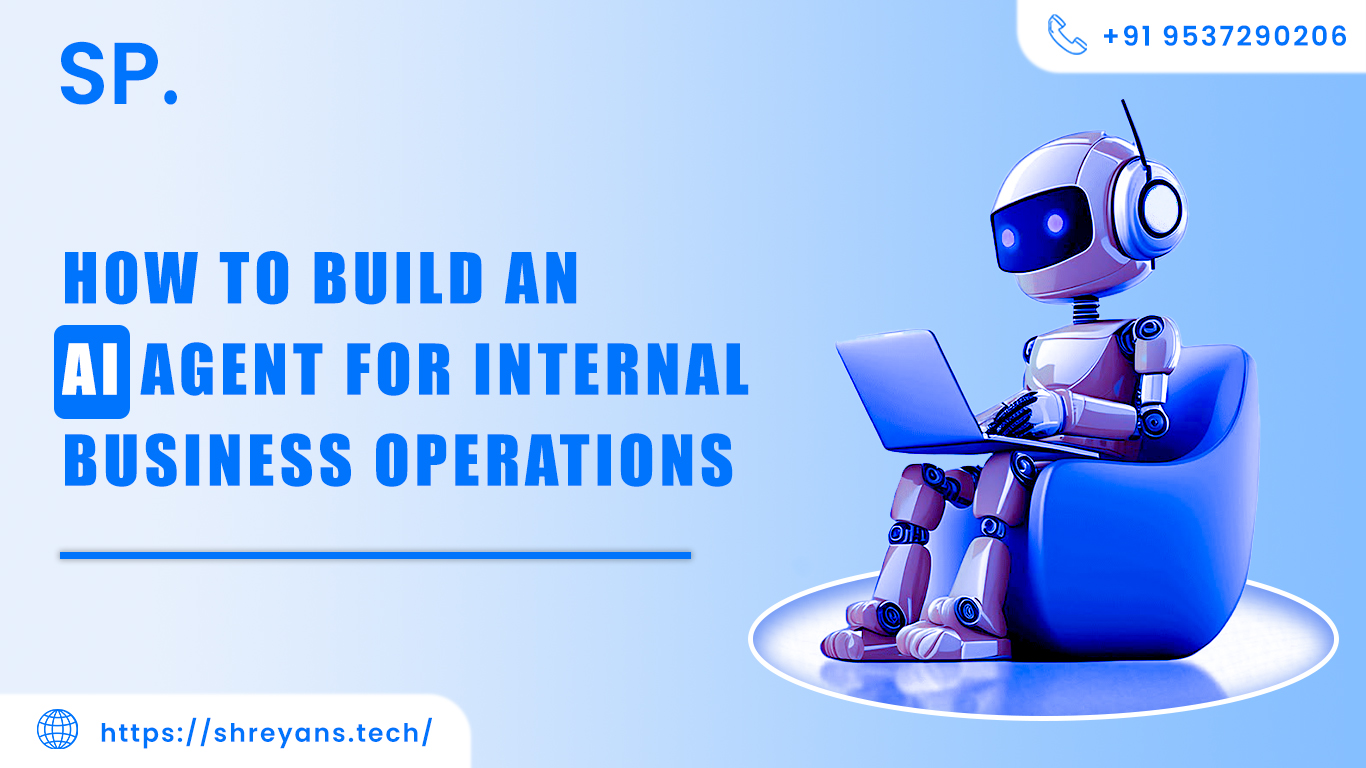
Introduction: The Rise of AI Agents in Business
In today's fast-paced business environment, operational efficiency is paramount. Companies are constantly seeking innovative ways to streamline processes, reduce manual overhead, and empower their teams to focus on strategic initiatives. This is where AI agents come into play. An AI agent is a sophisticated software entity capable of perceiving its environment, reasoning, making decisions, and taking actions autonomously to achieve specific goals.
What is an AI Agent for Internal Operations?
An AI agent for internal business operations is designed to automate, assist, and optimize various functions within an organization. Unlike general AI tools, these agents are tailored to understand internal workflows, access proprietary data, and execute tasks specific to a company's unique needs, such as managing IT tickets, automating HR onboarding, or compiling financial reports.
Why are AI Agents Essential Now?
The demand for AI agents is accelerating due to advancements in large language models (LLMs), machine learning, and automation technologies. Businesses are realizing the immense potential for productivity gains, cost reduction, and improved employee experience by delegating repetitive or complex tasks to intelligent agents, freeing up human capital for higher-value work.
Benefits of Implementing Internal AI Agents
Implementing AI agents can lead to numerous benefits, including:
- Increased Efficiency: Automate mundane tasks, reducing human error and processing times.
- Cost Savings: Lower operational expenses by optimizing resource allocation and reducing manual labor.
- Enhanced Decision-Making: Provide real-time data analysis and insights for informed strategic choices.
- Improved Employee Satisfaction: Free up employees from repetitive tasks, allowing them to focus on more engaging and critical work.
Core Concepts and Architecture of AI Agents
Building an effective AI agent requires understanding its fundamental components and architectural considerations. These agents are not monolithic systems but rather a collection of interconnected modules designed to work synergistically.
Key Components of an AI Agent
Most AI agents comprise several core components:
- Perception: The ability to gather information from the environment (e.g., internal databases, emails, system logs) using sensors or APIs.
- Cognition/Reasoning: The processing unit that interprets perceived data, understands context, and formulates a plan using AI models (like LLMs), rule engines, or machine learning algorithms.
- Action: The capability to execute tasks or make changes in the environment (e.g., sending emails, updating records, initiating workflows) through effectors or integrations.
- Memory: Storing past experiences, learned knowledge, and contextual information to improve future performance and maintain continuity.
Architectural Considerations: LLMs and Data Integration
The modern AI agent often leverages Large Language Models (LLMs) as its cognitive core, providing advanced natural language understanding and generation capabilities. The architecture typically involves:
- LLM Integration: Using APIs to connect with models like GPT-4, Llama, or custom fine-tuned models.
- Vector Databases: For efficient retrieval-augmented generation (RAG) to provide LLMs with relevant internal context.
- API Connectors: To interact with various internal systems (CRM, ERP, HRIS, project management tools).
- Orchestration Layer: A framework (e.g., LangChain, LlamaIndex) to manage the agent's workflow, tool usage, and decision-making process.
Types of AI Agents for Business
AI agents can be categorized based on their complexity and design principles:
- Reactive Agents: Simple agents that react directly to environmental stimuli based on predefined rules.
- Goal-Based Agents: Agents that aim to achieve specific goals, often involving planning and search algorithms.
- Utility-Based Agents: More sophisticated agents that strive to achieve the 'best' outcome by considering utility functions and potential consequences.
- Learning Agents: Agents that improve their performance over time by learning from experience.
Step-by-Step Guide to Building Your AI Agent
Developing an AI agent for your internal operations is a structured process that involves planning, development, testing, and deployment. Following a systematic approach ensures the agent is robust, effective, and aligns with business objectives.
1. Define the Problem and Scope
Start by identifying a specific business problem or a set of tasks that an AI agent can solve. Clearly define the agent's goals, the scope of its responsibilities, the systems it needs to interact with, and the expected outcomes. This ensures the project remains focused and delivers tangible value.
2. Choose Your Tech Stack and Tools
Select the appropriate technologies:
- Programming Language: Python is a popular choice due to its extensive AI/ML libraries.
- AI Frameworks: LangChain, LlamaIndex for agent orchestration.
- LLM Provider: OpenAI, Anthropic, Google AI, or open-source models (e.g., Llama 2).
- Database: Vector databases (e.g., Pinecone, Weaviate) for RAG, traditional databases for structured data.
- Integration Tools: APIs, webhooks, RPA tools for connecting with legacy systems.
3. Data Integration and Preparation
An AI agent is only as good as the data it accesses. Connect the agent to all necessary internal data sources (e.g., company policies, CRM data, support tickets, internal wikis). Ensure data is cleaned, preprocessed, and formatted appropriately for the agent to understand and utilize effectively. For RAG, convert relevant documents into embeddings and store them in a vector database.
4. Agent Development and Fine-tuning
Build the agent's logic, starting with its perception mechanisms (API calls, data parsing), reasoning capabilities (prompt engineering for LLMs, rule sets), and action execution (calling external tools/APIs). Iteratively test and fine-tune the agent's behavior, improving its accuracy, reliability, and efficiency. Focus on creating clear prompts, robust tool definitions, and effective error handling.
Practical Applications and Use Cases
AI agents can revolutionize various internal operations, transforming how teams work and interact with information. Here are some compelling applications:
Internal Customer Support and IT Helpdesks
An AI agent can automate the first line of support for employees, answering common questions about company policies, IT issues, or software usage. It can troubleshoot basic problems, guide users through processes, and escalate complex tickets to human agents, providing relevant context from its interaction history.
HR and Talent Management
AI agents can streamline HR processes from onboarding new hires (providing access, scheduling initial meetings, answering FAQs) to managing employee benefits inquiries, processing leave requests, and even assisting with talent acquisition by screening resumes and scheduling interviews based on specific criteria.
Financial Analysis and Reporting
For finance departments, AI agents can automate data aggregation from various financial systems, generate routine reports, identify anomalies in spending patterns, and even assist with budget forecasting by analyzing historical data and market trends. This frees up financial analysts for more strategic work.
Sales and Marketing Support
Sales teams can leverage AI agents for lead qualification, generating personalized email drafts, or updating CRM records automatically after calls. Marketing teams can use agents to analyze campaign performance data, draft content ideas, or even schedule social media posts based on engagement metrics, all within the internal ecosystem.
Challenges and Best Practices
While the potential of AI agents is vast, their implementation comes with a unique set of challenges. Addressing these proactively is crucial for successful deployment and long-term value.
Data Privacy and Security
Internal AI agents handle sensitive company data. Ensuring robust data encryption, access controls, compliance with regulations (GDPR, CCPA), and secure API integrations is paramount. Companies must implement strict data governance policies and conduct regular security audits.
Ethical Considerations and Bias
AI agents can inherit biases present in their training data, leading to unfair or discriminatory outcomes. It's essential to design agents with fairness in mind, regularly audit their decisions, and implement human-in-the-loop mechanisms for critical tasks to mitigate risks and ensure ethical operation.
Integration Complexities and Scalability
Integrating AI agents with diverse legacy systems and ensuring seamless data flow can be challenging. Plan for robust API management, error handling, and a scalable infrastructure that can accommodate increasing agent usage and data volumes. Phased rollouts can help manage complexity.
Conclusion: The Future of Internal Operations is Autonomous
The journey to building an AI agent for internal business operations is an investment in your company's future. By intelligently automating tasks, empowering employees, and fostering data-driven decision-making, these agents are set to redefine operational efficiency and unleash new levels of productivity.
Embrace Intelligent Automation
As AI technology continues to evolve, the capabilities of internal AI agents will only grow. Organizations that embrace this intelligent automation early will gain a significant competitive advantage, transforming their operational landscape from reactive to proactive, and from manual to intelligent.
Start Your AI Agent Journey Today
The path to building a successful AI agent begins with a clear vision, a structured approach, and a commitment to continuous improvement. By following the guidelines outlined in this guide, your organization can harness the power of AI to create a more efficient, productive, and future-ready internal ecosystem.
Frequently Asked Questions (FAQs)
Here are answers to some common questions about implementing AI agents for internal business operations.
Q1: What's the difference between an AI agent and a chatbot?
A chatbot typically engages in conversational interactions to answer questions or perform simple tasks. An AI agent is more autonomous, capable of complex reasoning, planning, and executing actions across multiple systems to achieve broader operational goals without constant human intervention.
Q2: How long does it take to build an AI agent?
The timeline varies significantly based on complexity, scope, and available resources. A simple agent for a specific task might take a few weeks, while a comprehensive agent integrating with multiple systems could take several months to a year or more for initial development and fine-tuning.
Q3: Do AI agents replace human jobs?
AI agents are generally designed to augment human capabilities rather than replace them. They automate repetitive, data-intensive, or mundane tasks, allowing human employees to focus on more creative, strategic, and interpersonal aspects of their roles. They transform job roles rather than eliminate them entirely.



Shreyans Padmani
Shreyans Padmani has 5+ years of experience leading innovative software solutions, specializing in AI, LLMs, RAG, and strategic application development. He transforms emerging technologies into scalable, high-performance systems, combining strong technical expertise with business-focused execution to deliver impactful digital solutions.