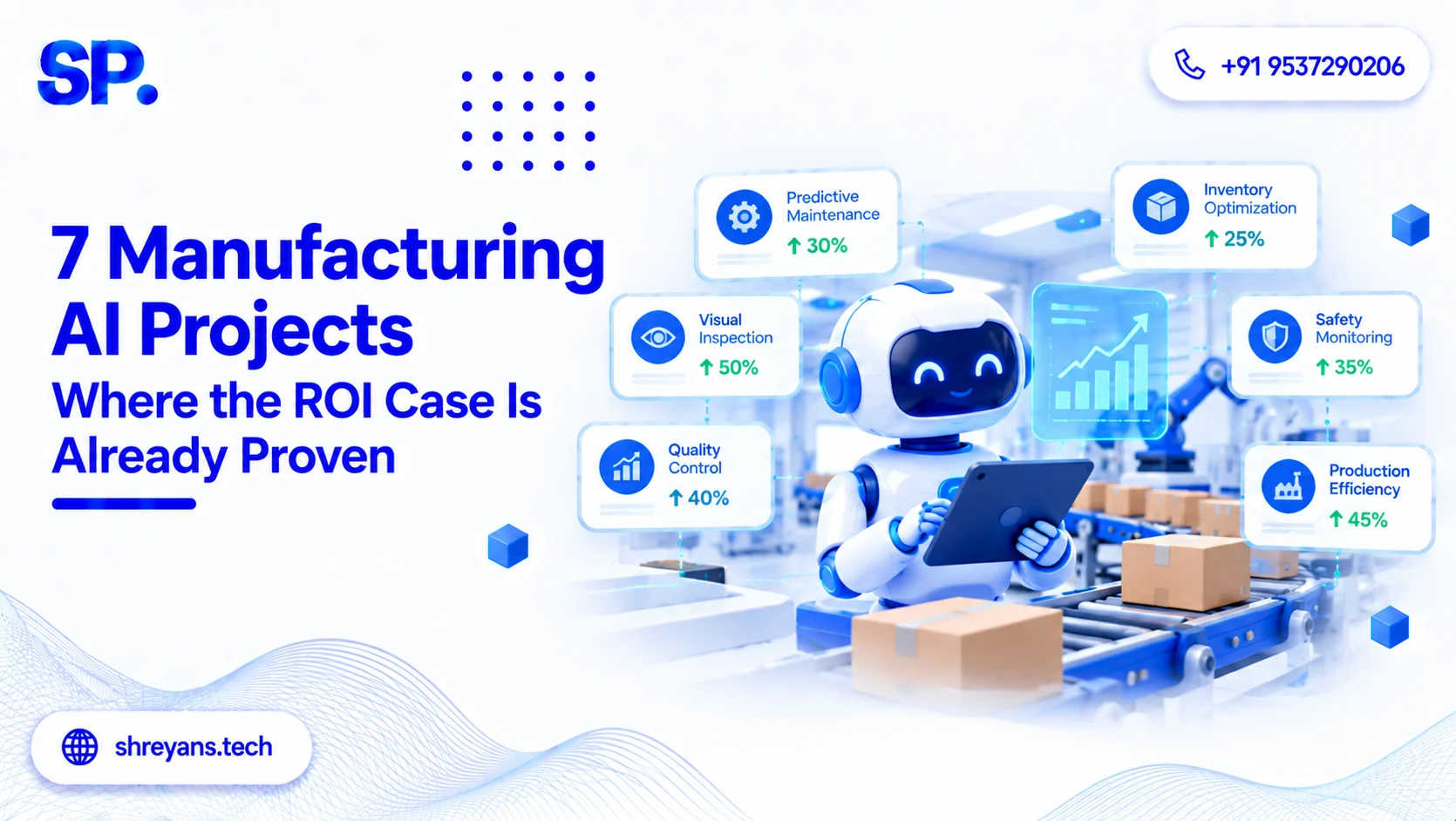
Ninety-five percent of predictive maintenance deployments achieve positive ROI, and 27 percent pay back within 12 months, according to industry benchmarks compiled across manufacturing case studies by AI Assembly Lines. Across the seven manufacturing AI use cases that consistently deliver returns, payback periods run 6 to 18 months, per Tommaso Maria Ricci's 2026 executive playbook, with several of the highest-ROI applications landing comfortably inside the first year.
Deloitte's 2025 manufacturing operations survey found 82 percent of manufacturers still rely on reactive or time-based maintenance, which means most plants adopting AI are replacing a genuinely inefficient status quo rather than making an incremental improvement on an already-optimised process. That baseline is exactly why these five projects, scoped correctly as AI development for manufacturing, show up so consistently at the top of ROI benchmarks.
1. Predictive Maintenance
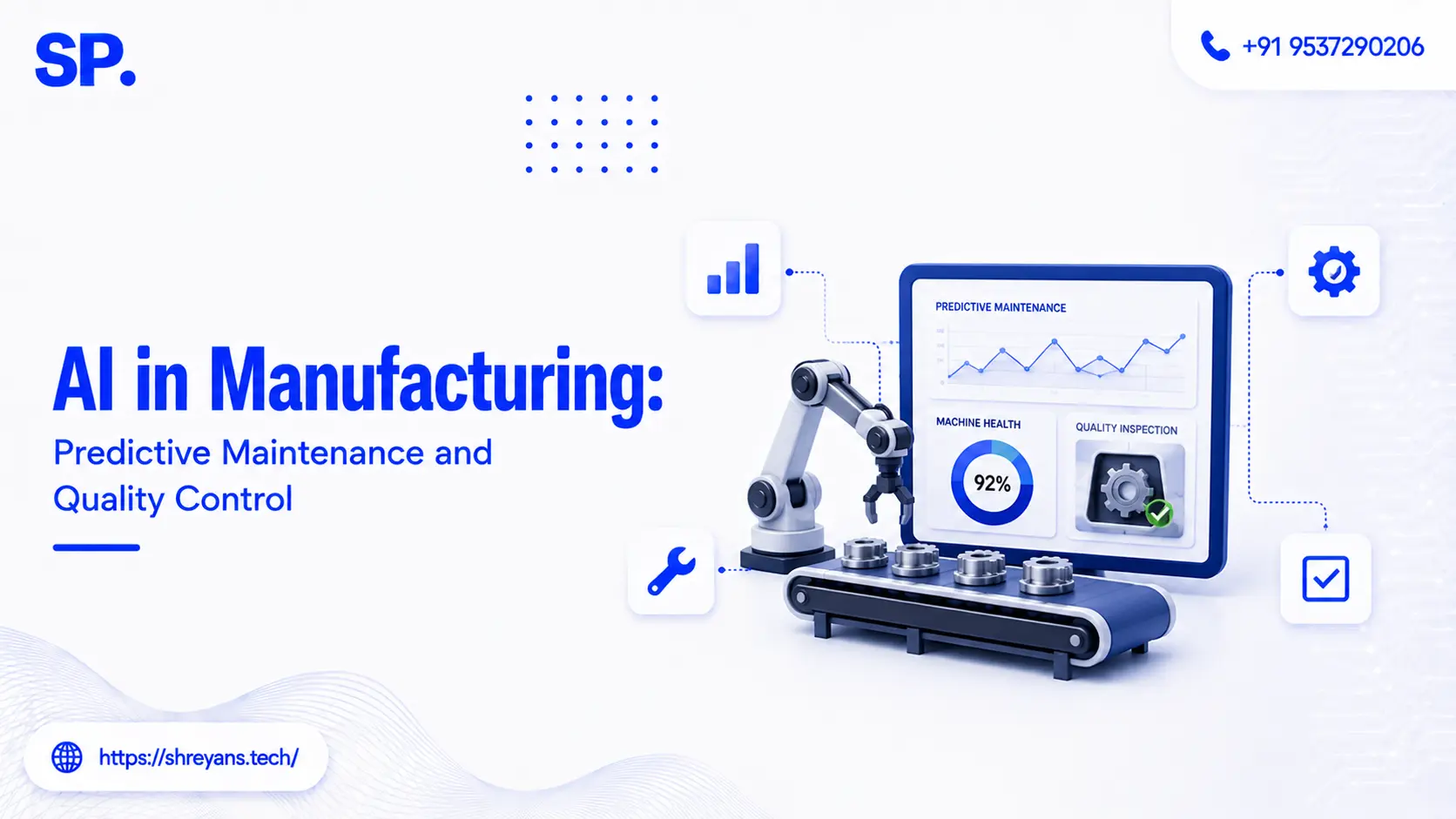
Predictive maintenance is the most deployed and most proven manufacturing AI use case globally. Machine learning models trained on vibration, temperature, current draw and acoustic sensor data predict equipment failures 48 to 72 hours before they occur, cutting unplanned downtime by 30 to 50 percent. Continental AG deployed predictive maintenance across its tyre manufacturing plants, monitoring 12,000 sensors across four facilities and processing 800 million data points daily, and reduced unplanned downtime by 37 percent in the first year, generating annual savings exceeding 8 million euros, per Continental AG's 2024 Sustainability Report.
Deloitte's analysis puts the average return at roughly 10 to 1 within two years of deployment. Three conditions predict whether a specific line will hit that number: critical equipment already carries vibration and temperature sensors or can be retrofitted affordably, there is enough historical failure data to train against, and maintenance teams actually act on the model's alerts rather than letting technically successful predictions go unused. The training approaches by budget guide covers how to scope the model-training investment against a plant's existing sensor infrastructure using machine learning development services.
2. Computer Vision Quality Inspection
AI-driven quality control can reduce manufacturing costs by up to 20 percent, per a McKinsey analysis, reflecting the compounding savings from eliminated scrap, reduced rework, lower warranty claims and faster throughput. Gartner's 2025 manufacturing benchmarks document defect-detection accuracy exceeding 98 percent in AI inspection systems, against 80 to 85 percent for manual inspection, and automated surface and dimensional inspection is consistently the highest-ROI single application, with documented three-year ROI around 374 percent and payback near seven to eight months.
AI quality inspection cuts scrap rates by roughly 30 percent, reducing both raw material waste and the labour and energy embedded in products that end up unsellable. This is computer vision development work in its purest industrial form, and the computer vision ROI by industry comparison shows how manufacturing's payback speed stacks up against retail and healthcare deployments of the same underlying technology.
3. Energy Optimisation
Energy optimisation through predictive control of energy-intensive processes and automated demand response delivers 300 to 400 percent three-year ROI, per Thinking Inc's 2026 manufacturing AI guide, making it one of the strongest returns of any manufacturing AI use case once a plant has the metering infrastructure to support it. The approach models energy consumption against production schedules and adjusts process parameters in near real time rather than relying on fixed operating schedules.
This use case sits lower on most manufacturers' priority lists than predictive maintenance or quality inspection, largely because the metering and control infrastructure prerequisite is less commonly in place, but for energy-intensive processes such as furnaces, compressors or HVAC-heavy facilities, it frequently delivers faster payback than either of the more commonly deployed use cases once that infrastructure exists.
4. Supply Chain Visibility and Risk
Demand forecasting, supplier risk monitoring and inventory optimisation together make up the supply chain visibility category, and logistics companies with AI-mature supply chains outperform peers by 23 percent on profitability, per AI Assembly Lines' 2026 industry reference. The payback timeline here runs longer than predictive maintenance or quality inspection, typically 18 to 24 months for full demand forecasting maturity, which is why most manufacturers sequence this project after the faster-payback use cases rather than starting with it.
Supplier risk monitoring alone, flagging a single-source supplier's financial distress or a geopolitical disruption before it hits the production line, often pays for itself inside a year even when the fuller demand-forecasting build takes longer, because the cost of a single missed disruption dwarfs the monitoring system's build cost. The ML consulting piece covers how manufacturers translate this kind of raw supply chain data into decisions rather than another dashboard nobody checks.
5. Engineering Productivity and Documentation
Generative AI for engineering documentation, CAD assistance and technical knowledge management is the newest of the five projects here, and Tommaso Maria Ricci's 2026 playbook places it among the seven use cases consistently delivering ROI in six to eighteen months for manufacturers with a real backlog of engineering documentation debt. Factories generate enormous volumes of specification documents, change orders and maintenance manuals, and a generative system that can answer an engineer's question against that corpus directly removes hours of searching per week.
The setup pattern that consistently works across all five of these projects is the same: pick one production line or one documented process with a known, measurable problem, deploy the AI system in 8 to 12 weeks, prove the return on that single line, then template the solution across similar lines or processes rather than attempting a facility-wide rollout on the first try.
Where Manufacturing AI Actually Pays Back
The manufacturers seeing real ROI are not the ones running the most AI pilots. They are the ones that picked one project with a documented ROI benchmark, sensor readiness and a clear payback window, proved it on a single line, and expanded from there.
Shreyans Padmani builds production predictive maintenance, computer vision inspection and supply chain AI systems for manufacturers who need a measurable return, not another pilot. Hire an AI developer to scope the first project for your plant.
Frequently asked questions
Which manufacturing AI project has the fastest ROI?
How much does predictive maintenance reduce unplanned downtime?
What conditions determine whether predictive maintenance will deliver ROI?
How accurate is AI computer vision compared with manual inspection?
Why does supply chain AI take longer to pay back than predictive maintenance?
What is the best way to start a manufacturing AI project?



Shreyans Padmani
Shreyans Padmani has 5+ years of experience leading innovative software solutions, specializing in AI, LLMs, RAG, and strategic application development. He transforms emerging technologies into scalable, high-performance systems, combining strong technical expertise with business-focused execution to deliver impactful digital solutions.