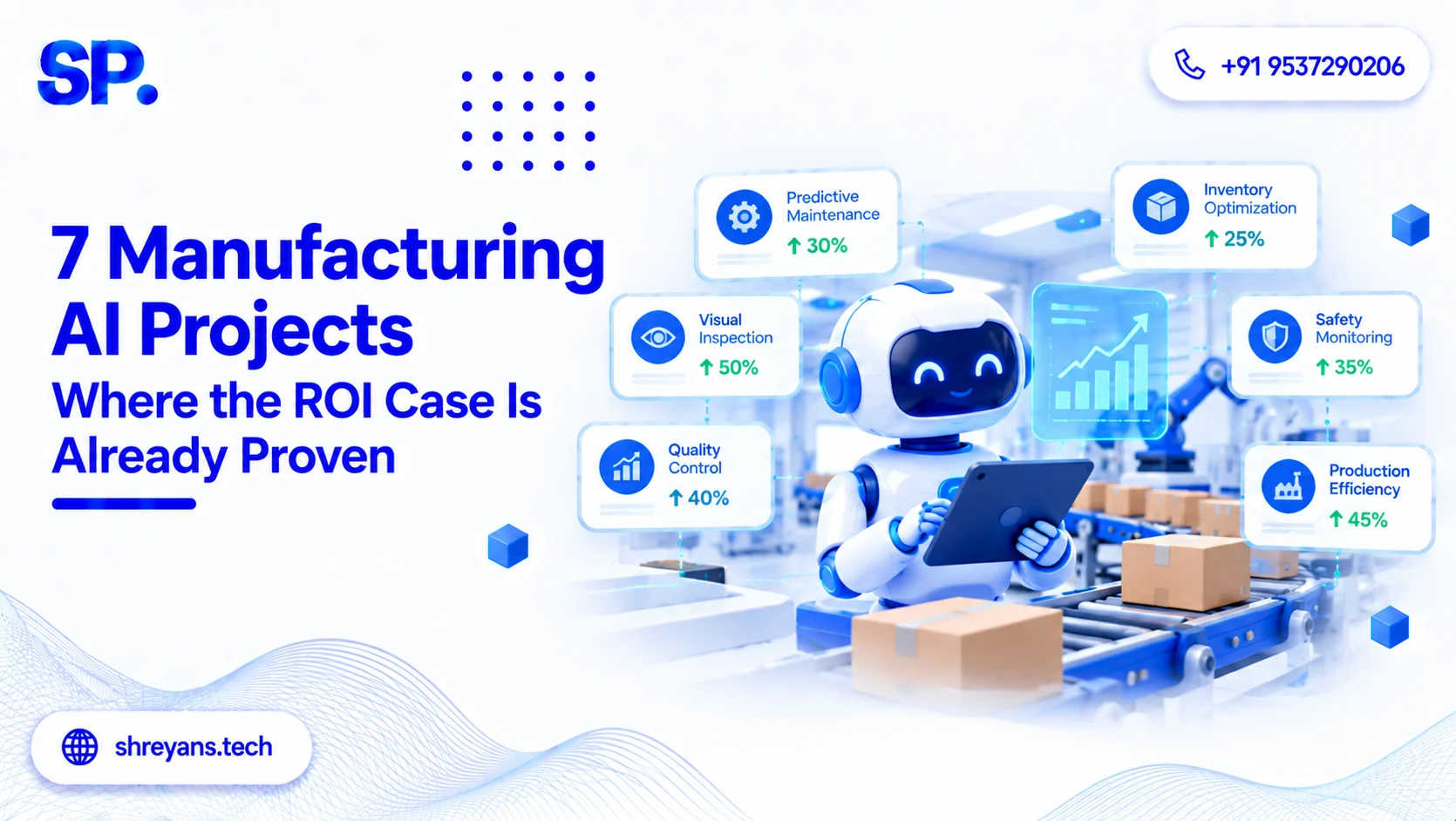
7 Manufacturing AI Projects Where the ROI Case Is Already Proven
Tech-Stack's 2026 manufacturing AI research puts hard numbers on ROI claims that used to be more marketing than substance: predictive maintenance typically generates 300 to 500 percent ROI, and full quality control AI infrastructure delivers 200 to 300 percent ROI through defect reduction and faster inspection cycles. AI Assembly Lines' 2026 benchmark guide adds context that makes this ROI easier to capture than it might sound: Deloitte's 2025 manufacturing operations survey finds 82 percent of manufacturers still rely on reactive or time-based maintenance, which means predictive maintenance AI is replacing a clearly inefficient status quo in most plants rather than improving on an already-optimised one.
The seven projects below are not exploratory pilots. They are the manufacturing AI use cases with the most consistently documented, third-party-verified ROI across 2026 research, each with named company results and payback timelines specific enough to take directly into a board conversation.
1. Predictive Maintenance
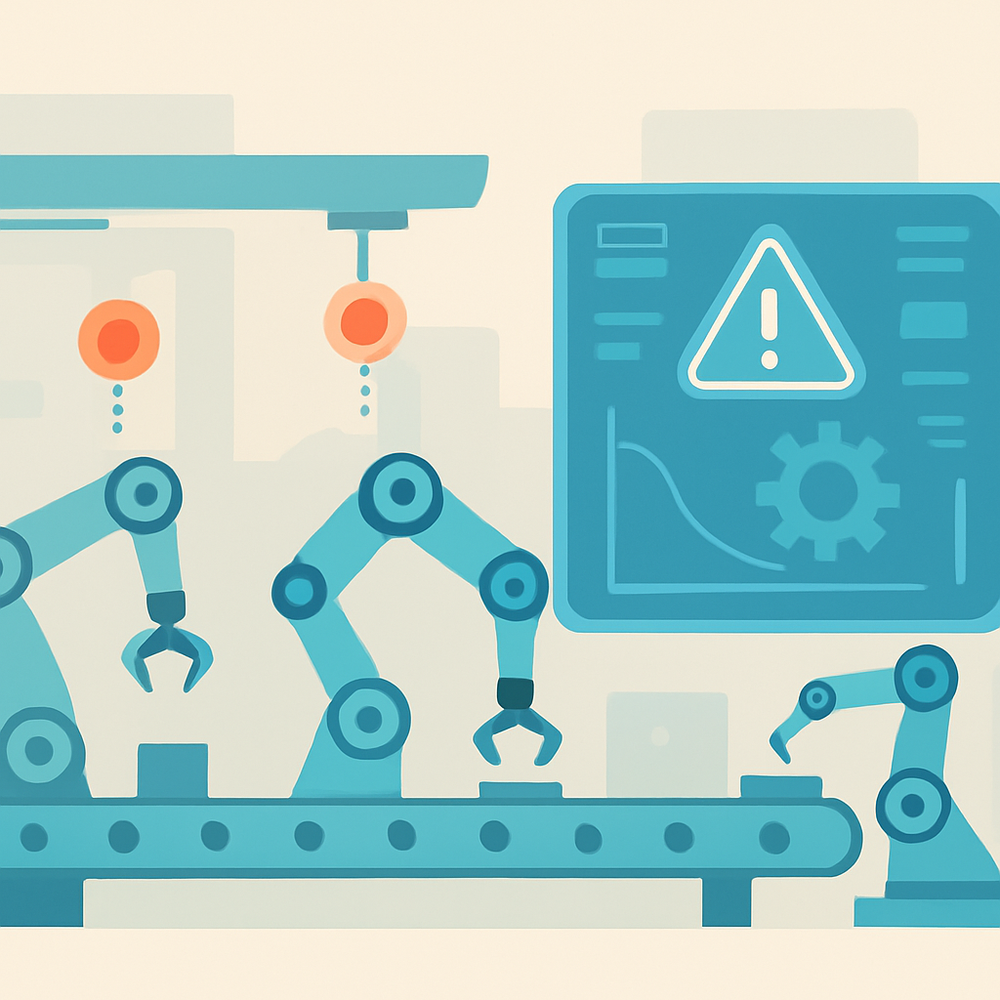
Predictive maintenance remains the most deployed and most proven manufacturing AI use case globally, and Thinking.inc's 2026 industry research puts three-year ROI at 400 to 500 percent. Continental has applied AI-driven predictive maintenance across production lines, cutting unplanned downtime by roughly a third and generating multi-million-euro annual savings, according to the same research. AI Assembly Lines' 2026 benchmark guide reports a median manufacturing enterprise sees 10:1 to 30:1 returns on predictive maintenance alone, with payback typically landing within 12 to 18 months.
The underlying models analyse vibration, temperature, current draw, and acoustic sensor data to predict equipment failures 48 to 72 hours before they occur, a data source most plants already generate but rarely act on systematically. A machine learning development services engagement scoped around existing sensor feeds is usually the fastest of the seven projects here to reach a working first version.
2. Computer Vision Quality Inspection
Quality inspection carries the strongest third-party-verified numbers of any use case on this list. AI Assembly Lines' 2026 research cites Forrester's three-year analysis across manufacturing quality control deployments documenting 374 percent average ROI with a 7 to 8 month payback period. Named results back this up directly: Siemens integrated computer vision across its electronics manufacturing lines and achieved 99.7 percent defect detection accuracy, while BMW reports 30 to 40 percent defect reduction and over 2 million US dollars in annual savings per facility. Automotive manufacturers more broadly report 60 percent reductions in warranty claims after implementing AI defect detection, with one documented case eliminating 1.8 million US dollars in warranty exposure at 99 percent-plus accuracy.
Tommaso Maria Ricci's 2026 manufacturing playbook adds operational detail worth budgeting around: manufacturers deploying vision inspection report scrap rates down 25 to 50 percent, false reject rates down 40 to 70 percent, and inspection labour freed up 60 to 80 percent on the lines where it runs. Typical investment for a mid-size deployment across 10 to 20 production lines runs 400,000 to 1.2 million US dollars, with payback in 8 to 18 months. Computer vision development work scoped to one production line first, proving ROI there before templating across similar lines, is the deployment pattern Ricci's research finds works most consistently.
Hire Edge Computer Vision
3. Energy Consumption Optimization
Thinking.inc's 2026 research places energy optimisation ROI at 300 to 400 percent, and Ifactoryapp's 2026 use case ranking reports it typically cuts utility bills 10 to 20 percent with no process changes required, since the model optimises existing equipment operation rather than requiring new hardware. A separate Ifactoryapp analysis puts the ROI signal at 12 to 22 percent energy cost reduction with a typical payback of 6 to 9 months, among the fastest paybacks of any use case covered here.
This project pairs naturally with predictive maintenance, since both draw on the same underlying sensor infrastructure, temperature, vibration, and power consumption data, which means a plant that has already instrumented equipment for one project has usually done most of the data groundwork the other needs as well.
4. Production Planning and Scheduling

Ifactoryapp's 2026 research reports machine learning schedulers optimising job sequencing, changeover sequencing, and resource allocation across multi-product lines lift Overall Equipment Effectiveness by 15 to 25 percent in documented deployments, without adding shift capacity. One automotive deployment cited in the same research documented a 22 percent OEE improvement specifically.
This use case tends to compound with the two above it: Ifactoryapp's broader research notes that use cases which connect to each other, predictive maintenance feeding scheduling decisions, quality prediction informing process control, are how AI stops functioning as an isolated cost centre and starts operating as a genuine margin engine across the plant.
5. Safety and PPE Compliance Monitoring
Ricci's 2026 manufacturing playbook lists safety equipment compliance, detecting whether workers are wearing required personal protective equipment, among the proven application areas for computer vision on the factory floor, alongside surface defect detection and assembly verification. This use case typically runs on the same camera infrastructure and model architecture already deployed for quality inspection, which lowers the marginal cost of adding it once a vision system is already in place for another purpose.
The computer vision project costs breakdown covers how safety and compliance monitoring projects typically price against other computer vision categories, since the underlying object detection task is well understood and the cost driver is usually camera coverage rather than model complexity.
Hire Edge Computer Vision
6. Demand Forecasting and Supply Chain Visibility
AI Assembly Lines' 2026 benchmark guide places demand forecasting payback at 18 to 24 months, longer than predictive maintenance or quality inspection but still well within a typical planning horizon. Ricci's playbook groups this with supplier risk monitoring and inventory optimisation under supply chain visibility and risk, since the same forecasting infrastructure that predicts demand also supports early detection of supplier disruption.
The predictive analytics projects post covers how demand forecasting, inventory optimisation, and predictive maintenance sequence together on the same underlying data infrastructure, which is worth reviewing before scoping this specific project in isolation.
7. Engineering Documentation and Knowledge Management
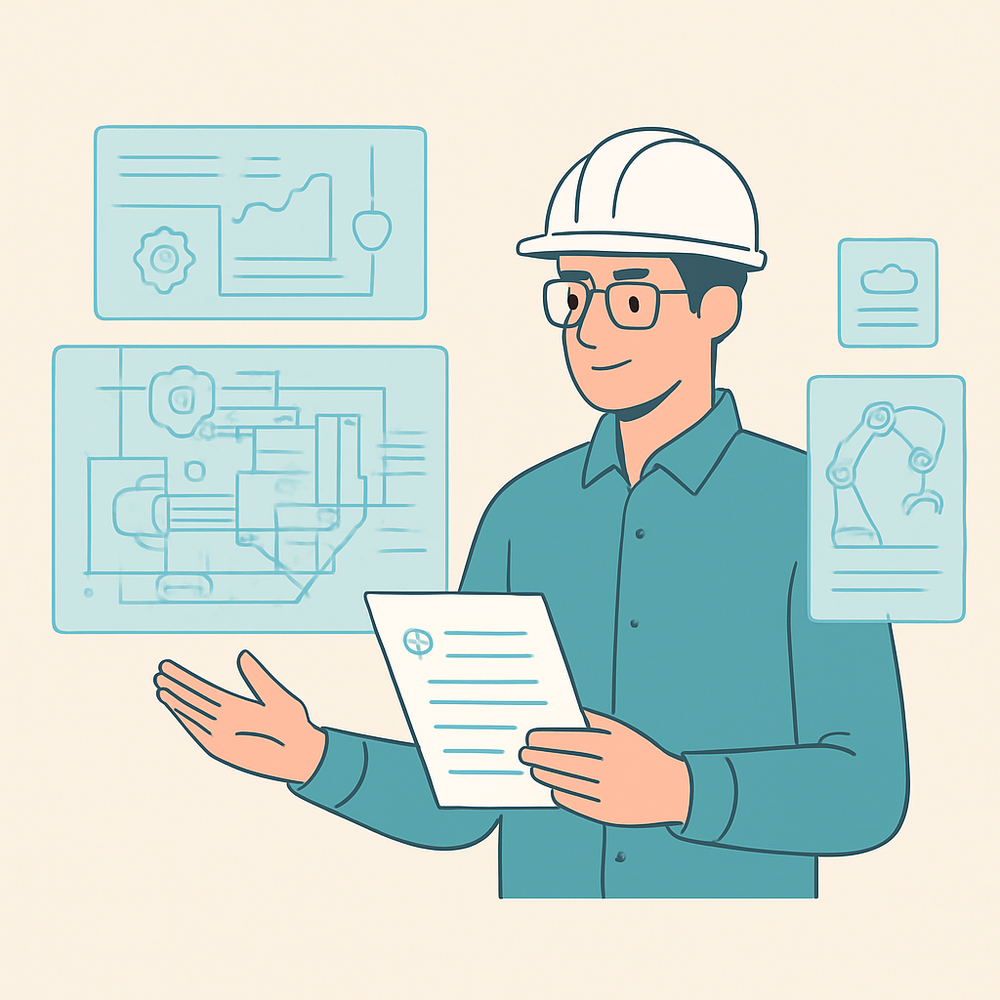
Ricci's 2026 playbook lists engineering productivity, generative AI applied to engineering documentation, CAD assistance, and knowledge management, as one of the seven manufacturing AI use cases consistently delivering ROI within 6 to 18 months, distinct from the shop-floor projects above it. This use case addresses a different cost centre entirely: engineering time spent searching for prior documentation, specifications, and design rationale rather than production-line efficiency directly.
A generative AI development services engagement built around retrieval over an engineering document archive is typically far cheaper to scope than a shop-floor project, since it needs no new hardware and draws entirely on documentation a manufacturer already has, making it a reasonable starting point for a team not yet ready to instrument physical equipment.
7 Manufacturing AI Projects: Documented ROI and Payback
|
Project |
Documented ROI |
Typical Payback |
|---|---|---|
|
Predictive maintenance |
400 to 500 percent (3-year) |
12 to 18 months |
|
Computer vision quality inspection |
374 percent average (Forrester) |
7 to 8 months |
|
Energy consumption optimization |
300 to 400 percent |
6 to 9 months |
|
Production planning and scheduling |
15 to 25 percent OEE improvement |
Compounds with maintenance and quality data |
|
Safety and PPE compliance monitoring |
Shares infrastructure with quality inspection |
Lower marginal cost if vision already deployed |
|
Demand forecasting and supply chain visibility |
Reduced stockouts and overstock |
18 to 24 months |
|
Engineering documentation and knowledge management |
6 to 18 months documented range |
No new hardware required |
Sequence, Don't Scatter, Your Manufacturing AI Investment
The manufacturers seeing the strongest documented ROI are not the ones deploying every AI use case at once. They are the ones picking two or three high-ROI projects, instrumenting the underlying data infrastructure properly, and letting the projects compound, predictive maintenance feeding scheduling, quality data informing process control, before expanding further.
The computer vision ROI by industry breakdown covers how manufacturing compares against other industries for computer vision ROI specifically. Hire an AI developer to map which of these seven projects fits your plant's current data readiness and where the fastest, best-documented return actually is.
Hire Edge Computer Vision
Frequently asked questions
Which manufacturing AI project has the fastest payback?
Is predictive maintenance still worth it if we already do scheduled maintenance?
How much does a computer vision quality inspection deployment typically cost?
Do these seven manufacturing AI projects need to be built separately?
Which manufacturing AI project needs the least new hardware investment?
What is a realistic first manufacturing AI project for a plant with no prior AI deployment?



Shreyans Padmani
Shreyans Padmani has 5+ years of experience leading innovative software solutions, specializing in AI, LLMs, RAG, and strategic application development. He transforms emerging technologies into scalable, high-performance systems, combining strong technical expertise with business-focused execution to deliver impactful digital solutions.