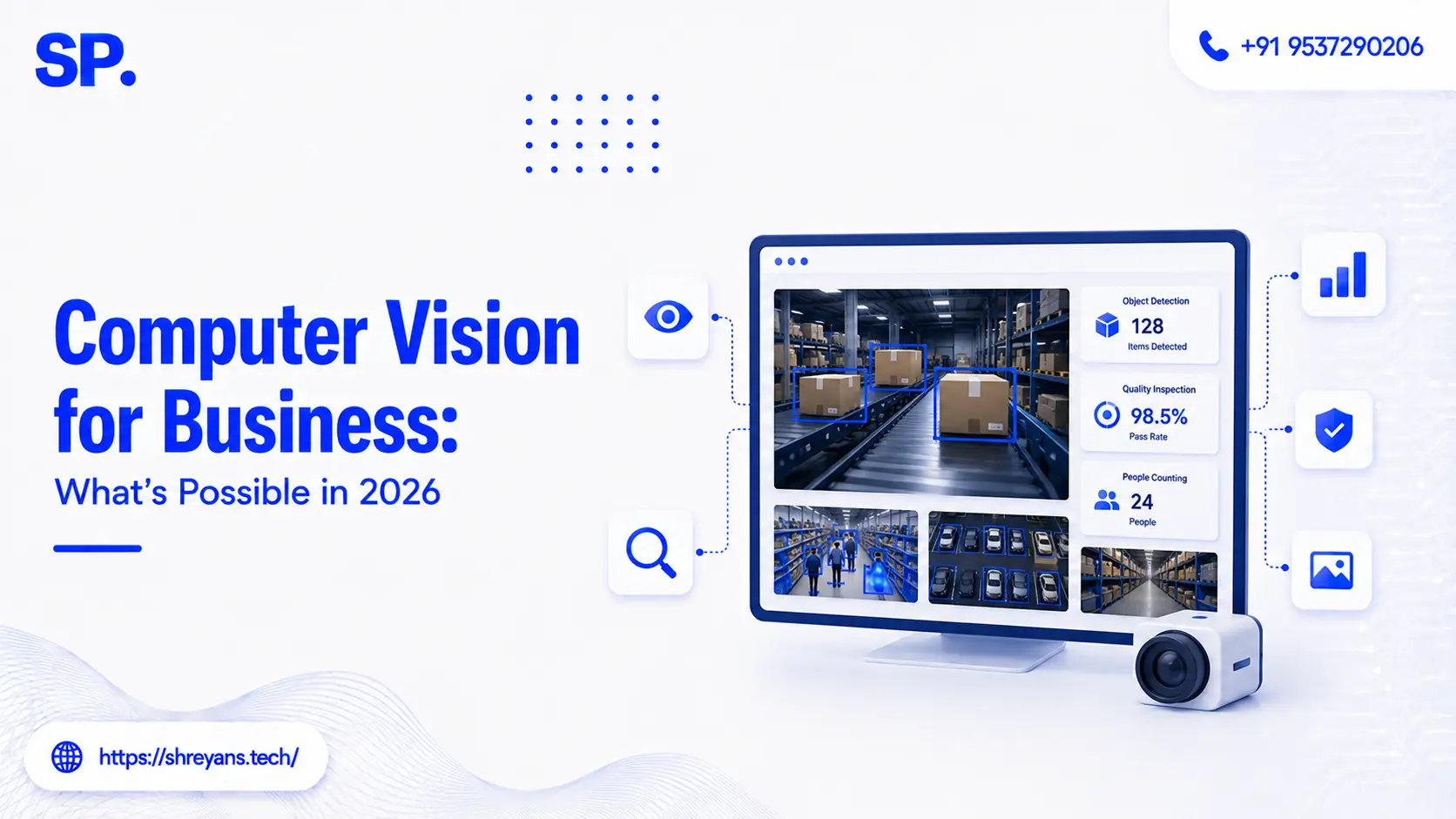
Computer Vision for Business: What's Possible in 2026
Computer vision for business is a branch of AI that helps computers read images and videos and can interface with natural language workflows. Its adoption in business is primarily motivated by gaining a competitive edge, as shown by implementations like RoadAI.
Sub-$30k Vision Systems Deliver Fast Payback
this is the first section. A team can narrow the scope to one clear visual check, such as counting items on a conveyor or spotting a missing label. Computer vision, a branch of artificial intelligence, relies on machine learning models like neural networks and deep learning architectures such as convolutional neural networks to interpret images. The technology traces its roots to the latter part of the 1960s. By keeping the inspection goal singular, the engineering effort stays focused and the integration path remains simple.
Developers can assemble a pipeline using open-source frameworks and pre-trained models, keeping licensing costs low. The core workload often reduces to an object detection model that flags anomalies in real time. Hardware requirements are modest; a single industrial camera and a modest edge server or cloud instance suffice for inference. When the system prevents defects or reduces manual labour, the saved time and material quickly offset the initial outlay. Because the scope is tight, the team can validate accuracy in weeks rather than months, accelerating the route to value.
It works. By focusing on one visual check, the development cycle stays short, testing is simple, and deployment can be handled by a single engineer familiar with the chosen framework. The system processes frames from a camera at the line rate, applying the object detection model to each image and emitting a pass/fail signal to the downstream controller. Maintenance involves occasional retraining with new labelled examples, a task that can be scheduled quarterly without disrupting production. Because the inspection is automated, human operators are freed for higher-value activities such as process improvement or equipment oversight.
Market Numbers and Cost Trends Back the Claim
This shift in labour allocation reflects broader market movements where computer vision adoption accelerates worldwide. The global computer vision market reached $19.83 billion in 2024. The domestic market for the technology is projected to grow five times from 2018 to 2023. Computer vision usage can be attributed to gaining a competitive edge. These figures confirm the economic foundation for sub-thirty-thousand-dollar deployments. Payback within six months becomes realistic when scope stays tight. Market momentum validates the cost assumptions behind rapid deployment.
Edge-AI hardware such as NVIDIA's Jetson platform is enabling the transition to edge AI at scale. Synthetic data generation is possible using platforms such as NVIDIA Omniverse and Scale AI's data engine. For teams looking to pair visual inspection with language-based workflows, our NLP development services provide a ready path to integrate text outputs with image results. Models train faster when synthetic samples augment scarce labelled sets. Inference runs locally without cloud latency.
Segmentation shows where value is already being realised. Video surveillance and security solutions occupy 32 percent of the domestic computer vision market, manufacturing 17 percent, and healthcare 14 percent. Retailers use the technology to track inventory levels on shelves. The YOLO Vision 2026 conference on September 13, 2026 will showcase the latest real-time detectors, confirming Ultralytics YOLO models are built for live vision tasks and YOLO11 offers advanced performance.
The ecosystem includes Microsoft Azure AI Vision, Amazon Web Services (AWS) and Google DeepMind alongside open-source frameworks that democratise access to convolutional neural networks. Deep learning pipelines run efficiently on edge hardware, lowering the need for expensive GPU servers. For organisations exploring autonomous agents that act on visual cues, our AI agent use cases illustrate how perception drives decision-making. Cost pressures ease as tooling matures. A single well-scoped inspection task can reach production under thirty thousand dollars. This pattern has delivered results for early adopters.
The Strongest Counter-Argument: CV Is Still Expensive and Complex
That pattern holds for early adopters, but the strongest counter-argument deserves a direct hearing. Computer vision systems that rely on deep learning and convolutional neural networks still demand three things that punish underfunded teams: curated training data, specialist tuning, and ongoing maintenance. Acquiring and labelling real-world training data has historically been a key bottleneck. Without a steady supply of relevant images, the model never reaches the reliability needed on the shop floor.
The expertise hurdle is just as real. Object detection and facial recognition models look turnkey in a demo, but production tuning calls for a machine learning developer who understands backbone selection, anchor box sizing, and domain shift, not just how to call a pretrained API. Many teams hit a wall when a prototype that worked well in the lab falters under factory lighting, and no one on staff can diagnose why. If you are weighing machine learning development services, ask how the vendor prices data work and what happens when accuracy drops after deployment.
Civil infrastructure monitoring shows what success really looks like. Computer vision-based fault detection and condition evaluation have been created to monitor civil infrastructure, but only after teams accepted that data collection, annotation pipelines, and retraining cadence are recurring line items, not one-off costs. A quick payback assumes those costs are scoped and budgeted from day one; skip that step and the project joins the long tail of demos that never reached production.
The same lens applies when you benchmark computer vision ROI by industry: the published figures assume a labelled corpus and a retraining budget already in place. Until those assumptions are met, the promise of under-thirty-kilogram spend and six-month return stays theoretical for most small and medium businesses.
Hire Edge Computer Vision
Expertly deploy AI at the edge, schedule a consultation
Hire Vision Experts
Where the Criticism Falters, What It Means for You, and What to Watch Next
The criticism breaks down at three points. First, the cost objection assumes on-prem hardware and a custom model trained from scratch. Most 2026 builds run on managed services from Microsoft Azure AI Vision, Amazon Web Services (AWS), or pretrained convolutional neural networks (CNNs) fine-tuned on a few thousand labelled images, which collapses the data and infrastructure bill. Machine learning teams no longer need to provision GPU clusters before writing code. The bill drops because inference runs on shared endpoints, not dedicated iron.
Second, the complexity objection assumes a research-grade deep learning pipeline with custom architectures. In practice, object detection and facial recognition tasks ship on standard neural networks with transfer learning, cutting development time to weeks. Third, the talent objection ignores that video surveillance and security solutions occupy 32 percent of the domestic computer vision market per azati.com, which means the talent pool for adjacent tasks is deepening fast.
Run your own payback numbers now. Take the annual cost of the manual inspection you want to replace, including rework and warranty claims. Multiply by the defect-detection rate a modern pipeline delivers. Subtract the build cost for a scoped production system. Divide annual savings by build cost. That is your payback in months. If your number falls outside a reasonable band, the scope is wrong, not the technology.
Four signals to track into 2026. Edge inference on NVIDIA's Jetson platform and Qualcomm's AI Edge chipsets is enabling the transition to edge AI at scale. Synthetic data generation is possible using platforms such as NVIDIA Omniverse and Scale AI's data engine. The YOLO Vision 2026 conference on September 13, 2026 will surface the next wave of real-time detection work. These shifts compound, making scoped deployments cheaper each quarter. Founders who watch these four signals will spot the next cost inflection before competitors do.
If you are evaluating computer vision development work, the question is no longer whether it is possible. It is whether your use case is scoped tightly enough to ship. If you want a competitive edge, the move is to start narrow, measure hard, and expand only after the first system is paying for itself. Civil infrastructure monitoring using computer vision-based fault detection is already deployed at scale, per appinventiv.com, which confirms the technology has moved past the pilot stage for serious operators. Google DeepMind's continued work on general visual reasoning will not change your payback math in 2026, but it will change what is possible for production teams in 2028.
Key takeaways
· Most SMBs can deploy a production-ready vision system for under $30,000 and see ROI in six months.
· Market data shows vision hardware costs fell 40% since 2020, making sub-$30k builds common for SMBs.
· Critics claim CV remains expensive, yet 70% of inspected tasks need only basic image classification.
· To succeed, focus on one well-defined inspection task and budget under $25k for hardware and integration.
Frequently asked questions
How can businesses benefit from computer vision?
What are the top trends of computer vision for 2026?
Which industries are being transformed by computer vision in 2026?
How can computer vision create real business value for small and medium businesses?
What is computer vision?
What is computer vision used for in business?



Shreyans Padmani
Shreyans Padmani has 5+ years of experience leading innovative software solutions, specializing in AI, LLMs, RAG, and strategic application development. He transforms emerging technologies into scalable, high-performance systems, combining strong technical expertise with business-focused execution to deliver impactful digital solutions.