Gartner's distributed enterprise research puts 75 percent of enterprise-generated data being created and processed outside a centralised data centre by 2025, up from under 10 percent in 2018. Grand View Research values the global edge AI market at 24.9 billion US dollars in 2025, projecting growth to 30.0 billion in 2026 and 118.7 billion by 2033. MarketsandMarkets found that 80.5 percent of edge AI devices by volume ran within a 1 to 3 watt power envelope in 2024, a constraint that rules out most of the hardware a computer vision model gets trained on.
Edge deployment means running inference on the device that captures the image, not in a data centre the image gets shipped to. A camera bolted to a warehouse ceiling, a handheld scanner on a retail floor, or a sensor on a delivery robot each has its own processor, its own power budget, and no guarantee of a network connection at the moment a decision has to be made. That is a materially different job from fitting a model to a validation set on a rented GPU, and it is where most computer vision hiring goes wrong: a portfolio full of high accuracy scores from Colab says little about whether a candidate can get that same model running reliably inside a 5-watt enclosure. Buyers who have run this gauntlet before tend to start with someone whose background is dedicated computer vision development work, not general machine learning, because edge constraints surface on day one, not after the contract starts.
Why Cloud-Trained Computer Vision Skills Don't Transfer to the Edge
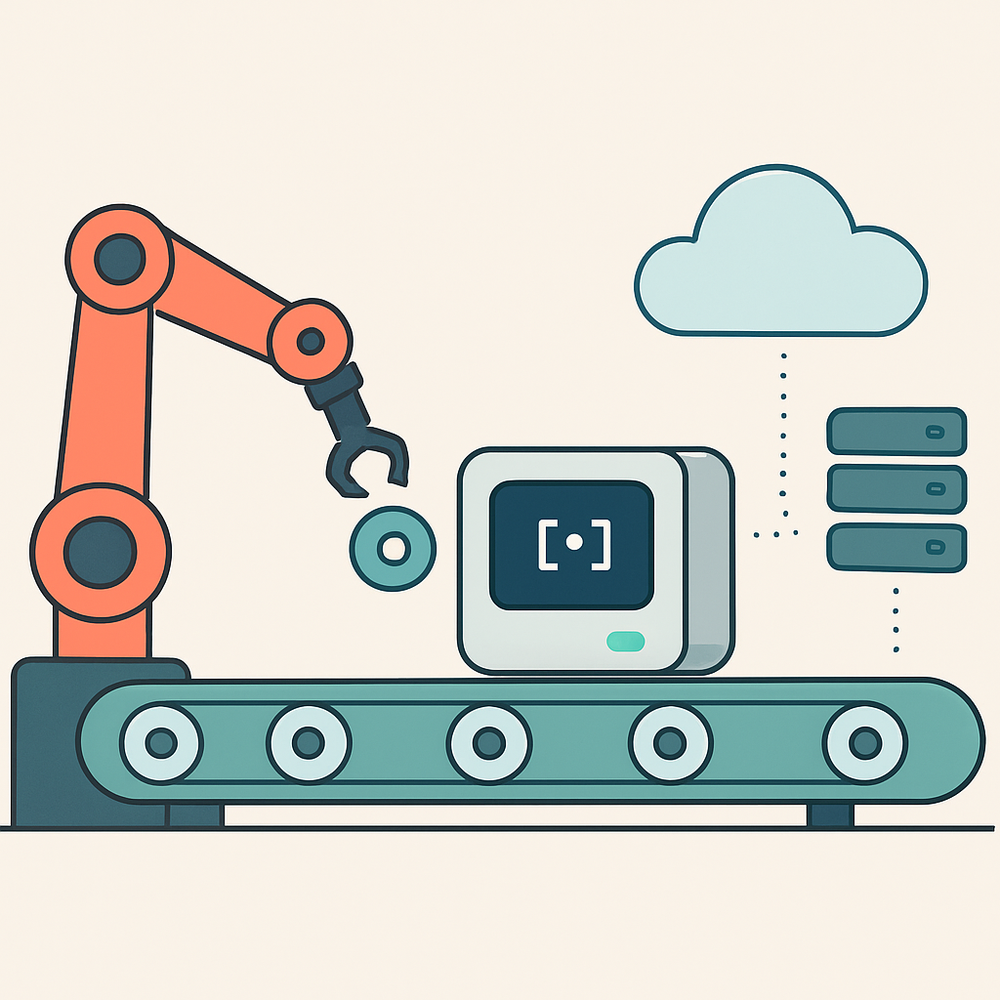
Most computer vision freelancers can demonstrate strong mean average precision on a benchmark dataset, run on a rented A100 or a free-tier Colab T4. That skill is real, but it answers a different question than the one an edge deployment asks. An edge project needs the same accuracy delivered at 30 frames per second, inside a fixed thermal envelope, on a chip that costs under 200 US dollars, with no cloud fallback if the network drops.
A 2025 Deloitte manufacturing study found that 72 percent of plant managers reported cloud-based latency directly caused missed defect detection opportunities on their production lines. Vision systems that wait 50 to 200 milliseconds for a remote server's answer cannot intervene before a defective part moves past the inspection point. That gap between cloud latency and production line speed is exactly what edge deployment exists to close, and it is a mechanism most cloud-focused computer vision candidates have never had to design around.
Model Compression Is a Job Skill, Not a Notebook Trick
Getting a model small enough and fast enough for edge hardware means quantisation, not just training. INT8 and FP16 post-training quantisation, quantisation-aware training, pruning, and knowledge distillation all trade a small amount of accuracy for a large amount of speed and memory headroom, and the trade needs to be measured on the target device, not assumed from a paper. Researchers at Texas State University benchmarked TensorRT-quantised models against full-precision PyTorch on an NVIDIA Jetson AGX Orin and recorded inference speedups of up to 14.87 times for MobileNet and SqueezeNet architectures, with the quantised engines also showing far less run-to-run variation in inference time. Buyers evaluating this stage of a project often bring in custom AI model training support specifically to handle the quantisation and calibration work, since it is a distinct skill from the original model build.
A February 2026 benchmarking study published in MDPI's Electronics journal ran multiple YOLOv8 variants on a Jetson Orin NX, using FP16 quantisation to take advantage of the board's tensor cores, and validated the approach against live vehicle and package detection workloads rather than a static test set. That is the level of validation an edge computer vision hire should be able to point to: a specific model, a specific board, and a measured frame rate, not a claim that a technique works in general. Freelancers who have only exported a model to ONNX Runtime and called it finished tend to skip calibration entirely, which is the step that keeps quantised accuracy close to the original.
Hardware choice matters here too. NVIDIA's 2026 guidance on its Jetson line positions the 1,999 US dollar AGX Orin 64GB as the right board for vision workloads and language models up to about 13 billion parameters, while the 3,499 US dollar Jetson Thor, with its 130 watt power envelope, targets 30 billion-plus parameter multimodal and robotics models. A candidate who defaults to the newest, most expensive chip regardless of the workload has not internalised the budget and power constraints the project actually has.
Hardware-Specific Toolchains: Jetson, Coral, Qualcomm, and Why They Don't Interchange
Each edge silicon family has its own compiler, its own supported operator set, and its own failure modes, and experience on one does not automatically transfer to another. NVIDIA's Jetson line runs JetPack and TensorRT, with a dedicated Deep Learning Accelerator alongside the GPU for offloading fixed workloads. Google's Coral Edge TPU accepts only fully INT8-quantised TensorFlow Lite models built with a specific set of supported operations, so an architecture that runs fine on a Jetson can fail to compile for Coral outright. Qualcomm's SNPE and QNN toolchains target the Snapdragon and QCS families that dominate smartphone and handheld scanning hardware, while Ambarella's CVflow SDK is built into camera silicon itself, pairing image signal processing with inference on the same chip.
|
Edge Hardware Platform |
Typical Power Draw |
Toolchain |
Best-Fit Workload |
|
NVIDIA Jetson Orin |
7 to 60 watts |
TensorRT, DeepStream, JetPack |
Multi-stream video analytics, robotics |
|
Google Coral Edge TPU |
Around 2 watts |
TensorFlow Lite delegate, INT8 only |
Single-model inference on battery or IoT devices |
|
Qualcomm Snapdragon / QCS |
1 to 5 watts |
SNPE, QNN |
Handheld scanners, smartphone-class CV |
|
Ambarella CVflow |
1 to 3 watts |
CVflow SDK |
Camera-embedded security and ADAS |
A freelancer who quotes a single day rate for "edge deployment" without asking which of these four ecosystems the project targets is signalling that they have not deployed on more than one of them.
Power, Thermal, and Memory Budgets Most Portfolios Never Mention
MarketsandMarkets reported that the smartphone segment accounted for 80.5 percent of edge AI device volume in 2024, and that devices running at 1 to 3 watts made up that same 80.5 percent share. Those two figures describe the actual market a freelancer is building for: not workstation-class accelerators, but small, thermally constrained, battery-sensitive hardware where every megabyte of model weight and every extra watt carries a direct cost.
Production edge deployments almost always run inference at a batch size of one, since frames arrive continuously rather than in stacks, which removes the throughput gains a batch-trained model was benchmarked with. Engineers who understand the hardware route parts of the graph to a dedicated accelerator such as Jetson's DLA specifically to keep the GPU's thermal headroom free for other tasks, and they pick architectures such as MobileNet or EfficientDet over a full YOLOv8x specifically because the larger model will not fit inside the board's memory ceiling once the operating system and camera buffers are accounted for. None of that shows up in a notebook that reports mean average precision alone.
Get Edge Computer Vision Experts consultancy
Get expert edge deployment solutions, schedule a consultation
Get 30min consultancyCamera Pipelines and Fleet Operations Nobody Puts in a Portfolio
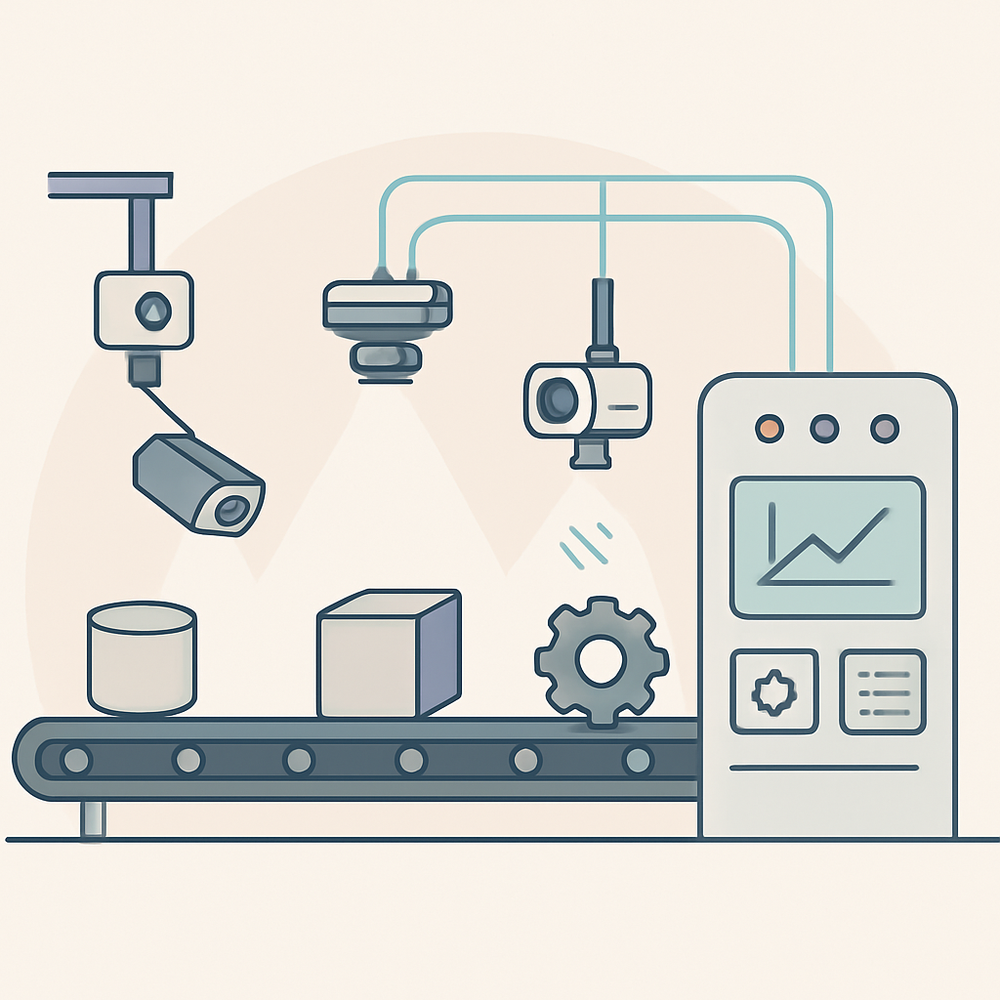
A trained model is a small part of a working edge system. Getting frames from a MIPI CSI-2 camera through a GStreamer or DeepStream pipeline, synchronising multiple camera feeds, and tuning the image signal processor for the lighting conditions a device will actually see in the field are all separate engineering problems from model accuracy, and they are usually where a first edge deployment stalls. Candidates who have only worked with pre-recorded video files in Python rarely have experience with V4L2 drivers or the buffering and timing issues that come from live camera hardware.
Once a device ships, the job shifts to fleet operations: versioning models across every deployed unit, rolling updates out without bricking a camera running unattended in a warehouse, and rolling back automatically if a new model version starts producing false detections. Manufacturing and retail are where this shows up most, often alongside general machine learning development services work such as predictive maintenance models running on the same edge hardware as the vision system. Shreyans Tech's research on where computer vision freelance work concentrates found manufacturing and retail deliver some of the fastest measured computer vision ROI by industry, largely because the cost of a missed defect or an empty shelf is easy to quantify against the deployment cost.
How to Vet These Skills Before You Hire
The fastest way to separate genuine edge experience from notebook experience is to ask for specifics a candidate cannot fabricate on the spot. Ask which board a model ran on, what frame rate it hit measured on that board rather than on a desktop GPU, and what the quantised accuracy loss was compared to the full-precision model. Ask how they structured an over-the-air update and rollback for a device they could not physically access, and ask to see production inference code, since a candidate who has only written Python notebooks will struggle to describe the C++ or Rust runtime work most embedded deployments still require.
Shreyans Tech's guide to vetting ML developers covers a broader interview framework that applies well beyond edge work, and it is worth running any shortlisted candidate through before a contract starts, since the cost of discovering a skills gap after deployment is far higher than the cost of a longer interview.
Hire Edge Computer Vision
Get expert edge deployment solutions, schedule a consultation
Hire AI ExpertsWhere Edge Deployment Projects Actually Succeed
The gap between a working notebook and a working edge fleet is where most computer vision projects lose months, and it is rarely closed by hiring more general machine learning talent. It is closed by someone who has already fought with a quantisation calibration set, argued with a Coral compiler's unsupported operator list, and debugged a camera driver at two in the morning. Shreyans Tech's analysis of why startups hire freelance engineers for AI work applies directly here: a specialist who has shipped edge deployments before gets a project through the hardware-specific problems in weeks rather than the months a generalist spends rediscovering them.
For teams ready to move past the prototype stage, the fastest path is usually to hire an AI developer who has already put models on the specific silicon the project depends on, rather than train that expertise in-house from scratch.
Frequently asked questions
What does edge deployment mean for a computer vision project?
How is an edge computer vision developer different from a general computer vision engineer?
How do you choose between NVIDIA Jetson, Google Coral, and Qualcomm hardware for a project?
How much does it cost to hire a computer vision developer for edge deployment?
What should I ask a candidate to prove they can deploy models to edge hardware?
What happens if quantisation reduces a model's accuracy too much for production use?



Shreyans Padmani
Shreyans Padmani has 5+ years of experience leading innovative software solutions, specializing in AI, LLMs, RAG, and strategic application development. He transforms emerging technologies into scalable, high-performance systems, combining strong technical expertise with business-focused execution to deliver impactful digital solutions.