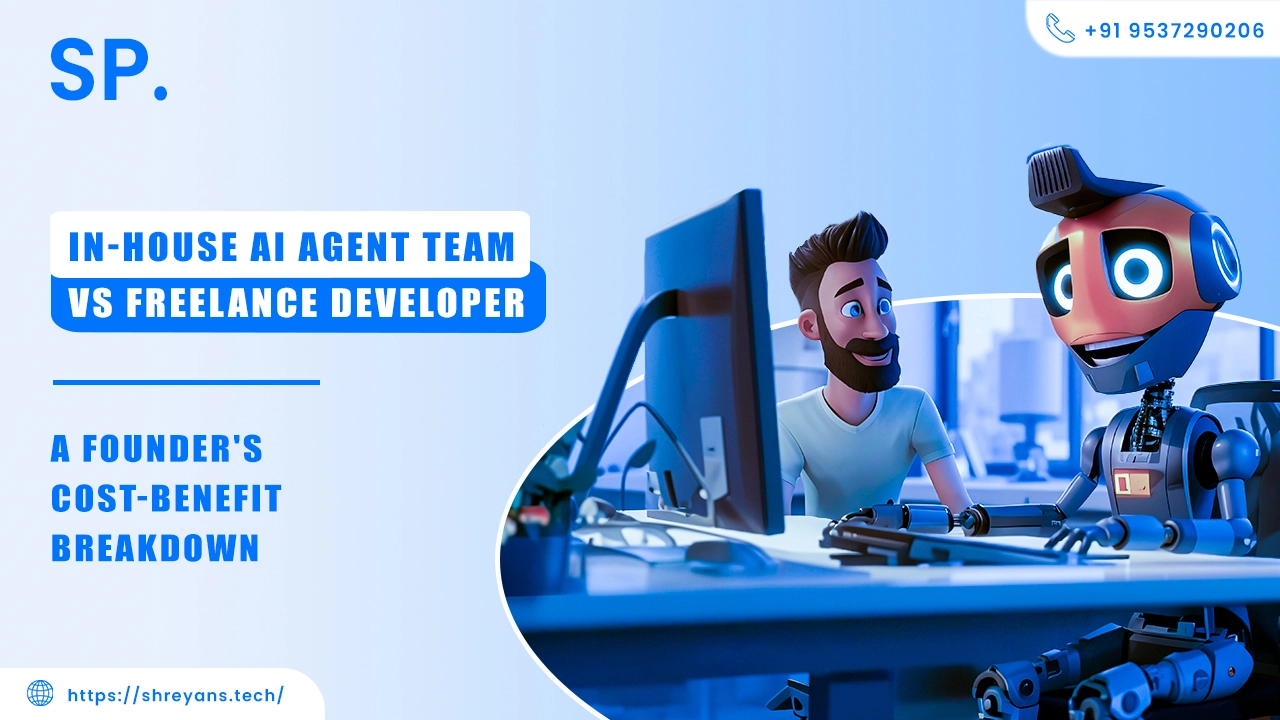
An in-house AI development team costs 1.35 million to 2.2 million US dollars annually in the United States, against 12,000 to 120,000 US dollars a month for an outsourced team, according to Intellectyx's 2026 cost breakdown. Bolder Apps' 2026 comparison found that even a small in-house engineering team, 500,000 to 750,000 US dollars a year fully loaded, costs more than two complete agency-built MVPs plus a full year of post-launch support.
The gap is large enough that the decision is rarely close on cost alone, yet founders keep making it on instinct instead of arithmetic. This breakdown puts real 2026 numbers against both paths, in-house AI agent team and freelance AI agent developer, and works through the variables that actually decide which one fits a given company at a given stage.
The Real Question: Ongoing Capability or a Defined System
DestiLabs' 2026 hiring guide frames the decision correctly: hire in-house when AI is a permanent core capability, hire a freelancer or partner when a specific system needs to be shipped reliably and fast. A company that will keep building and retraining agents for the next three years is solving a different problem than one that needs a single lead-routing agent shipped this quarter.
Most founders answer this question backwards: they hire in-house because it feels more serious, only to discover the team has no defined backlog once the first agent ships. Bolder Apps' 2026 research identifies this as the most consequential mistake early-stage founders make: building in-house teams before 1 million US dollars in annual recurring revenue or before a Series A round.
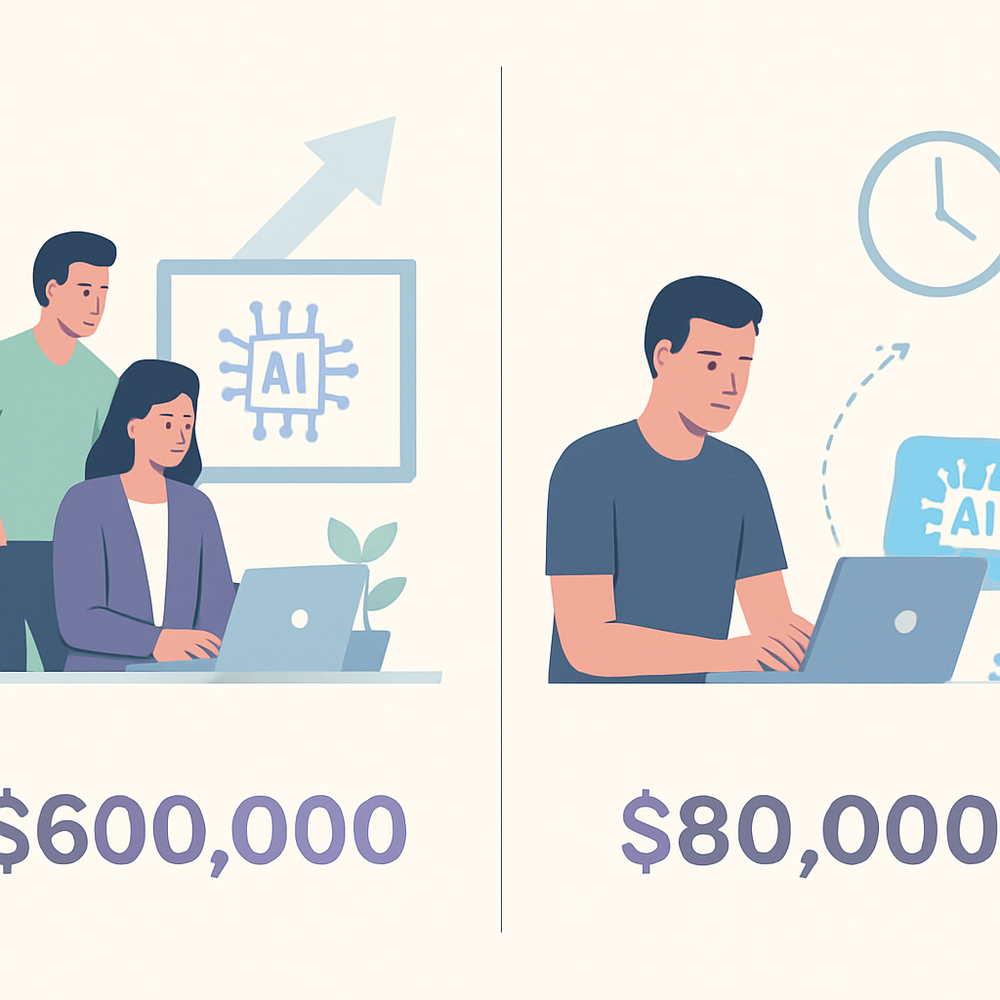
What an In-House AI Agent Team Actually Costs
A senior AI engineer alone commands 140,000 to 220,000-plus US dollars a year in major US markets before benefits, which BLS data puts at roughly 30 percent of total compensation, plus recruiting fees and ramp time. Building a full agent team, typically an architect, one or two implementation engineers, and a data or MLOps specialist, pushes the loaded annual number into the 500,000 to 1.2 million US dollar range that Intellectyx documents for a fully in-house AI function scoping custom AI agent solutions end to end.
|
Cost component |
In-house team (annual) |
Freelance/dedicated engagement |
|
Core team compensation |
$500,000 to $1.2M+ (Intellectyx) |
$50 to $250/hr, project or retainer |
|
Recruiting and ramp |
2 to 4 months before first ship |
Days to weeks for a scoped engagement |
|
Benefits and overhead load |
+25% to 35% on top of salary |
Included in the quoted rate |
|
Time to first working system |
Months (hiring + onboarding) |
Roughly 5 days to prototype (DestiLabs) |
What a Freelance AI Agent Developer Actually Costs
Freelance AI developers range widely, often 50 to 150-plus US dollars an hour, with specialist agent and LLM work reaching 350 US dollars an hour and beyond for the most senior practitioners, per DestiLabs and Second Talent's 2026 data. A defined agent build, scoped as a fixed project rather than an open retainer, typically settles 20 to 30 percent below the equivalent hourly total because the deliverable is fixed rather than open-ended.
The trade a founder makes when choosing this path is flexibility for stability, not just a lower number. A team that can hire AI and ML developers for a single well-scoped engagement gets speed and a lower upfront number, but takes on continuity risk if the freelancer's availability changes mid-project, which is why scope clarity and documentation matter more in this model than in an in-house hire.
Speed to Production: The Overlooked Variable
DestiLabs reports that an AI development partner ships a working prototype in about five days and a production system in weeks, against months of recruiting before an in-house hire writes a line of code. For a founder burning runway, that gap between weeks and months is frequently worth more than the difference in hourly rate, because a shipped agent generating revenue changes the entire cost conversation.
SFAI Labs' 2026 comparison found that the freelance and agency path delivers 30 to 40 percent savings on projects under six months and is typically 30 to 50 percent cheaper for a company's first AI project, specifically because first-time implementers do not yet have the internal process to make an in-house hire productive quickly.
Risk and Continuity: What Each Model Gets Wrong
The freelance model's failure mode is coordination and continuity, a contractor who leaves mid-project, or a fixed-bid quote that did not anticipate the iteration an agent needs once real traffic exposes eval gaps and cost overruns. The hidden costs guide walks through the categories that most fixed-bid agent quotes leave out before that traffic ever arrives.
The in-house model's failure mode is different and more expensive to unwind. A new hire can select tools based on personal familiarity rather than the company's actual needs, building custom infrastructure where a proven pattern would have done the job, and that decision is much harder to reverse than a freelance contract that simply ends.
The Hybrid Model Founders Are Actually Using
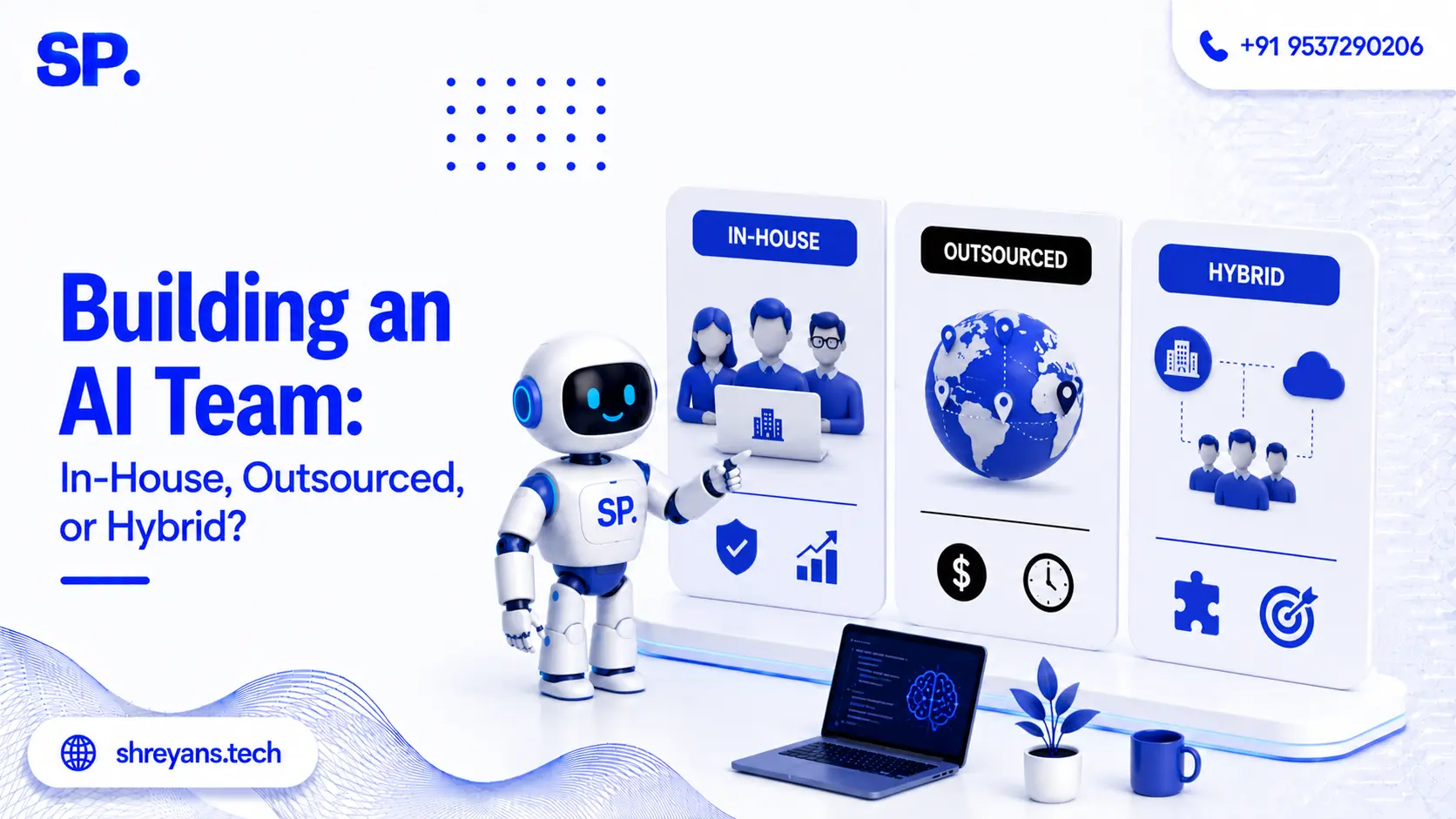
AI Essentials' 2026 cost guide documents the sequence most companies actually follow: freelancer or consultant first to validate the use case and ship the first system, then an internal operations hire once the workload is proven, then a specialist hired later only once the validated backlog becomes a genuine full-time function. This matches the broader pattern behind why startups hire freelance talent for the first phase of an AI initiative rather than committing to headcount before the use case is proven.
McKinsey's 2025 global survey, cited in AI Essentials' analysis, found nearly two-thirds of organisations had not begun scaling AI enterprise-wide, and that high performers were nearly three times more likely to redesign workflows fundamentally rather than simply add headcount. Buying tools or adding a vague AI hire is not the differentiator; a validated, working system is.
A Founder's Decision Framework
Choose freelance or a development partner when the need is a defined agent or system with a clear success metric, the timeline is measured in weeks, or this is the company's first AI project. Choose in-house when AI agent development is becoming a permanent core function, the company has passed roughly 1 million US dollars in annual recurring revenue, and there is a real backlog to keep a team busy past the first build. The freelancer vs full-time team comparison works through the same framework with a wider lens across AI and ML hiring generally.
Where the Real Cost Lands
The lowest hourly rate rarely produces the lowest total cost, and the most senior in-house hire rarely produces the fastest shipped system. What decides the real cost is whether the company is buying a defined outcome or building a permanent capability, and most founders are further from needing the second than they think.
Shreyans Padmani ships production AI agents and generative AI systems for founders who need a working system this quarter, not a headcount plan for next year. Hire an AI developer to scope the fastest, most cost-effective path for your specific agent build.
Frequently asked questions
Is it cheaper to build an in-house AI agent team or hire a freelance developer?
How much does a full in-house AI agent team cost per year?
How fast can a freelance AI agent developer ship a working system?
When should a startup switch from freelance AI development to an in-house team?
What is the biggest risk of hiring a freelance AI agent developer?
What is the biggest risk of building an AI agent team in-house too early?



Shreyans Padmani
Shreyans Padmani has 5+ years of experience leading innovative software solutions, specializing in AI, LLMs, RAG, and strategic application development. He transforms emerging technologies into scalable, high-performance systems, combining strong technical expertise with business-focused execution to deliver impactful digital solutions.