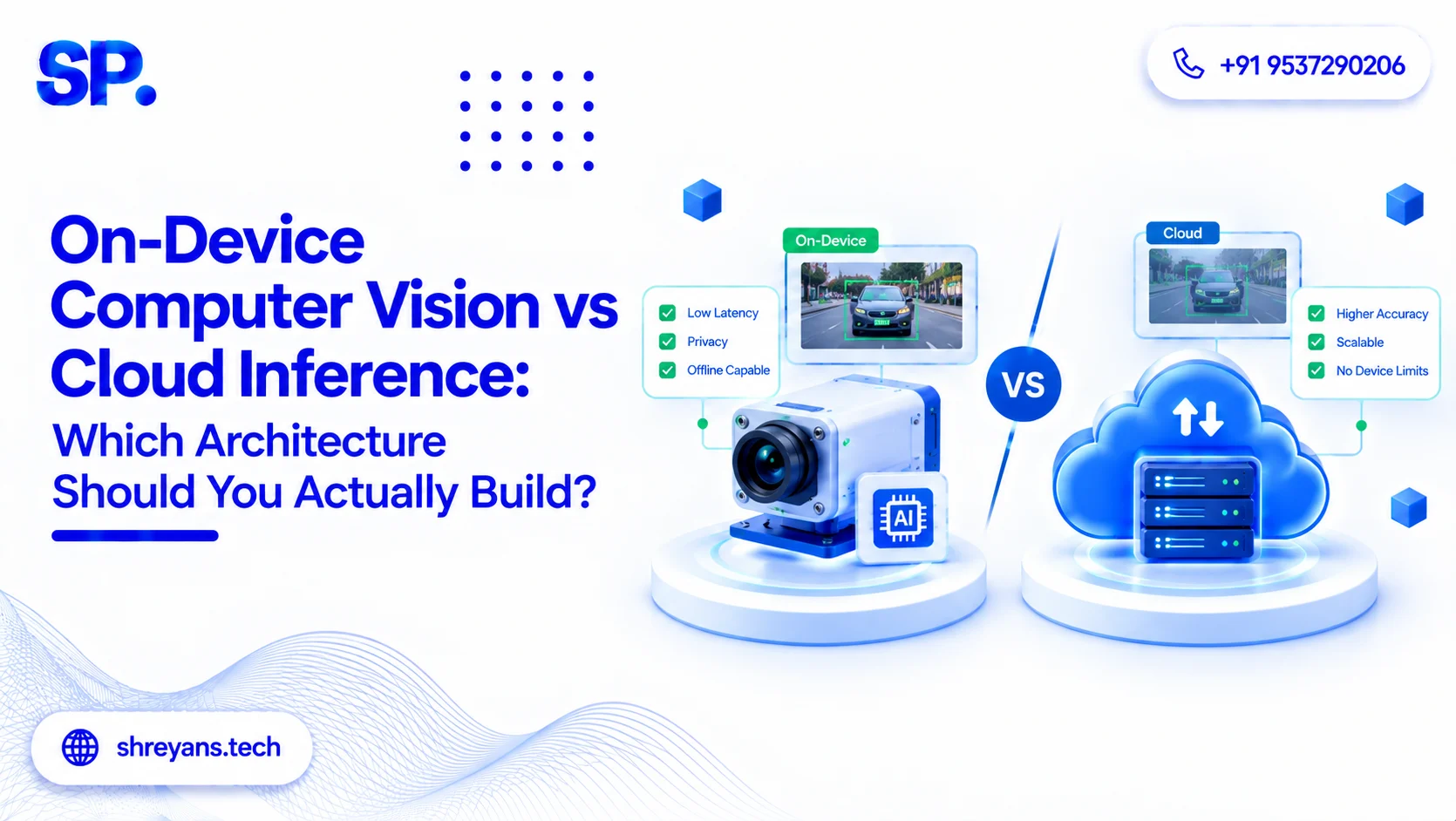
On-Device Computer Vision vs Cloud Inference: Which Architecture Should You Actually Build?
Intellisee's 2026 physical security research quantifies a shift that used to be a philosophical debate: more than 50 percent of new enterprise computer vision deployments now run inference at the edge, up from roughly 30 percent in 2023, driven largely by silicon catching up to the workload. NVIDIA's Jetson AGX Orin module now delivers up to 275 TOPS of AI compute within a roughly 60 watt power envelope, small enough for a camera-adjacent enclosure rather than a server rack. Fora Soft's 2026 surveillance architecture research names three forces that converged to force this decision onto every CTO's desk this year: the EU AI Act's high-risk classification of remote biometric identification took effect in August, AWS Panorama announced its end-of-life for May 31, 2026, and the price of capable edge accelerators dropped to where a Hailo-8 module now costs less than a single month of cloud-GPU inference.
"We send everything to the cloud" is no longer a default a team can defend to legal, finance, or operations without a specific case for it. This guide covers the dimensions that should actually decide which architecture your product needs, and where a computer vision development work scoping conversation should start.
1. Latency: Where On-Device Wins Outright
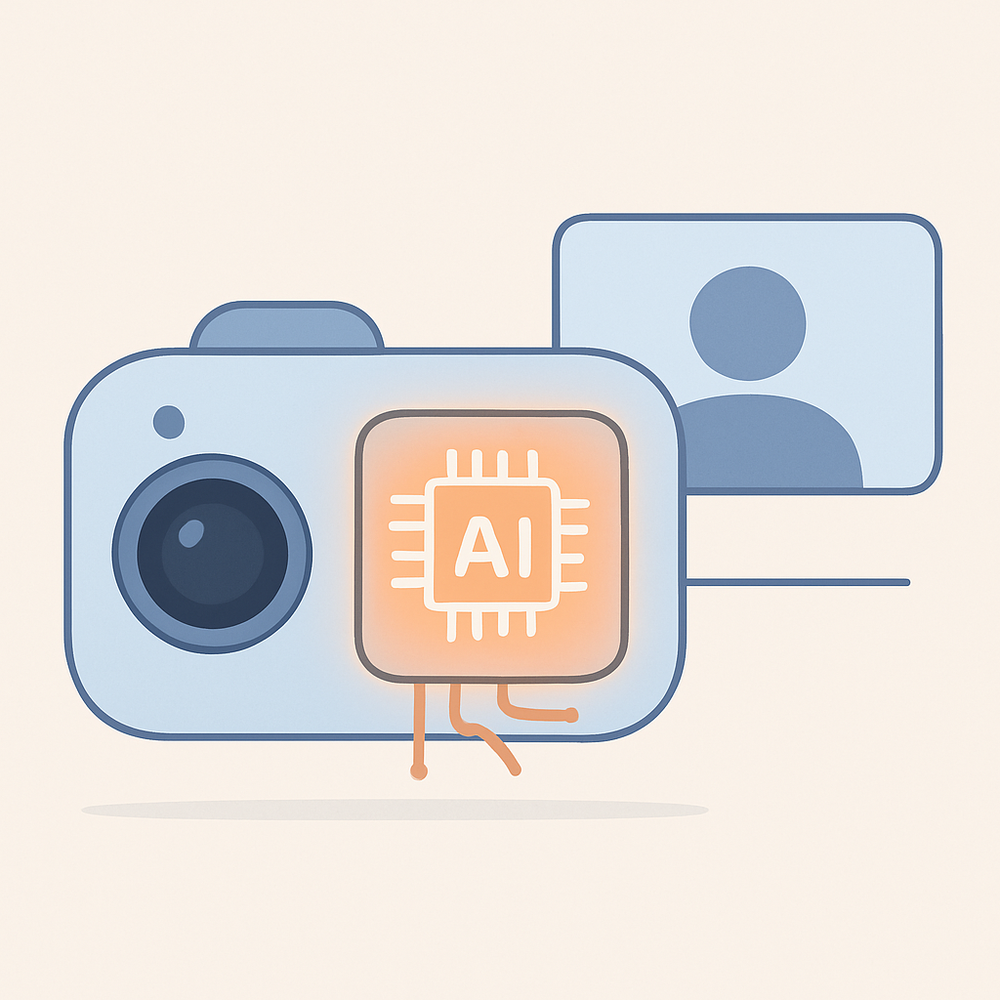
CamThink's 2026 architecture comparison is direct about the structural difference: in an edge AI camera setup, the model runs on a dedicated processing unit inside the camera itself, with no cloud round-trip, no per-call fee, and no connectivity dependency for inference to complete. AlephZero Labs' 2026 on-device benchmarking research names the specific use cases where this matters most for vision workloads: real-time camera overlays, instant document scanning, and live gesture recognition all require latency budgets that no cloud endpoint can reliably meet, since even a fast API call carries network round-trip time on top of inference time itself.
This is the dimension worth weighing first for manufacturing quality control cameras, in-vehicle detection systems, and any product where a delayed response is functionally the same as a wrong one. A developer scoping AI model training work for edge deployment needs to account for model compression and quantization from the start, since a model trained for a cloud GPU rarely compresses cleanly onto camera-grade hardware without a deliberate rework.
2. Cost: The Crossover Point Between Hardware and Per-Call Fees
CamThink's 2026 total cost of ownership analysis puts real numbers against a decision that is usually argued in the abstract. At a default scenario of 50 camera units running four checks a day, an edge AI camera fleet costs approximately 10,000 US dollars in hardware with effectively zero recurring inference cost, while an equivalent IP camera plus cloud vision API setup costs roughly 120 US dollars per unit in hardware and generates approximately 109,500 API calls over three years, adding around 164 US dollars in API costs on top. At this frequency, hardware cost dominates the comparison, and the edge hardware premium is typically offset within the first year of operation.
The crossover point matters more at higher usage: CamThink's analysis shows the API cost gap widens significantly once checks run ten or more times a day across 100 or more units, which is where cloud-only architectures start losing the cost argument even before latency and privacy enter the picture. The computer vision project costs breakdown covers how this cost structure interacts with the eight most common computer vision project types.
3. Privacy and Regulatory Exposure
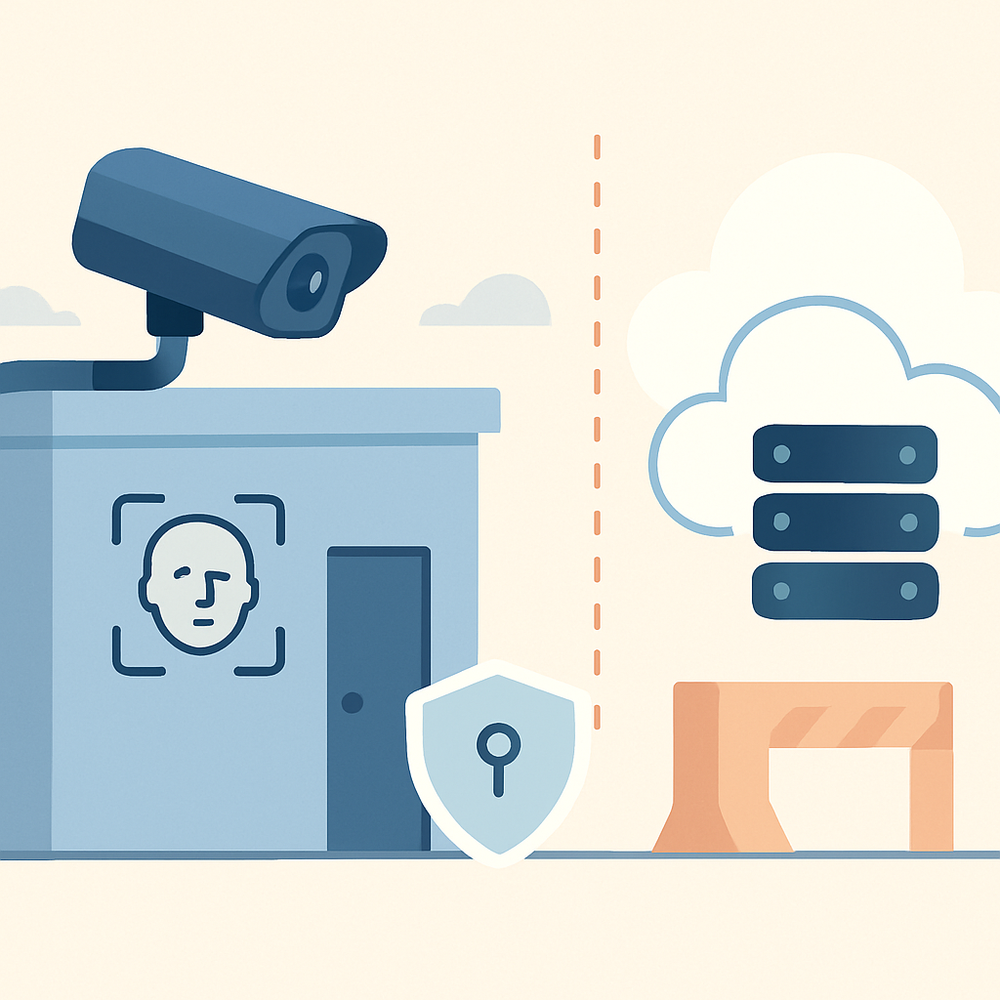
Roboflow's 2026 inference architecture research is direct about a cost that a pure latency-and-throughput comparison misses entirely: regulations like GDPR and the EU AI Act create real legal and operational friction whenever sensitive visual data leaves a facility for cloud processing. Fora Soft's 2026 surveillance research adds the specific regulatory trigger reshaping this decision in 2026: the EU AI Act's high-risk classification of remote biometric identification took effect in August, which changes the compliance calculus for any computer vision system that processes faces or identifying visual data at all.
On-device processing keeps this category of data inside a facility's own infrastructure by default, reducing the compliance surface a legal or security review needs to examine. For any computer vision project touching biometric data, healthcare imagery, or other regulated visual information, this dimension alone is often reason enough to weight the architecture decision toward the edge before latency or cost even enter the conversation.
4. Offline Resilience and Reliability
Fora Soft's 2026 research finds that architectures mixing edge buffering with cloud synchronisation are objectively more reliable than either a pure edge or pure cloud approach on its own. Edge devices storing 24 to 72 hours of data locally, some commercial smart cameras now ship with up to 4 terabytes of onboard storage, and trickle-uploading to the cloud during off-peak hours means a network outage does not halt operation. Fora Soft reports mean time to recovery after an outage drops to seconds in this hybrid pattern, compared with 15 minutes to two hours for a cloud-only system that has to fully re-sync state once connectivity returns.
This dimension matters most for any deployment where connectivity cannot be assumed reliably: manufacturing floors with spotty industrial WiFi, remote facilities, or any site where a cloud outage during a critical operating window carries real operational cost, not just an inconvenience.
Hire Edge Computer Vision
5. Where Cloud Still Wins: Cross-Camera Reasoning and Model Flexibility
None of this makes cloud inference obsolete. Fora Soft's research is explicit that cloud wins on cross-camera reasoning, correlating events across multiple camera feeds into a single coherent picture is a task that benefits from centralised processing power an individual edge device cannot match. Spheron's 2026 hybrid inference research frames the underlying trade-off precisely: cloud GPU wins on raw throughput per dollar at high utilisation, while edge hardware wins on latency and cost at low or moderate utilisation, which is exactly why the choice depends on your specific usage pattern rather than a general preference for one architecture.
Roboflow's research reframes the whole question usefully: cloud and edge are not separate architectures, they are deployment targets for the same underlying workflow logic, designed once and able to run wherever it makes the most sense for a given task. A system that routes the simple, frequent, latency-sensitive detection to the edge and escalates the rare, complex case to the cloud captures the strengths of both rather than forcing an all-or-nothing choice.
6. A Decision Framework: How to Actually Choose
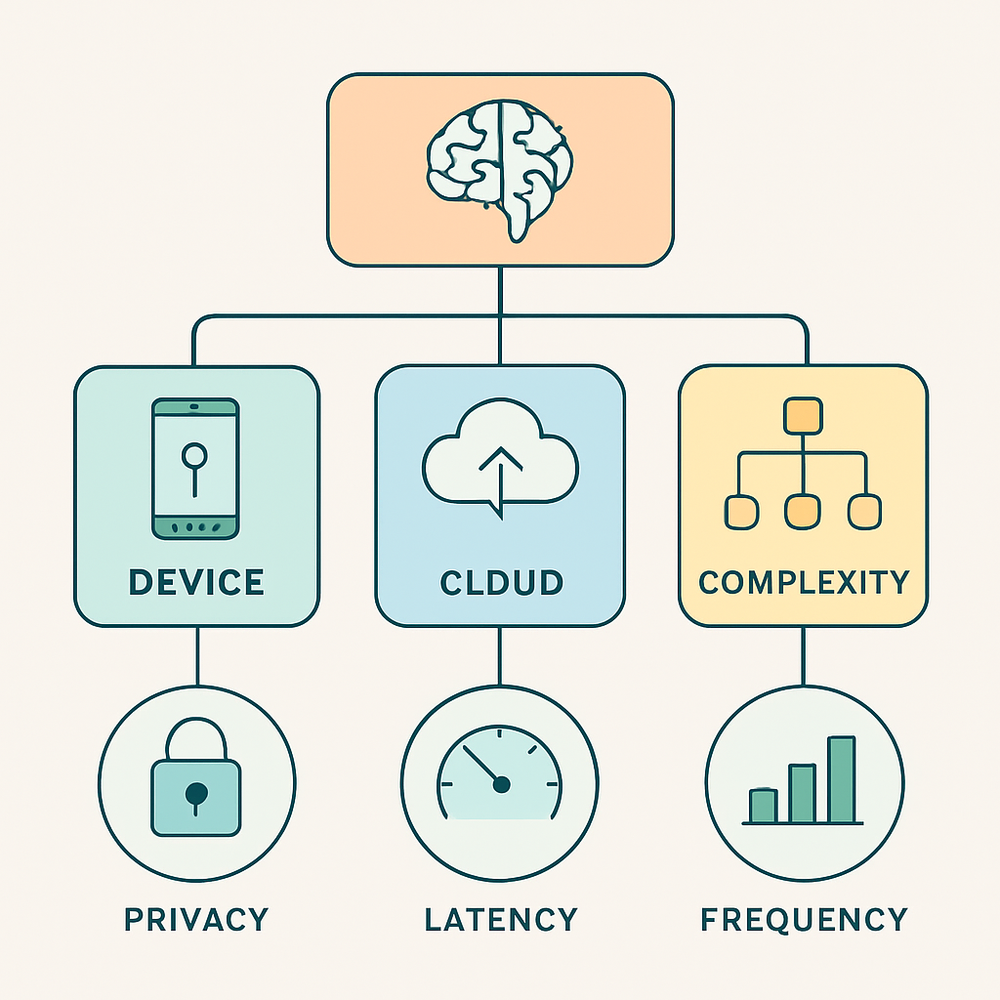
Spheron's 2026 guide recommends a concrete first step: list every inference task your system handles, and for each one record the acceptable end-to-end latency, whether a smaller model actually meets your accuracy requirement, how frequently the task runs, and whether the data involved can leave the device at all for privacy or regulatory reasons. Sorting each task into always-on-device, always-cloud, or route-by-complexity buckets turns an abstract architecture debate into a concrete, task-by-task specification a developer can actually build against.
The computer vision ROI by industry breakdown covers where this framework tends to land for different industries specifically, since a manufacturing defect detection system and a retail shelf monitoring system rarely land in the same bucket even when both are broadly "computer vision."
On-Device vs Cloud: Which Wins on Each Dimension
|
Dimension |
On-Device Wins When |
Cloud Wins When |
|---|---|---|
|
Latency |
Real-time response is required (under 100ms) |
Response time in the hundreds of milliseconds is acceptable |
|
Cost |
Usage is low to moderate frequency across many units |
Usage is high-frequency and needs maximum throughput per dollar |
|
Privacy and regulation |
Data is biometric, healthcare, or otherwise regulated |
Data has no special privacy or regulatory constraint |
|
Reliability |
Connectivity cannot be assumed reliable |
Connectivity is consistently available |
|
Reasoning complexity |
Task is a single-camera, well-defined detection |
Task needs cross-camera or highly complex reasoning |
Build the Workflow Once, Route It by Task
The most durable architecture decision in 2026 is rarely a single answer for an entire product. It is a task-by-task routing decision built on latency requirements, usage frequency, regulatory exposure, and connectivity reliability, with the underlying detection and workflow logic designed once and deployed wherever each specific task actually needs to run.
The why startups hire freelance post covers why a freelance specialist often scopes this kind of architecture decision more realistically than a vendor pushing a single default. Hire a computer vision developer who can map your specific tasks against this framework before committing to an architecture that is expensive to reverse once cameras are in the field.
Hire Edge Computer Vision
Frequently asked questions
Is on-device computer vision always cheaper than cloud inference?
What computer vision use cases actually require on-device inference?
Does the EU AI Act affect where I should run computer vision inference?
Can I build a computer vision system that uses both edge and cloud inference?
How do I decide which specific tasks in my computer vision system should run on-device versus in the cloud?
Is edge AI hardware powerful enough to run modern computer vision models in 2026?



Shreyans Padmani
Shreyans Padmani has 5+ years of experience leading innovative software solutions, specializing in AI, LLMs, RAG, and strategic application development. He transforms emerging technologies into scalable, high-performance systems, combining strong technical expertise with business-focused execution to deliver impactful digital solutions.