The Thinking Company's 2026 retail AI ROI guide found quick-win use cases such as recommendations and chatbots break even in eight to twelve weeks, while demand forecasting and inventory optimisation reach payback in four to six months. LocalExpress's 2026 grocery AI analysis puts the average payback period for operational AI projects at fourteen months industry-wide, with the fastest movers, inventory optimisation and labour scheduling, recovering their cost far sooner than that average.
Retail is one of the few industries where AI payback consistently beats the broader enterprise average of two to four years reported by Deloitte, largely because retail transaction volume is high enough that even small per-transaction gains compound quickly. Retailers weighing where to start with AI development for retail should sequence spend by payback speed, not by which project sounds most transformative. Here are the seven projects delivering the fastest returns in 2026, fastest to slowest.
1. Product Recommendations and Personalisation
The Thinking Company's 2026 guide places personalised recommendations among the fastest-paying retail AI investments, breaking even in eight to twelve weeks and delivering 350 to 500 percent three-year ROI, the highest of any retail AI category it tracks. Adobe data cited in industry 2026 AI statistics found AI-referred traffic to retail sites grew 4,700 percent year over year, a signal of how quickly personalisation-driven discovery is reshaping where retail revenue actually originates.
The speed of payback here comes from the fact that recommendation engines improve an existing revenue stream rather than requiring a new one. A retailer already has the browsing and purchase history; the AI layer's job is extracting more value from data that already exists, which is why this is consistently the first project retailers greenlight. Building a recommendation and content personalisation layer well requires generative AI development services that can generate contextual product copy and offers, not just a similarity-matching algorithm.
2. AI Customer Service Agents

Customer service is the one enterprise function where a majority of AI programs, 63 percent, reach payback within the first year, according to Bain's Agentic AI Benchmark 2026 covering 1,840 deployments, with a median payback of 4.1 months for customer service specifically. Gorgias's 2026 State of Conversational Commerce report found 79 percent of brands say AI-driven conversational commerce increased their sales, moving customer service agents from a cost centre to a measurable revenue driver.
The structural reason this category pays back fast is the same reason it does in every industry: high-volume, standardised interactions with a measurable before-and-after in handle time and cost per contact. When an agent resolves 30 to 40 percent of tickets that previously required a human, the labour cost reduction is immediate rather than gradual. This is one of the clearest AI agent use cases in retail specifically because order status, returns, and sizing questions are repetitive enough to automate well without sacrificing the customer experience.
Hire Retail AI Developers
Boost sales with expert AI solutions, schedule a consultation
Hire AI Experts3. Demand Forecasting
The Thinking Company's 2026 analysis puts demand forecasting payback at four to six months, with three-year ROI in the 280 to 400 percent range, second only to personalisation among retail AI categories. LocalExpress's 2026 grocery data reports 95 percent inventory accuracy achievable with AI-driven forecasting against the industry's historical baseline of manual, spreadsheet-driven demand planning.
Forecasting is where retail's transaction volume becomes a genuine advantage: a model trained on years of SKU-level sales, seasonality, and promotional data has far more signal to work with than an FP&A model in a lower-volume business. Retailers building this capability with proper machine learning development services typically see the model outperform legacy statistical forecasting within the first full seasonal cycle, once it has enough data to learn the retailer's specific demand patterns rather than generic category trends.
4. Inventory Optimisation and Labour Scheduling
LocalExpress's 2026 grocery AI statistics identify inventory optimisation and labour scheduling as the fastest-paying applications within the fourteen-month industry average payback, with 49 percent waste reduction reported among grocery retailers deploying AI-driven inventory systems. Aiassemblylines' 2026 retail operations playbook reports retailers deploying AI across inventory and workforce operations see 40 percent reductions in inventory carrying costs and 15 percent labour savings within the first year.
One of the largest grocery retailers in the world exceeded its own one billion euro AI savings target by 35 percent, according to LocalExpress's sourced case data, which is a useful reminder that inventory optimisation gains tend to outperform initial projections rather than fall short of them once the model has enough operating history to fine-tune reorder thresholds and staffing curves against actual store-level demand.
5. Dynamic Pricing
The Thinking Company's 2026 data places dynamic pricing at six to nine months payback, longer than forecasting or personalisation because of the governance and model tuning required before a retailer trusts an algorithm to move live prices. McKinsey and Alhena AI's 2025 research, cited in 2026 industry statistics, found AI-powered dynamic pricing delivers 5 to 10 percent margin improvements with a six to twelve month payback period, yet fewer than 15 percent of retailers currently use it.
The gap between the payback speed and the low adoption rate is the real story here: dynamic pricing is proven to work, but most retailers have not built the governance layer, price floors, competitor monitoring, and margin guardrails, needed to deploy it with confidence. Retailers that treat the governance work as part of the project scope from the start, rather than an afterthought, are the ones who hit the faster end of that six to nine month range.
6. Computer Vision for Loss Prevention
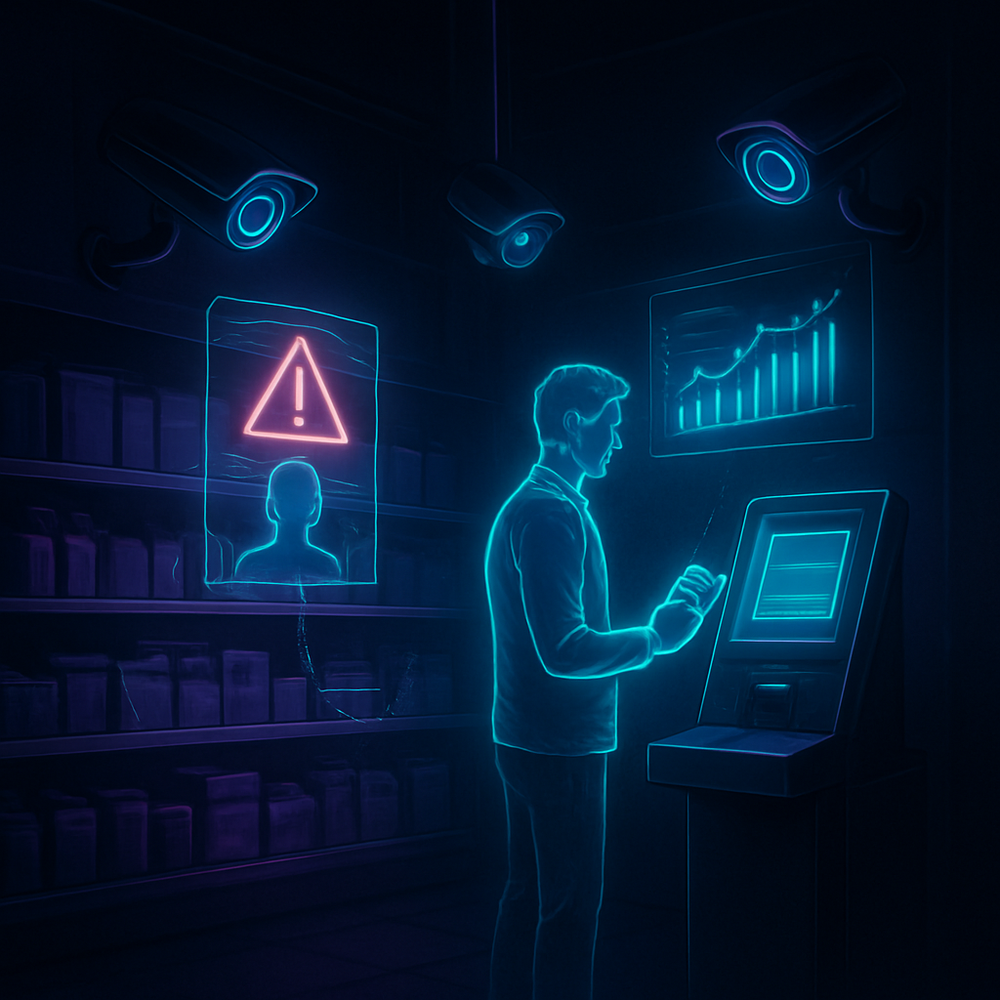
Aiassemblylines' 2026 retail operations research reports shrinkage reductions of up to 50 percent within the first year for retailers deploying computer vision-based loss prevention systems, a category with an unusually direct line between deployment and measurable savings since shrinkage is already tracked as a specific line item on every retailer's P&L.
Loss prevention computer vision differs from checkout-facing systems in that it runs continuously in the background, flagging patterns, unusual scan behaviour at self-checkout, employee-customer interactions at points of known vulnerability, without requiring a change to the customer-facing experience. That makes it one of the lower-friction computer vision development work projects to deploy, since store operations do not need to change for the system to start generating savings.
7. Computer Vision for Frictionless Checkout
LocalExpress's 2026 grocery statistics cite checkout times as fast as seven seconds achievable with computer vision-based frictionless checkout systems, alongside 400 percent growth in this category of deployment by 2025. Checkout automation sits slightly behind loss prevention in typical payback speed because the upfront camera and sensor infrastructure cost is higher, but the customer experience gain, shorter lines, fewer abandoned baskets, adds a revenue benefit that pure loss-prevention systems do not capture.
Retailers evaluating this category should read the full breakdown of computer vision ROI by industry before scoping a pilot, since payback speed varies significantly by store format and existing point-of-sale infrastructure, and a small-format convenience store sees a materially different payback curve than a large-format grocery location.
Hire Retail AI Experts
Boost sales with expert AI solutions, schedule a consultation
Hire AI DevelopersRetail AI Payback Period Ranking
|
Project |
Typical Payback |
Reported ROI Range |
|
Product recommendations and personalisation |
8 to 12 weeks |
350 to 500 percent (3-year) |
|
AI customer service agents |
4 to 5 months |
63 percent hit payback in year one |
|
Demand forecasting |
4 to 6 months |
280 to 400 percent (3-year) |
|
Inventory optimisation and labour scheduling |
4 to 6 months |
40 percent lower carrying costs |
|
Dynamic pricing |
6 to 9 months |
5 to 10 percent margin improvement |
|
Computer vision loss prevention |
6 to 12 months |
Up to 50 percent shrinkage reduction |
|
Computer vision frictionless checkout |
9 to 14 months |
7-second checkout times |
Sequencing the Retail AI Roadmap
The retailers seeing the strongest results in 2026 are not the ones betting everything on a single transformative project. Aiassemblylines' industry data shows successful retailers deploy six or more AI use cases simultaneously, sequenced so that early wins from personalisation and forecasting fund the longer-payback infrastructure work in dynamic pricing and computer vision.
That sequencing only works if each project is scoped by a team that understands both the retail operating model and the underlying model architecture, since a forecasting model built without retail-specific seasonality logic or a checkout system without proper edge-case handling erodes the payback numbers above quickly. Retailers ready to move past the pilot stage can hire an AI and ML developer who has shipped production retail systems rather than a generic automation template.
Frequently asked questions
Which retail AI project pays back the fastest?
How does retail AI payback compare to other industries?
Why does dynamic pricing take longer to pay back than forecasting?
How much can computer vision reduce retail shrinkage?
Is AI customer service actually reducing labour costs in retail?
Should a retailer start with computer vision or forecasting first?



Shreyans Padmani
Shreyans Padmani has 5+ years of experience leading innovative software solutions, specializing in AI, LLMs, RAG, and strategic application development. He transforms emerging technologies into scalable, high-performance systems, combining strong technical expertise with business-focused execution to deliver impactful digital solutions.