Agentic AI in 2026: 7 Capabilities That Separate Production Agents From Demo Prototypes
Symphony Solutions' 2026 research puts a number on how fast this shifted: over 57 percent of enterprises now run AI agents in production, and Gartner's forecast that 40 percent of enterprise applications will include task-specific agents by the end of 2026, up from less than 5 percent in 2025, is on track. Nikita Raj Kapini's 2026 systems research names the reason so many pilots never reach production: error propagation, unbounded loops, unpredictable latency, and security risks emerge from system design, not model capability, since a prototype works because its environment is clean and production fails because the real world is not.
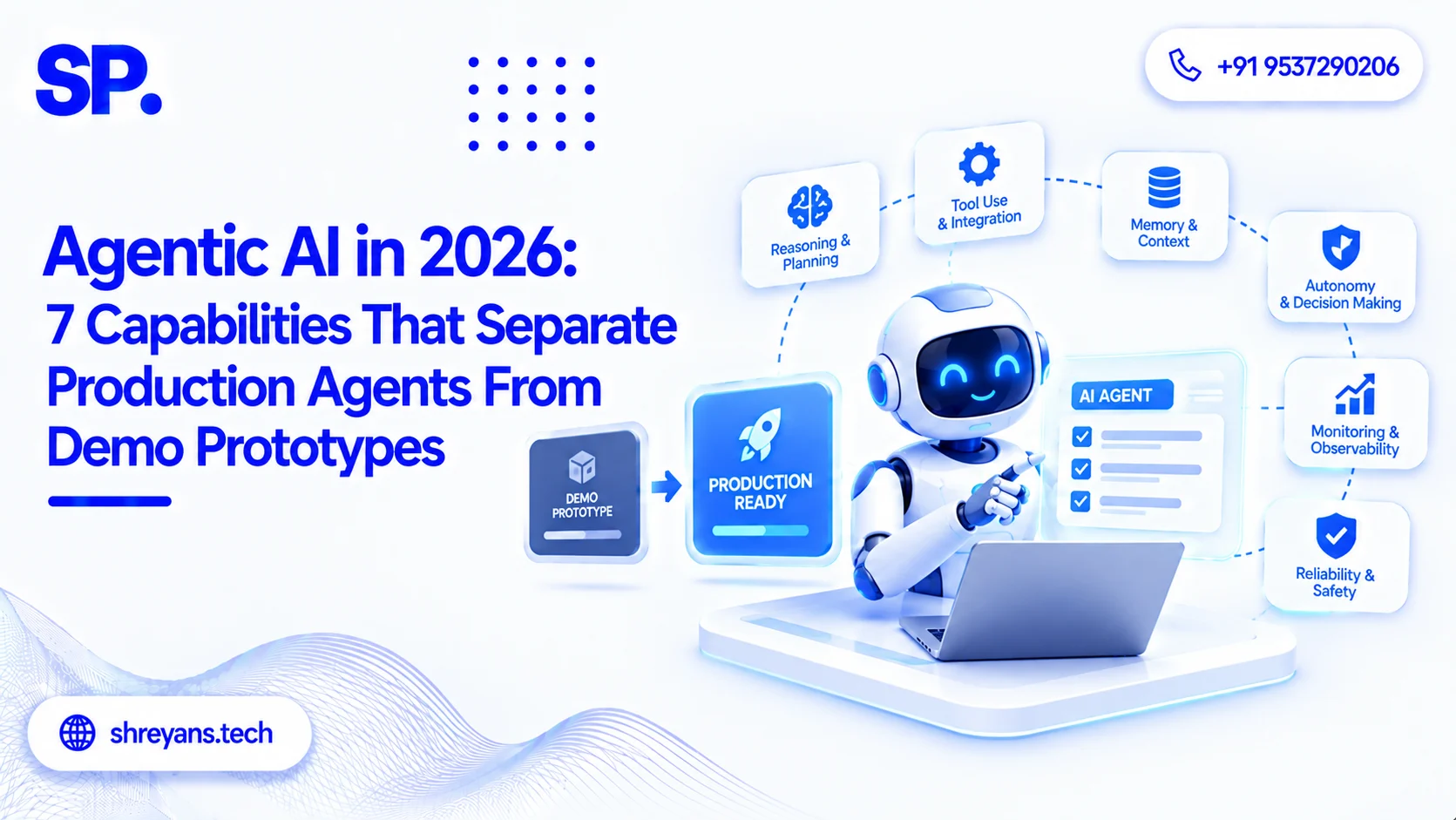
ToolDirectory.ai's 2026 research is specific about where this gap actually shows up: the breadth and reliability of an agent's tool layer, and how well it handles memory across a multi-step task, is what separates an agent that demos well from one that actually ships. The seven capabilities below are what turns a working demo into a system a business can run, and what a custom AI agent solutions engagement should be built around from the first prototype, not added after the first incident.
1. Bounded Error Recovery, Not Just Retry Logic
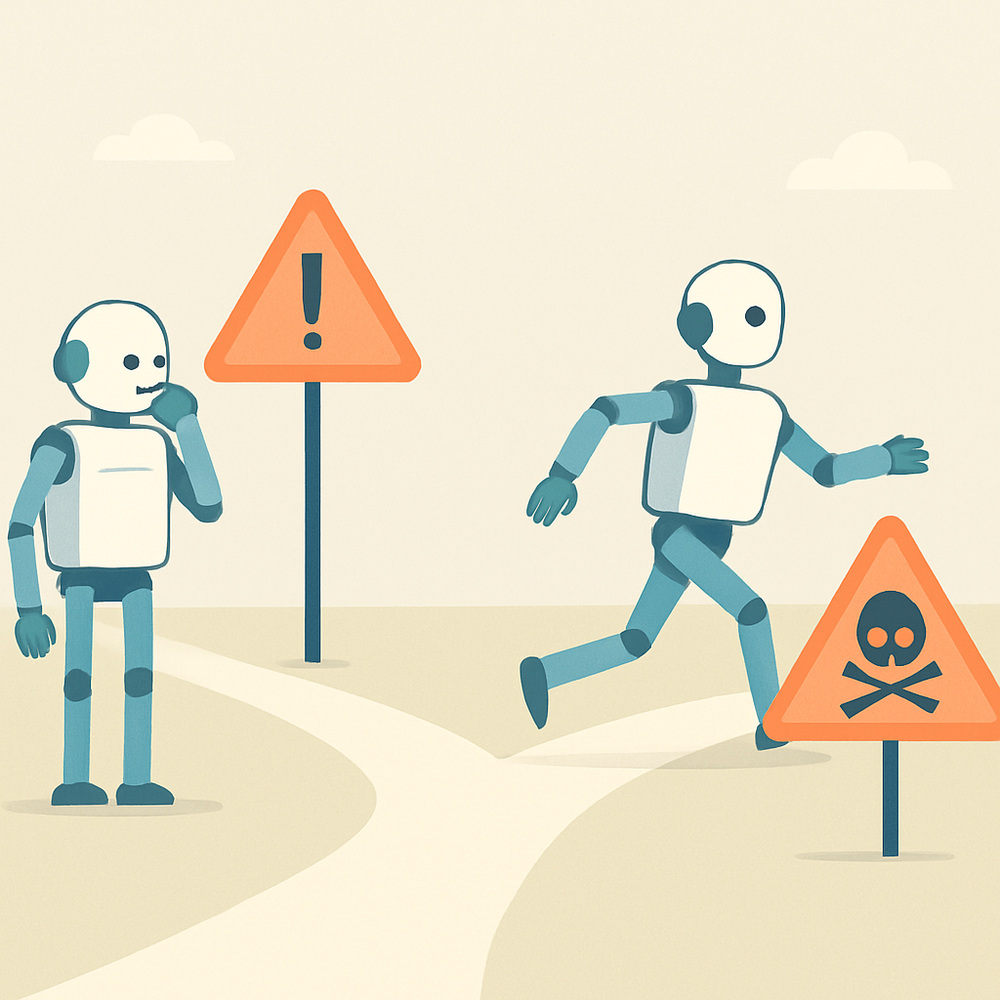
DEV Community's 2026 field report on production agents identifies the most common reliability trap directly: most agent frameworks treat failure recovery as simply retrying the failed step, but production systems need the agent to reason about whether the failure changes the viability of the entire task, not just the immediate action that failed. An agent that retries confidently while in a degraded state can cause more damage than one that stops and asks for human input, which is the opposite of what most teams assume bounded retry logic should do.
This distinction is the difference between an agent that fails safely and one that compounds a small error into a larger incident. A demo prototype rarely surfaces this gap, since demo environments are clean by design; production reveals it the first time a tool call returns something the original test cases never covered.
2. Persistent Memory Across Steps and Sessions
ToolDirectory.ai's 2026 research calls memory the hardest layer to build well, noting that most production agent failures trace back to an agent losing context partway through a multi-step task, not to a reasoning error in any single step. Symphony Solutions' 2026 research quantifies why this investment pays off: well-built memory architectures show accuracy improvements of around 26 percent while simultaneously cutting latency and token costs, which is why persistent memory is becoming a standard requirement in enterprise agent systems rather than an advanced feature.
The orchestration framework comparison post covers how memory handling differs meaningfully across CrewAI, LangGraph, and AutoGen specifically, since this is one of the dimensions where framework choice has the most direct impact on whether an agent holds context reliably across a long task.
Hire Edge Computer Vision
3. Judgment: Knowing When to Stop, Retry, or Escalate
Nikita Raj Kapini's 2026 research frames this as the core control problem of agentic systems: the system must decide when to stop, when to retry, and when to escalate, and without this, autonomy turns into instability rather than useful independence. The research is explicit that the goal is not full autonomy, it is controlled autonomy, systems that act within defined boundaries, remain observable throughout, and degrade gracefully under failure rather than compounding it.
ToolDirectory.ai's research describes this same capability from the agent's own decision-making side: the agent needs to decide when it is done, when it should escalate to a human, and when it should ask for clarification rather than guessing and proceeding. A demo that only ever completes tasks successfully has never actually tested this judgment layer, since a demo environment rarely produces the ambiguous cases where judgment matters most.
4. Built-In Observability From Day One
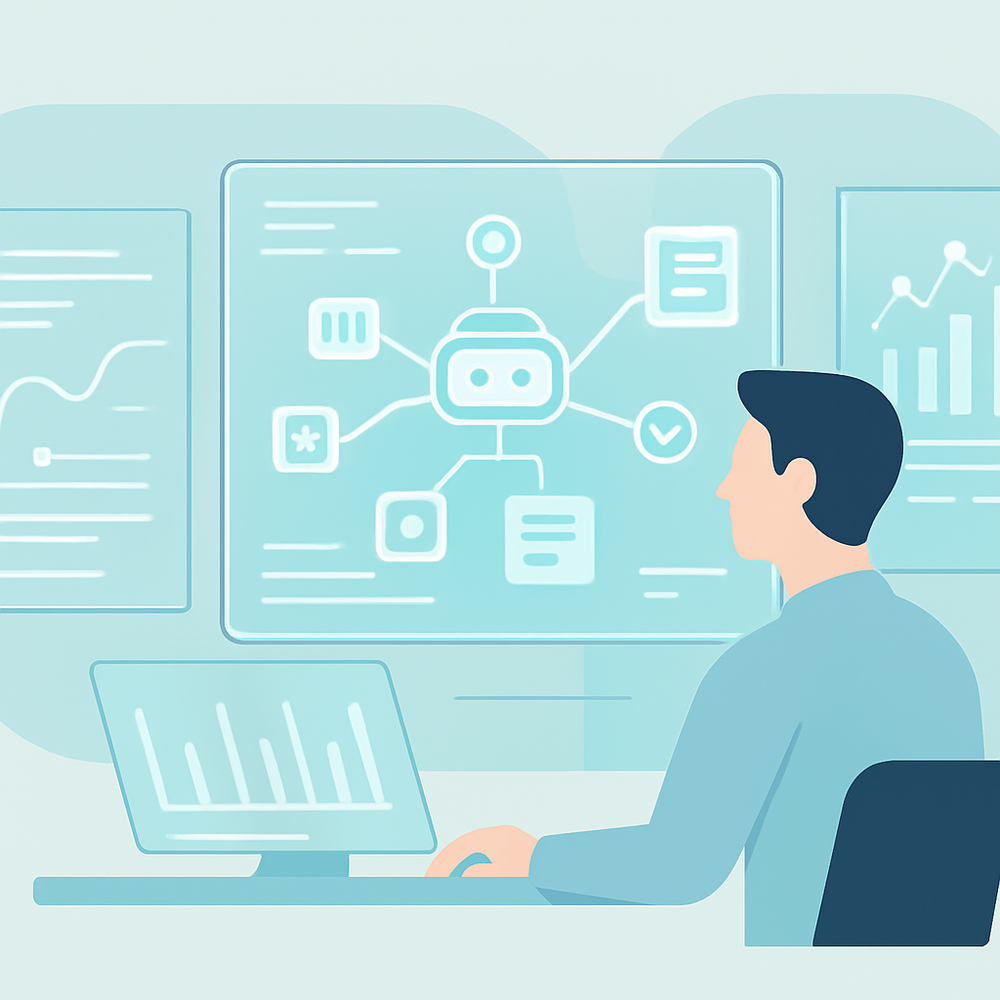
DEV Community's 2026 research names this the single practice that most reliably closes the gap between prototype and production: treating every agent action as observable by default from day one, not as an afterthought added once something breaks. The teams that scale agents successfully build observability into the first prototype, not after the tenth incident forces the investment.
Confident AI's 2026 observability platform research confirms complete trace visibility is table stakes in 2026, but notes the stronger platforms go further, scoring what they capture with both fine-grained step-level metrics and broader trace-level metrics, since a tool that only shows what happened without evaluating whether it was correct is mostly a trace viewer, useful for debugging one run but weak for measuring quality across thousands of production runs. Machine Learning Mastery's 2026 research adds a structural reason this is hard: agentic behaviour is non-deterministic by nature, so the same input can produce wildly different execution paths, which means a failure cannot simply be snapshotted and replayed reliably the way a traditional software bug can. The AI agent hiring red flags post covers what it looks like when a candidate has never actually built this observability layer before.
5. A Broad, Reliable Tool Layer
ToolDirectory.ai's research is direct that the breadth and reliability of an agent's tool layer is what separates an agent that demos well from one that ships: the best production agents in 2026 have access to dozens of tools, choose the right one for a given step, and handle tool failures gracefully rather than stalling or producing a confident wrong answer when a tool call fails.
This capability is easy to underweight during a demo, since a demo typically exercises only the handful of tools needed for its scripted scenario. A generative AI development services engagement building an agent for open-ended production use needs to test tool selection and failure handling across a far wider range of scenarios than the ones a stakeholder will see in a pitch meeting.
Hire Edge Computer Vision
6. Defined Human-in-the-Loop Escalation Paths

SpaceO's 2026 enterprise agentic AI guide recommends building approval workflows into agent systems from the start, with agents handling routine decisions autonomously while escalating edge cases and high-stakes decisions to a human, framing the goal explicitly as augmentation rather than full replacement. ToolDirectory.ai's research adds an important caution for buyers: agentic workflows that need to run for more than a few hours without human review, or that operate in regulated industries with audit requirements, mostly do not yet work reliably in 2026, and any vendor claiming otherwise deserves scrutiny.
This is not a limitation to work around quietly, it is a design requirement. An agent with no defined escalation path is not more autonomous, it is simply failing silently instead of failing visibly, which is a worse outcome in almost every production context.
7. Cost Predictability at Scale
DEV Community's research names cost predictability as the second major production challenge after reliability, and Machine Learning Mastery's 2026 research is blunt about the underlying reality: agentic systems are expensive to run, since a single task can trigger many chained model calls across planning, tool use, and reflection steps, and that cost multiplies quickly at scale without deliberate controls.
The AI agent development cost post covers how to budget for this realistically rather than discovering the true per-task cost only after a system is already in production. A cost control layer, capping token usage per task, routing simpler steps to cheaper models, and monitoring spend in real time, is as much a production requirement as the reliability and observability capabilities covered above.
Hire Edge Computer Vision
Demo Prototype vs Production Agent: 7 Capabilities
|
Capability |
Demo Prototype |
Production Agent |
|---|---|---|
|
Error recovery |
Simple retry on the failed step |
Reasons about whether the failure changes task viability |
|
Memory |
Holds context for a short, scripted scenario |
Retains context reliably across long, varied tasks |
|
Judgment |
Always completes the task successfully |
Knows when to stop, retry, or escalate on ambiguous cases |
|
Observability |
No tracing beyond the final output |
Every action traced and scored from day one |
|
Tool layer |
Uses a handful of scripted tools |
Chooses correctly among dozens of tools, handles failures |
|
Human escalation |
No defined escalation path |
Approval workflows for edge cases and high-stakes actions |
|
Cost |
Untested at real usage volume |
Controlled per-task cost with real-time monitoring |
The Gap Is in the System, Not the Model
None of these seven capabilities are about picking a smarter underlying model. They are about the system design around that model, error recovery, memory, judgment, observability, tool reliability, escalation paths, and cost control, which is exactly where a working demo and a production agent diverge. A demo that impresses in a pitch meeting has usually tested none of these seven capabilities under real conditions.
Hire an AI developer who can speak to all seven of these capabilities specifically, with examples of how they have handled each one in a system that actually shipped, not just a demo that ran once successfully in front of a stakeholder.
Hire Edge Computer Vision
Frequently asked questions
Why do AI agents that work well in demos often fail in production?
What is the difference between full autonomy and controlled autonomy for AI agents?
Why is memory considered the hardest capability for AI agents to get right?
Should AI agents be allowed to run for hours without human review?
Why is observability important to build into an AI agent from the start rather than adding it later?
Are AI agents expensive to run at production scale?



Shreyans Padmani
Shreyans Padmani has 5+ years of experience leading innovative software solutions, specializing in AI, LLMs, RAG, and strategic application development. He transforms emerging technologies into scalable, high-performance systems, combining strong technical expertise with business-focused execution to deliver impactful digital solutions.