Introduction
Why AI Model Training Isn't One-Size-Fits-All
Choosing the right AI model training approach can feel like navigating a maze, especially when you're faced with terms like 'custom,' 'fine-tuned,' and 'RAG.' The reality is, there's no magic bullet; what works for one business might be overkill or inadequate for another. It all comes down to your specific needs, the data you possess, and frankly, your budget.
We’ve seen businesses pour resources into training custom models when a simpler, more cost-effective solution like fine-tuning or RAG would have sufficed. Conversely, trying to force a pre-trained model into a highly niche task without proper adaptation can lead to frustratingly poor results. It’s a common misstep, and honestly, one we're passionate about helping you avoid.
The Decision Tree: Custom, Fine-Tuned, or RAG?
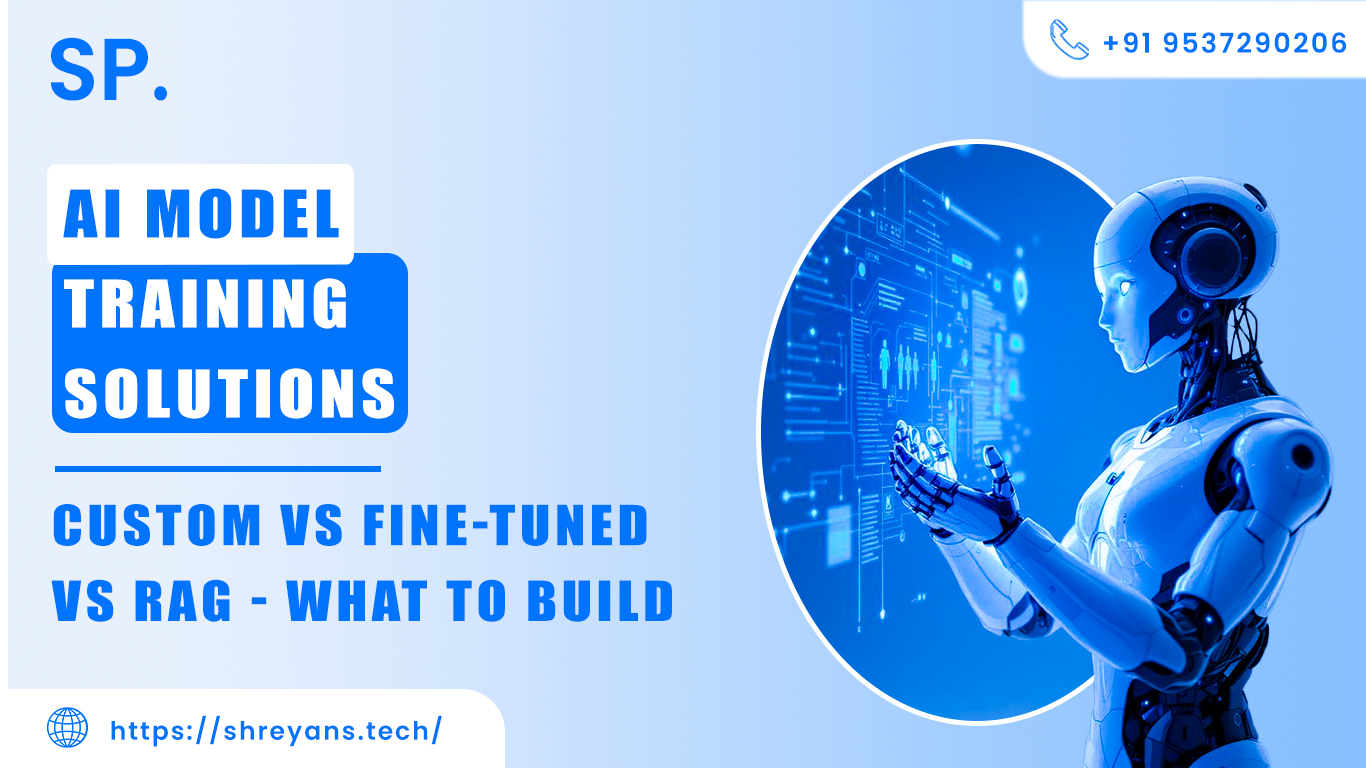
Your journey into AI model training begins with understanding a core decision tree. Are you building something truly novel, requiring deep domain expertise from the ground up? That might point to a custom model. Or do you have an existing general-purpose model that just needs to learn your specific jargon or style? Fine-tuning is probably your answer. What if you need current, factual data that changes frequently? That's where Retrieval Augmented Generation (RAG) often shines.
This isn't just about technical jargon; it's about making smart strategic choices that impact development time, accuracy, and ultimately, your return on investment. Getting this right from the start can save you a ton of headaches and resources down the line.
What You'll Learn About Optimizing Your AI Strategy
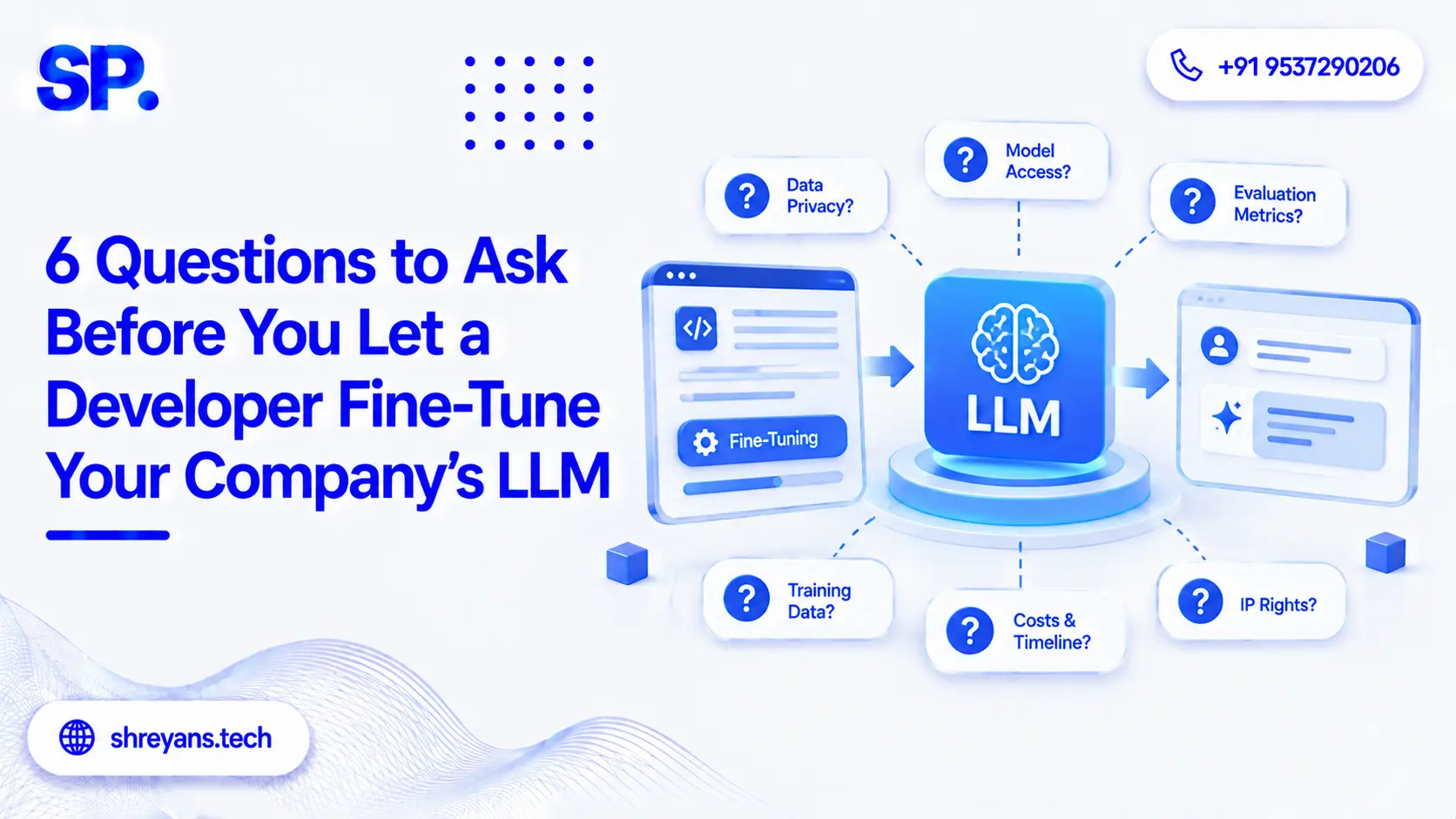
In this guide, we’re going to break down these three primary AI model training approaches, giving you the clarity you need to make informed decisions. We'll explore what each method entails, how they work in practice, and most importantly, when to use which. You'll gain practical insights into the trade-offs of data volume, latency requirements, and the financial implications of each path. Our goal is to empower you to optimize your AI strategy, ensuring you build the right solution the first time.
Core Concept / What It Actually Is
Custom AI Models: Building from the Ground Up
Custom AI model training involves developing an AI model entirely from scratch, tailored precisely to a unique problem or dataset. This approach is necessary when no existing pre-trained model can adequately address your specific challenge, often due to highly specialized data or novel task requirements. Think of it like commissioning a bespoke suit; every stitch is for you.
We typically pursue custom models for groundbreaking solutions where existing architectures simply don't cut it, or when the competitive advantage lies in proprietary data and algorithms. It's an intensive process, demanding significant resources and deep expertise in generative AI development or other specialized AI fields.
Fine-Tuning: Adapting Pre-Trained Powerhouses
Fine-tuning means taking a large, pre-trained AI model (often a foundation model like GPT-3, Llama, or BERT) and further training it on a smaller, more specific dataset to adapt its general knowledge to a particular task or domain. This method is incredibly powerful because you're not starting from zero; you're leveraging billions of parameters already learned from vast amounts of internet data. It’s like teaching an experienced chef a new, specialized recipe.
We often recommend fine-tuning when a general model is almost right but needs to learn your company's specific tone, terminology, or handle a niche classification task with higher accuracy. It’s a faster, less resource-intensive path to high performance for many business applications.
Retrieval Augmented Generation (RAG): Smart Information Access for LLMs
Retrieval Augmented Generation, or RAG, enhances the capabilities of large language models (LLMs) by allowing them to retrieve relevant information from an external knowledge base before generating a response. Instead of solely relying on their pre-trained knowledge, LLMs can fetch specific, up-to-date, or proprietary data, which they then use to inform their output. This is crucial for maintaining factual accuracy and staying current.
We see RAG as a game-changer for applications that need to provide real-time, verifiable information, such as customer support bots answering questions about product specifics or financial analysis tools needing the latest market data. It tackles the 'hallucination' problem of LLMs head-on.
The Key Differences in Approach and Outcome
The core distinction lies in the origin of knowledge. Custom models learn everything from your data. Fine-tuned models adapt existing general knowledge to your specific data. RAG models use existing general knowledge but augment it with real-time or proprietary information fetched from an external source. This means they behave very differently.
Custom models offer ultimate control but at maximum cost and time. Fine-tuning provides efficiency and domain adaptation. RAG delivers factual accuracy and up-to-dateness without the need for constant model retraining. Understanding these fundamental differences is your first step toward effective AI deployment.
How It Works / Step-by-Step
The Custom Model Development Process
Developing a custom AI model typically begins with extensive data collection and annotation, which is often the most time-consuming phase. Next, we design and select a suitable model architecture, which can range from neural networks to more traditional machine learning algorithms, depending on the problem. The model is then trained iteratively on your prepared dataset, with performance rigorously evaluated and hyper-parameters tuned until desired accuracy is achieved.
This process is highly iterative, and honestly, it requires a lot of patience and expertise. We're constantly monitoring, adjusting, and re-training until the model performs exactly as needed in real-world scenarios.
Fine-Tuning: An Iterative Refinement
Fine-tuning starts by choosing a suitable pre-trained base model that aligns broadly with your task. Then, you prepare a smaller, high-quality, task-specific dataset. This data is used to continue the training of the pre-trained model, adjusting its internal weights to better capture the nuances of your specific domain. It’s generally quicker than full custom training.
Pro-Tip: Don't overlook the importance of data quality in fine-tuning. Even though you're using less data than a custom build, its quality directly dictates how well the model adapts. Garbage in, garbage out – it's a timeless truth in AI.
The beauty of fine-tuning is that it inherits the vast general knowledge of the base model, meaning it needs significantly less task-specific data to achieve impressive results. We often find this approach delivers a strong balance of performance and efficiency for many business applications.
Implementing RAG for Contextual Accuracy
Implementing RAG involves several steps. First, you'll create a robust knowledge base, which could be your company documents, databases, or web content. This data is then broken into chunks and indexed, often using vector embeddings for efficient similarity search. When a query comes in, the RAG system first retrieves the most relevant chunks from this knowledge base. These retrieved chunks are then passed along with the original query to the LLM, which uses this external context to formulate its response.
This method significantly reduces the chance of the LLM 'making things up,' ensuring responses are grounded in verifiable facts. If you want to dive deeper into how this works, we've broken down RAG in generative AI in detail before.
Common Misconceptions About Each Method
A common misconception is that a custom model is always 'better.' While it offers ultimate control, it's often an over-investment for problems that can be solved with less resource-intensive methods. For fine-tuning, people sometimes think any pre-trained model will do, but choosing the right base model for your task is critical. And with RAG, the assumption that it magically solves all hallucination issues overlooks the importance of a well-structured and comprehensive knowledge base.
Each approach has its sweet spot, and misunderstanding these nuances can lead to suboptimal outcomes. We always stress that context is king when making these strategic decisions.
Real-World Applications / Use Cases
When a Fully Custom AI Model Excels
A fully custom AI model is your go-to when you're pioneering a solution that requires understanding deeply proprietary or highly niche data patterns. For example, in cutting-edge scientific research where new biomarkers are being identified, or for unique fraud detection in a very specific financial instrument, a custom model can learn patterns that no general model would ever encounter. These are the scenarios where the data itself is a competitive advantage.
Fine-Tuning for Specialized Tasks
Fine-tuning is fantastic for specializing existing models. Imagine a customer support chatbot that needs to respond in your brand's unique voice and access specific product FAQs, without generating generic answers. Or perhaps an internal knowledge management system that needs to categorize documents based on your company's internal jargon. These are perfect scenarios for fine-tuning, as they leverage a powerful base model and adapt it efficiently.
RAG for Dynamic, Up-to-Date Information
RAG really shines when you need to combine the creative fluency of an LLM with real-time, factual accuracy. Consider a legal assistant AI that needs to cite the latest case law or a medical chatbot that references the most recent clinical guidelines. In these cases, retraining an LLM every time new information emerges is impractical. RAG ensures the model's responses are always grounded in the most current available data.
AI Automated Question Generation: A Case Study in Smart Training
Let's look at an example. We developed an AI Automated Question Generation system. This wasn't a case for a fully custom model because powerful language models already exist. However, a generic LLM wouldn't generate questions perfectly aligned with specific educational curricula or assessment styles. Here, fine-tuning played a crucial role. We fine-tuned a base LLM on a dataset of high-quality, context-specific questions, allowing it to understand the nuances of generating relevant and challenging questions tailored to particular topics and difficulty levels. This approach maximized efficiency while delivering precise, domain-specific results.
Challenges & How to Overcome Them
The High Bar of Custom Model Data & Cost
The biggest hurdles for custom AI models are often data and cost. You need an enormous, high-quality, labeled dataset, which can be expensive and time-consuming to acquire and prepare. Beyond that, the computational resources for training can be astronomical, and you'll need a highly skilled team of AI engineers. This is why we often encourage clients to first consider custom AI development vs. ready-made AI tools to ensure they aren't overspending.
To overcome this, start with a clear problem definition and a realistic assessment of your data availability. If you don't have truly unique data, a custom model might not be your optimal path.
Fine-Tuning Risks: Overfitting and Bias
While efficient, fine-tuning isn't without its risks. Overfitting is a common issue, where the model learns the fine-tuning data too well, losing its ability to generalize to new, unseen examples. There's also the risk of inheriting or amplifying biases present in either the original pre-trained model or your fine-tuning dataset. We've seen this trip up teams more than once, leading to unintended and harmful outputs.
Mitigating these risks involves careful data curation, rigorous validation and testing on diverse datasets, and using regularization techniques during training. Always monitor for unexpected behaviors.
RAG's Complexity and Retrieval Accuracy Hurdles
RAG systems introduce their own set of complexities, primarily centered around the quality of your knowledge base and the efficiency of your retrieval mechanism. If your documents are poorly structured, incomplete, or your search algorithm isn't precise, the LLM will retrieve irrelevant information, leading to poor generations. That's hardly a useful outcome!
Pro-Tip: Don't just dump all your documents into a RAG system. Curate and chunk your knowledge base intelligently. Think about how a human would find information and structure your data accordingly. Better retrieval, better answers.
Overcoming this requires robust data preprocessing, advanced indexing techniques (like hybrid search combining keyword and vector search), and continuous evaluation of retrieval relevance. It's an ongoing process to keep your RAG system sharp.
Overcoming Latency and Scalability Issues
For any AI system, especially those deployed in real-time applications, latency can be a deal-breaker. Custom models might be optimized for specific hardware, but their complexity can still slow things down. Fine-tuned models generally run faster than custom ones but scaling them to handle millions of queries efficiently still requires careful engineering. RAG introduces an extra step of retrieval, which adds to latency, though often negligibly with proper optimization.
Addressing these challenges involves careful system architecture design, using efficient inference engines, optimizing data pipelines, and choosing the right cloud infrastructure. It's an engineering challenge that often requires specialist attention.
Best Practices / Expert Tips
Start with Clear Objectives, Not Just Data
Before you even think about data, clearly define what problem your AI model is supposed to solve and what success looks like. A vague objective leads to wasted efforts, regardless of the training method. What specific business metric will this AI impact? How will you measure its performance? Having these answers upfront guides every technical decision.
Data Quality is Non-Negotiable
This is the most crucial piece of advice we can give: the quality of your data will always dictate the quality of your model. Whether you’re collecting massive datasets for a custom build or curating a small, focused set for fine-tuning, clean, relevant, and unbiased data is paramount. Skimping here will cost you exponentially more down the road in debugging and re-training. It's a foundational truth in AI, and one you absolutely can't ignore.
When to Consider Generative AI Development for Your Needs
Often, the discussion around training methods is intertwined with the capabilities of generative AI. If your goal involves creating new content, summarizing, or complex reasoning, then understanding the nuances of generative AI development becomes essential. Fine-tuning and RAG are frequently used to harness these models for specific enterprise use cases. Think about how these technologies can fundamentally change what's possible for your business.
Iterate and Monitor: The Unsung Heroes of Success
No AI model is ever truly 'done.' Successful AI deployment is an iterative process. Continuously monitor your model's performance in production, gather feedback, and be prepared to retrain or fine-tune as data changes or new edge cases emerge. Many businesses launch an AI model and forget it, only to find its performance degrades over time. Sustained success in AI requires sustained attention, and this is the part most guides skip.
This continuous improvement cycle is also why we think understanding choosing the right AI model for business problems is so vital. It's not a one-time choice, but an ongoing optimization.
Conclusion
Charting Your Path to AI Success
Navigating the world of AI model training can seem daunting, but by understanding the distinct advantages and considerations of custom models, fine-tuning, and RAG, you're now equipped to make smarter decisions. Remember, the 'best' approach isn't universal; it's the one that aligns perfectly with your data, budget, and specific business objectives. We’ve covered why each method exists and when it truly shines.
Ultimately, your choice will determine the efficiency, cost-effectiveness, and ultimate success of your AI initiatives. Don't underestimate the impact of an informed decision here. We've seen firsthand why hiring an AI/ML developer transforms business, helping you make these critical choices.
Ready to Build Your Intelligent Future?
If you're ready to move beyond the theoretical and start building practical, impactful AI solutions, we’re here to help. Whether you need a fully custom model developed, an existing model fine-tuned, or a robust RAG system implemented, our expertise spans the full spectrum of AI model training solutions. Let's discuss your unique challenges and craft an AI strategy that truly drives results for your business. Your intelligent future is waiting.
Frequently asked questions
What are the main factors in choosing an AI model training method?
How does fine-tuning differ from training a custom AI model?
When should I use Retrieval Augmented Generation (RAG)?
What is the typical cost difference between these training approaches?



Shreyans Padmani
Shreyans Padmani has 5+ years of experience leading innovative software solutions, specializing in AI, LLMs, RAG, and strategic application development. He transforms emerging technologies into scalable, high-performance systems, combining strong technical expertise with business-focused execution to deliver impactful digital solutions.