Anthropic's own research into multi-agent systems measured roughly four times the token usage of a standard chat interaction for a single agent, and roughly fifteen times for a multi-agent system performing a comparable task. The same research found that token spend alone explains approximately 80 percent of performance variance on the BrowseComp benchmark. That is not a rounding difference between two similar hires; it is evidence that multi-agent systems are a materially different engineering problem, and treating the hiring decision as interchangeable with a single-agent chatbot build is where most of these projects go wrong before a line of code is written.
A team that has shipped a competent customer support chatbot has proven they can build a single reasoning loop with good tool access. That is a real and valuable skill, and it is not the skill a multi-agent system needs. This guide sets out specifically what changes, what a multi-agent hire needs to demonstrate that a chatbot builder does not, and how to vet for the difference before a contract is signed.
What a Single-Agent Chatbot Actually Is
A single-agent system combines reasoning, memory and tool execution into one model instance that receives a prompt, decides on a sequence of actions, and produces an output, adapting its approach as conditions change without coordinating with any other agent. Practitioners running production deployments consistently report that single agents with well-scoped tool calling handle 70 to 80 percent of what businesses actually need from agentic AI, which is the inconvenient statistic most multi-agent pitches skip over. A customer service assistant that answers questions, looks up an order, and escalates when it cannot resolve something is a single agent doing its job well, not an under-built multi-agent system waiting to happen.
Single agents fail in predictable, contained ways: context overflow as a conversation grows too long, sequential bottlenecks when every step must complete before the next begins, and role conflicts when one model is asked to plan, retrieve and execute simultaneously without a clear separation between those functions. Each of these has a known fix, which is part of why single-agent systems are the right default until a specific, demonstrated failure mode proves otherwise.
What Changes When You Add a Second Agent
The moment a system splits work across two or more agents, coordination itself becomes an engineering problem rather than an implementation detail. Every message passed between agents is a full language model call, so cost and latency scale with the number of agents involved, not with how difficult the underlying task actually is. An error introduced by one agent can be accepted as fact by the next agent in the chain, and by the time it reaches the final output, tracing which agent introduced it requires reconstructing the entire multi-step conversation rather than reading a single trace.
Failure handling compounds this directly. In a five-agent pipeline, a timeout in agent three has to be handled explicitly, because the other four agents are left waiting on a dependency that will never resolve unless someone designed for partial failure from the outset. This is the class of problem a single-agent build never encounters, because there is nothing else in the system to wait on.
The Skills Gap: What a Chatbot Builder Has Never Had to Solve
A candidate who has shipped chatbots has typically never had to design explicit role boundaries between multiple autonomous decision-makers, build a communication protocol that avoids flooding the system with redundant context, or reason about what happens when two agents disagree about a shared piece of state. These are not advanced versions of chatbot-building skills; they are a different discipline that happens to use the same underlying language models. Vetting for AI agent development services on a multi-agent project specifically means testing for this discipline, not for general familiarity with an agent framework.
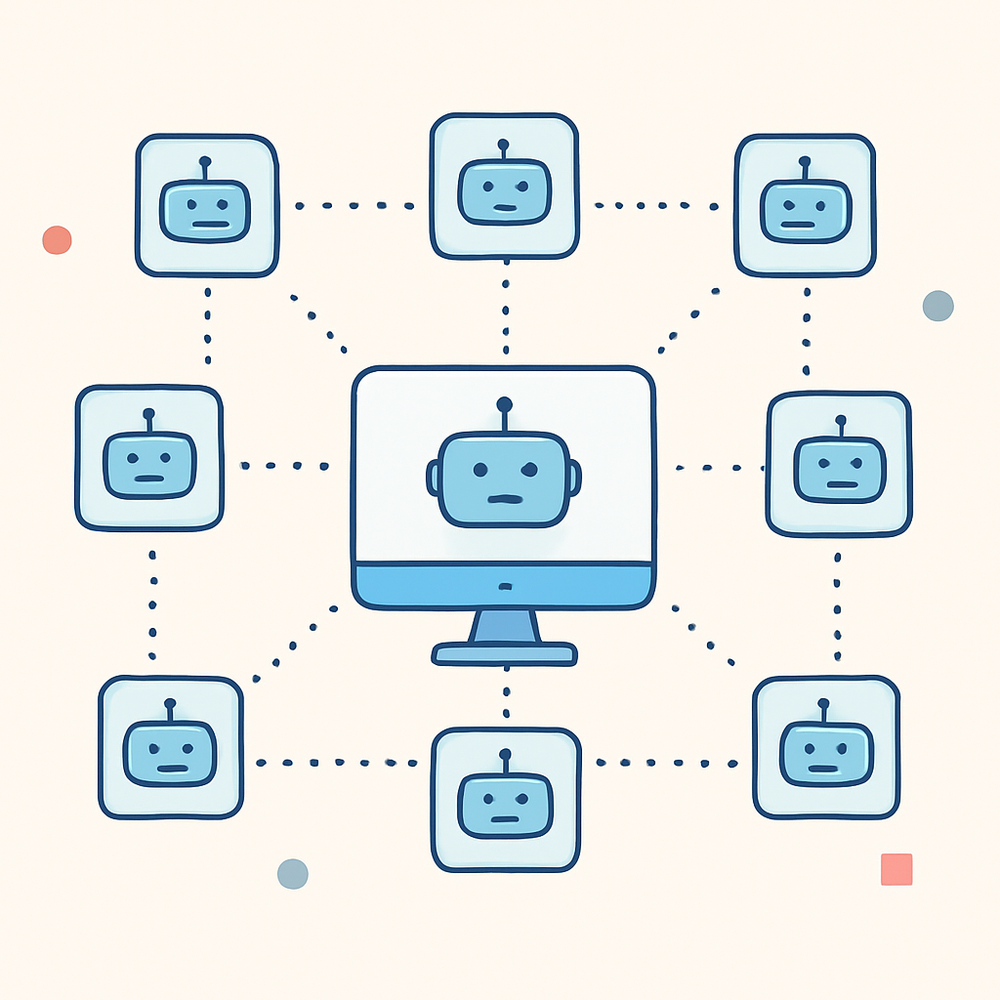
The specific test worth running in an interview is whether a candidate can articulate the test that should precede any multi-agent build: can a single agent, with access to all the necessary tools and a well-written system prompt, handle this task adequately? If the honest answer is yes, a candidate proposing a multi-agent architecture anyway is optimising for an impressive-looking diagram over a working, maintainable system.
Orchestration Patterns: The Choice That Predicts Reliability
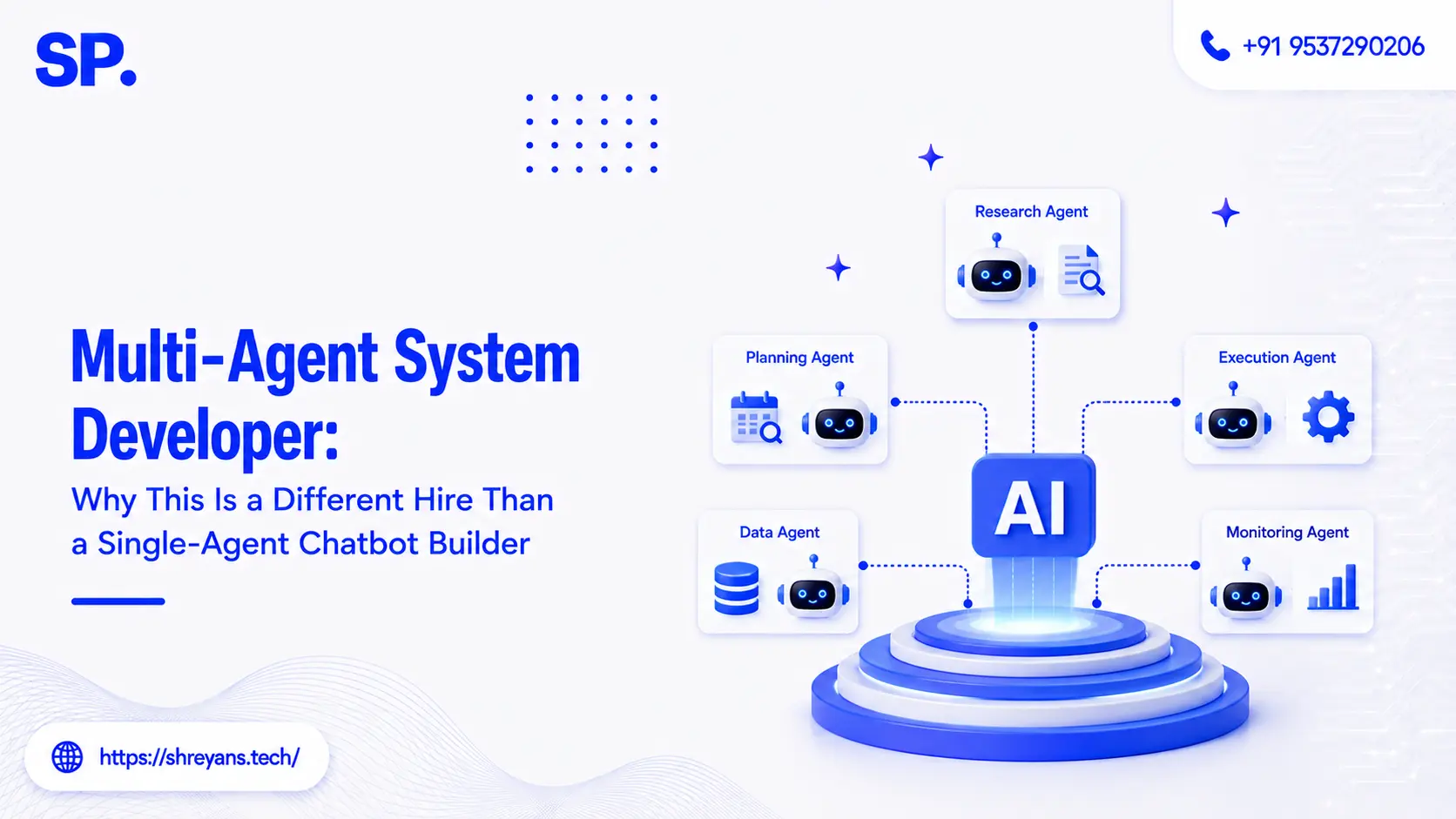
Two coordination patterns dominate current multi-agent practice, and they are not interchangeable. Peer-to-peer designs, seen in frameworks such as AutoGen's group chat and CrewAI's hierarchical mode, have multiple agents share a communication bus, ask each other questions, and re-read the full transcript on every turn. Orchestrator-subagent designs, the pattern behind Anthropic's own research architecture and Claude Code's task tool, have one agent own the full context, spawn isolated workers for specific subtasks, and receive concise summaries back rather than a full transcript. Current practice increasingly converges on the second pattern for production systems, because a summary-based handoff prevents the orchestrator's context window from being flooded with redundant detail on every exchange.
Benchmark analysis published in 2025 found that roughly half of the total performance gain in a swarm-versus-supervisor comparison came from a single architectural change: forwarding a worker's output directly to the user when the orchestrator's remaining job is simply to deliver it, rather than paraphrasing it first and then paraphrasing the user's reply back to the worker. That round trip is pure waste, and a candidate who has actually built these systems will recognise it immediately. The AI agent orchestration frameworks comparison covers which frameworks support each pattern and where the trade-offs sit.
Evaluation and Observability: Where the Real Difference Shows Up
A single agent can be evaluated by reading its reasoning trace end to end. A multi-agent system needs an evaluation approach that can isolate which agent's decision caused a downstream failure, distinguish a genuine reasoning error from a communication breakdown between agents, and catch the specific failure pattern where an agent enters an unreproducible loop and quietly triples token spend before anyone notices. Building this evaluation and observability layer is ordinary machine learning development services engineering discipline rather than research work, and it is consistently the part of a multi-agent proposal most likely to be missing or hand-waved.
Ninety-five percent of agentic AI pilots reportedly fail to reach production according to widely cited 2026 industry analysis, and the pattern behind most of those failures is not an under-powered model; it is a system nobody could debug once something went subtly wrong. A multi-agent developer who leads with the framework they will use rather than how they will observe and evaluate the system is signalling the same gap that shows up in those failed pilots.
|
Dimension |
Single-Agent Chatbot |
Multi-Agent System |
Why It Differs |
|---|---|---|---|
|
Token cost per task |
Roughly 4x a standard chat interaction |
Roughly 15x a standard chat interaction |
Every inter-agent message is a full LLM call |
|
Failure diagnosis |
One reasoning trace to inspect |
Error can enter at any agent and propagate silently |
No single agent owns the full context |
|
State management |
Single conversation history |
Shared or per-agent state requiring explicit design |
Coordination itself becomes an engineering problem |
|
Right tool for |
70 to 80 percent of production use cases |
Tasks needing parallel execution or a truly separate context |
Complexity should be justified, not assumed |
What This Costs Compared to a Single-Agent Build
The token multiplier alone means a multi-agent system costs meaningfully more to run than a single agent handling a comparable task, before accounting for the additional engineering time multi-agent coordination, failure handling and evaluation require. Teams that have shipped both report the single-agent versions consistently ship faster, cost less to run, and generate fewer production incidents, while the multi-agent versions earn their complexity only on problems that could not be solved any other way without splitting work across specialised roles. The AI agent development cost post covers the fuller cost breakdown, and the gap between single- and multi-agent pricing is one of the largest variables in it.
Hire Multi-Agent System Developers
Get expert multi-agent system development with a free 5-day trial
Start 5-Day Free TrialVetting: Questions a Single-Agent Builder Can't Answer
The questions that separate a genuine multi-agent specialist from a chatbot builder stretching their résumé are specific and hard to fake convincingly. Ask how they would design for a timeout in the middle of a five-agent pipeline. Ask which orchestration pattern they would choose, peer-to-peer or orchestrator-subagent, and why, for your specific workflow. Ask how they would prove, after the fact, which agent introduced an error that only became visible three steps later. A candidate who has actually built these systems answers with specifics from something they shipped; a candidate who has only read about them answers with the framework's marketing language. The AI agent hiring red flags post covers the broader signals worth watching during this stage of vetting.
The Question to Ask Before the Architecture
The most useful thing a multi-agent specialist can tell a client is that the project does not need one yet. That answer costs the developer a more complex, higher-billing engagement, which is exactly why it is a reliable signal: a candidate willing to give it has diagnosed the actual problem rather than reached for the architecture that sounds more impressive in a proposal.
If you are scoping an agent project and are not certain whether it needs one agent or several, hire an AI developer who will run that test candidly before proposing an architecture. The system that ships and stays debuggable beats the one with the more sophisticated diagram.
Frequently asked questions
Is a multi-agent system always better than a single agent?
Why does a multi-agent system cost more to run than a chatbot?
What should I ask a developer to check they can actually build multi-agent systems?
What is the orchestrator-subagent pattern and why does it matter?
Why do most agentic AI pilots fail to reach production?
Should I ask a freelancer to justify choosing a multi-agent architecture?



Shreyans Padmani
Shreyans Padmani has 5+ years of experience leading innovative software solutions, specializing in AI, LLMs, RAG, and strategic application development. He transforms emerging technologies into scalable, high-performance systems, combining strong technical expertise with business-focused execution to deliver impactful digital solutions.